
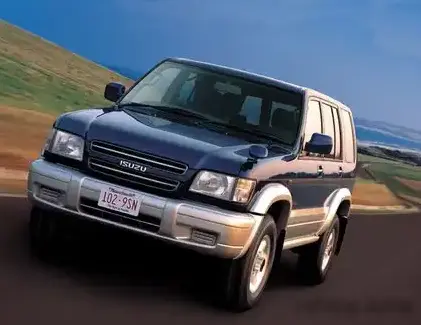
The Isuzu Bighorn, known as the Trooper in North American markets, was a mid-size SUV produced by Isuzu between 1981 and 2002, spanning three generations. The first generation, introduced in 1981, was a body-on-frame design intended to compete with vehicles like the Toyota Land Cruiser and Nissan Patrol. The variant detailed here, the 2.2 D with 87 horsepower, was produced between 1987 and 1991, representing a mid-cycle update to the first generation (UB10/UB20 series). This diesel-powered version was primarily aimed at markets outside of North America, where diesel engines were more popular for their fuel efficiency and durability. It served as an entry-level option within the Bighorn lineup, offering a more affordable and economical alternative to the gasoline-powered models.
Technical Specifications
| Brand | Isuzu |
| Model | Bighorn |
| Generation | Bighorn (SUV) |
| Type (Engine) | 2.2 D (87 Hp) |
| Start of production | 1987 year |
| End of production | 1991 year |
| Powertrain Architecture | Internal Combustion engine |
| Body type | SUV |
| Seats | 5 |
| Doors | 5 |
| Fuel Type | Diesel |
| Weight-to-power ratio | 19.5 kg/Hp, 51.2 Hp/tonne |
| Weight-to-torque ratio | 9.3 kg/Nm, 107.6 Nm/tonne |
| Power | 87 Hp @ 4000 rpm |
| Power per litre | 38.9 Hp/l |
| Torque | 183 Nm @ 4000 rpm, 134.97 lb.-ft. @ 4000 rpm |
| Engine layout | Front, Longitudinal |
| Engine Model/Code | C223 |
| Engine displacement | 2238 cm3, 136.57 cu. in. |
| Fuel injection system | Precombustion chamber injection |
| Engine aspiration | Turbocharger |
| Valvetrain | OHC |
| Kerb Weight | 1700 kg, 3747.86 lbs |
| Fuel tank capacity | 83 l, 21.93 US gal | 18.26 UK gal |
| Length | 4470 mm, 175.98 in |
| Width | 1760 mm, 69.29 in |
| Height | 1845 mm, 72.64 in |
| Wheelbase | 2650 mm, 104.33 in |
| Front track | 1450 mm, 57.09 in |
| Rear (Back) track | 1460 mm, 57.48 in |
| Minimum turning circle (turning diameter) | 10.8 m, 35.43 ft |
| Drive wheel | All wheel drive (4×4) |
| Number of gears and type of gearbox | 5 gears, manual transmission |
| Front brakes | Ventilated discs |
| Rear brakes | Drum |
Powertrain & Engine Architecture
The Isuzu Bighorn 2.2 D utilized the C223 diesel engine, a 2.2-liter inline-four cylinder powerplant. This engine employed precombustion chamber injection, a system common in diesel engines of the era. This system involved injecting fuel into a precombustion chamber connected to the main cylinder, promoting more complete combustion and reducing engine noise. The addition of a turbocharger boosted power output to 87 horsepower at 4000 rpm and 183 Nm (134.97 lb-ft) of torque, also at 4000 rpm. The engine featured an overhead camshaft (OHC) valvetrain, a relatively modern design for a diesel engine in the late 1980s. The 2.2 D was paired with a 5-speed manual transmission, delivering power to all four wheels via a part-time four-wheel-drive system. The longitudinal engine layout was typical for body-on-frame SUVs of this period, allowing for a more traditional driveline configuration.
Driving Characteristics
The 87 hp 2.2 D Bighorn offered modest performance. Acceleration was not its strong suit, with the focus being on fuel economy and durability rather than outright speed. The turbocharger helped to mitigate some of the power deficit, providing a noticeable boost in torque at lower engine speeds. However, compared to the gasoline-powered Bighorn variants, the diesel model felt significantly slower, especially when fully loaded. The 5-speed manual transmission allowed drivers to keep the engine in its optimal power band, but frequent downshifting was often necessary, particularly when tackling hills or overtaking. The part-time 4WD system provided enhanced traction on loose surfaces, making it suitable for off-road driving, but it wasn’t designed for sustained high-speed operation on paved roads.
Equipment & Trim Levels
The 2.2 D Bighorn typically represented the base trim level in many markets. Standard equipment generally included basic cloth upholstery, manual windows and door locks, and a simple dashboard layout. Air conditioning was often an optional extra, as were features like power steering and a radio. The interior was functional and utilitarian, prioritizing durability over luxury. The exterior styling was relatively basic, with steel wheels and minimal chrome trim. The focus was on providing a rugged and reliable vehicle at an affordable price point. Higher trim levels, available with gasoline engines, offered more luxurious features such as leather upholstery, power windows, and upgraded audio systems.
Chassis & Braking
The Bighorn utilized a traditional body-on-frame construction, providing a robust and durable chassis. The suspension consisted of independent front suspension with coil springs and a live axle rear suspension with leaf springs. This setup offered a reasonable balance between ride comfort and off-road capability. The front brakes were ventilated discs, providing adequate stopping power, while the rear brakes were drums, a cost-saving measure common in base-model vehicles of this era. Stabilizer bars were typically fitted to the front axle to reduce body roll during cornering. The overall chassis design was geared towards providing a durable and capable platform for both on-road and off-road use.
Market Reception & Comparison
The Isuzu Bighorn 2.2 D was generally well-received in markets where diesel engines were popular, such as Europe and Australia. Critics praised its fuel efficiency, durability, and off-road capability. However, its modest performance and basic interior were often cited as drawbacks. Compared to the gasoline-powered Bighorn variants, the 2.2 D offered significantly better fuel economy but lacked the same level of refinement and performance. It also differed from competitors like the Toyota Land Cruiser and Nissan Patrol, which often offered more powerful engines and more luxurious features. The Bighorn 2.2 D positioned itself as a more affordable and practical alternative, appealing to buyers who prioritized functionality and reliability over luxury and performance.
Legacy
The Isuzu Bighorn 2.2 D, while not the most powerful or luxurious SUV of its time, established a reputation for reliability and durability. The C223 diesel engine proved to be a robust and long-lasting powerplant, and many examples are still in use today. In the used car market, these vehicles are often sought after by enthusiasts and those looking for a simple, dependable, and affordable 4×4. While maintenance can be challenging due to the age of the vehicle and the availability of parts, the Bighorn 2.2 D remains a popular choice for those seeking a classic off-road SUV. Its legacy lies in its ability to provide reliable transportation and capable off-road performance at a reasonable cost.

