
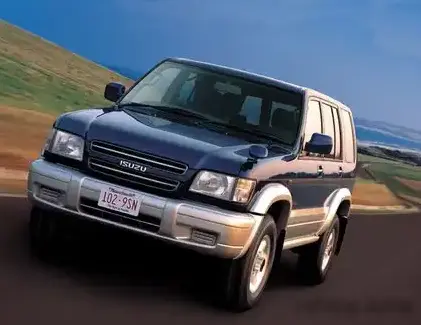
The Isuzu Bighorn, known as the Isuzu Mu in some markets, was a mid-size SUV produced by Isuzu between 1991 and 1998. This generation, internally designated as the UBS series, represented Isuzu’s entry into the increasingly popular SUV segment. The 3.2 i V6 Automatic variant, equipped with the 6VD1 engine, was positioned as a premium offering within the Bighorn lineup, providing a balance of power, comfort, and off-road capability. It was primarily sold in Japan, Australia, and parts of Europe, and was not officially offered in the North American market.
Technical Specifications
| Brand | Isuzu |
| Model | Bighorn |
| Generation | Bighorn (SUV) |
| Type (Engine) | 3.2 i V6 (200 Hp) Automatic |
| Start of production | 1991 |
| End of production | 1998 |
| Powertrain Architecture | Internal Combustion engine |
| Body type | SUV |
| Seats | 5 |
| Doors | 5 |
| Fuel Type | Petrol (Gasoline) |
| Weight-to-power ratio | 10.2 kg/Hp, 98.5 Hp/tonne |
| Weight-to-torque ratio | 7.7 kg/Nm, 130.5 Nm/tonne |
| Power | 200 Hp @ 5600 rpm |
| Power per litre | 63.2 Hp/l |
| Torque | 265 Nm @ 3600 rpm, 195.45 lb.-ft. @ 3600 rpm |
| Engine layout | Front, Longitudinal |
| Engine Model/Code | 6VD1 |
| Engine displacement | 3165 cm3, 193.14 cu. in. |
| Number of cylinders | 6 |
| Engine configuration | V-engine |
| Cylinder Bore | 93.4 mm, 3.68 in. |
| Piston Stroke | 77 mm, 3.03 in. |
| Compression ratio | 9:1 |
| Fuel injection system | Multi-port manifold injection |
| Engine aspiration | Naturally aspirated engine |
| Engine oil capacity | 5.3 l, 5.6 US qt | 4.66 UK qt |
| Coolant | 8.4 l, 8.88 US qt | 7.39 UK qt |
| Kerb Weight | 2030 kg, 4475.38 lbs |
| Fuel tank capacity | 85 l, 22.45 US gal | 18.7 UK gal |
| Length | 4750 mm, 187.01 in |
| Width | 1745 mm, 68.7 in |
| Height | 1840 mm, 72.44 in |
| Wheelbase | 2760 mm, 108.66 in |
| Front track | 1455 mm, 57.28 in |
| Rear (Back) track | 1460 mm, 57.48 in |
| Minimum turning circle | 11.6 m, 38.06 ft |
| Drive wheel | All wheel drive (4×4) |
| Number of gears | 4 |
| Gearbox type | automatic transmission |
| Front brakes | Ventilated discs |
| Rear brakes | Drum |
| Tires size | 245/70 R16 |
| Wheel rims size | 7JJ x 16 |
Powertrain & Engine Architecture
The heart of the Bighorn 3.2 i V6 was the 6VD1 engine, a 3.2-liter naturally aspirated V6. This engine featured a 60-degree V-angle, contributing to a relatively compact engine bay layout. The 6VD1 utilized a multi-port fuel injection system, delivering fuel directly to each intake port for improved combustion efficiency. The valvetrain employed single overhead camshafts (SOHC) per cylinder bank, operating two valves per cylinder. This configuration prioritized smooth operation and reliability over outright high-performance. The four-speed automatic transmission, while not the most modern by today’s standards, was chosen for its ease of use and suitability for both on-road cruising and moderate off-road conditions. It provided relatively smooth shifts, although it lacked the responsiveness of a manual transmission.
Driving Characteristics
The 200 horsepower and 265 Nm (195 lb-ft) of torque provided by the 6VD1 engine and automatic transmission delivered adequate performance for the Bighorn. Acceleration was respectable, but not particularly brisk, with a 0-60 mph time estimated around 10-11 seconds. The automatic transmission’s gear ratios were tuned for comfortable cruising, with a focus on fuel economy rather than aggressive acceleration. Compared to the available manual transmission or the later turbocharged diesel variants, the 3.2 i V6 Automatic felt less engaging to drive. However, it offered a more relaxed driving experience, particularly in urban environments. The all-wheel-drive system provided enhanced traction in slippery conditions, making it a capable vehicle for light off-roading.
Equipment & Trim Levels
The 3.2 i V6 Automatic Bighorn typically came well-equipped, reflecting its position as a premium trim level. Standard features often included air conditioning, power windows and locks, central locking, and a basic audio system. Interior upholstery was typically cloth, although leather options were available. Dashboard configuration was functional and straightforward, with clearly labeled controls. Optional extras could include a sunroof, upgraded audio systems, and alloy wheels. The level of equipment varied depending on the specific market and package selected.
Chassis & Braking
The Bighorn’s chassis was a traditional body-on-frame construction, providing robustness and off-road capability. The front suspension utilized independent double wishbones, while the rear suspension employed a multi-link setup with coil springs. This configuration aimed to balance ride comfort with handling stability. Braking duties were handled by ventilated discs at the front and drum brakes at the rear. While adequate for normal driving conditions, the rear drum brakes were a point of criticism, as they offered less stopping power and fade resistance compared to disc brakes. A stabilizer bar was fitted to both the front and rear axles to reduce body roll during cornering.
Market Reception & Comparison
The Isuzu Bighorn 3.2 i V6 Automatic received generally positive reviews, particularly for its comfortable ride, spacious interior, and capable all-wheel-drive system. Critics noted that the engine, while adequate, lacked the refinement and power of some of its competitors. The automatic transmission was praised for its smoothness but criticized for its lack of responsiveness. Compared to other trims in the Bighorn lineup, the 3.2 i V6 Automatic offered a more luxurious and refined driving experience, but at the expense of fuel economy. The diesel variants, while less powerful, offered significantly better fuel efficiency and torque for towing.
Legacy
The Isuzu Bighorn 3.2 i V6 Automatic, while not a high-volume seller, has developed a loyal following among enthusiasts. The 6VD1 engine is known for its reliability, provided it is properly maintained. Common issues include oil leaks and occasional sensor failures. Today, well-maintained examples are becoming increasingly collectible. The Bighorn’s robust construction and capable all-wheel-drive system make it a viable option for those seeking a classic SUV with off-road potential. Parts availability can be a challenge in some markets, but a dedicated community of owners and online resources help to mitigate this issue. The Bighorn represents a unique blend of Japanese engineering and SUV practicality, offering a distinctive alternative to more mainstream models.

