Technical Specifications
| Brand | Isuzu |
| Model | D-Max |
| Generation | D-Max I |
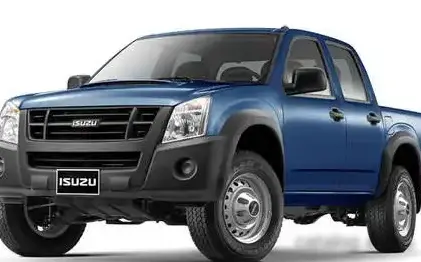
| Type (Engine) | 2.5 TD Double Cab (136 Hp) |
| Start of production | 2008 |
| End of production | 2012 |
| Powertrain Architecture | Internal Combustion engine |
| Body type | Pick-up |
| Seats | 5 |
| Doors | 4 |
| Fuel consumption (urban) | 9.8 l/100 km (24 US mpg, 28.8 UK mpg, 10.2 km/l) |
| Fuel consumption (extra urban) | 7.1 l/100 km (33.1 US mpg, 39.8 UK mpg, 14.1 km/l) |
| Fuel consumption (combined) | 8.1 l/100 km (29 US mpg, 34.9 UK mpg, 12.3 km/l) |
| Fuel Type | Diesel |
| Acceleration 0 – 100 km/h | 25.7 sec |
| Acceleration 0 – 62 mph | 25.7 sec |
| Acceleration 0 – 60 mph | 24.4 sec |
| Maximum speed | 150 km/h (93.21 mph) |
| Emission standard | Euro 4 |
| Power | 136 Hp @ 3600 rpm |
| Power per litre | 54.4 Hp/l |
| Torque | 280 Nm @ 1800 rpm (206.52 lb.-ft. @ 1800 rpm) |
| Engine layout | Front, Longitudinal |
| Engine Model/Code | 4JK1 |
| Engine displacement | 2499 cm3 (152.5 cu. in.) |
| Number of cylinders | 4 |
| Engine configuration | Inline |
| Cylinder Bore | 95.4 mm (3.76 in.) |
| Piston Stroke | 87.4 mm (3.44 in.) |
| Compression ratio | 8.3:1 |
| Number of valves per cylinder | 2 |
| Fuel injection system | Precombustion chamber injection |
| Engine aspiration | Turbocharger, Intercooler |
| Engine oil capacity | 7 l (7.4 US qt | 6.16 UK qt) |
| Coolant capacity | 8.7 l (9.19 US qt | 7.65 UK qt) |
| Fuel tank capacity | 76 l (20.08 US gal | 16.72 UK gal) |
| Length | 5035 mm (198.23 in.) |
| Width | 1800 mm (70.87 in.) |
| Height | 1735 mm (68.31 in.) |
| Wheelbase | 3050 mm (120.08 in.) |
| Front track | 1520 mm (59.84 in.) |
| Rear track | 1520 mm (59.84 in.) |
| Drive wheel | All wheel drive (4×4) |
| Number of gears | 5 |
| Gearbox type | Manual transmission |
| Front suspension | Independent torsion bar, double wishbone |
| Rear suspension | Spring Strut |
| Front brakes | Ventilated discs |
| Rear brakes | Drum |
| Tires size | 225/75 R15 |
The Isuzu D-Max, a mid-size pickup truck, debuted in 2005 as a successor to the Isuzu Rodeo. The first generation, internally designated the TF series, was manufactured from 2005 to 2012, with various configurations offered globally. The 2.5 TD Double Cab model, producing 136 horsepower, was a significant offering in numerous markets, particularly in Europe, Australia, and parts of Asia, where dependable and practical work vehicles are highly sought after. This variant occupied a middle ground within the D-Max lineup, balancing capability, fuel efficiency, and affordability. Production of this specific configuration spanned from 2008 to 2012.
Powertrain & Engine Architecture
The Isuzu D-Max 2.5 TD Double Cab is powered by the Isuzu 4JK1-TC 2.5-liter inline-four diesel engine. This engine employs a precombustion chamber injection system, a common design in older diesel engines aimed at improving combustion efficiency and reducing engine noise. The 4JK1 is turbocharged and intercooled, enhancing power and torque output. The turbocharger forces more air into the cylinders, while the intercooler cools the compressed air, increasing its density and further improving combustion. The engine generates 136 horsepower at 3600 rpm and 280 Nm (206.52 lb-ft) of torque at 1800 rpm. This torque figure is crucial for a pickup truck, providing substantial pulling power for hauling and towing. The engine is mounted longitudinally within the chassis. A 5-speed manual transmission was standard for this variant, offering a direct mechanical connection between the engine and the wheels.
Driving Characteristics
The 136 hp 2.5-liter engine, coupled with the 5-speed manual transmission, provided adequate, though not particularly exciting, performance. Acceleration from 0-60 mph took approximately 24.4 seconds, and the top speed was limited to 150 km/h (93.21 mph). The engine’s strength resided in its mid-range torque, making it well-suited for everyday driving and hauling loads. The gear ratios were optimized for practicality rather than outright speed, prioritizing fuel economy and drivability. Compared to higher-output D-Max versions, this variant felt less responsive, especially when carrying a full load. However, it delivered a more economical and refined driving experience.
Equipment & Trim Levels
The 2.5 TD Double Cab typically included a reasonable array of standard features. These generally consisted of air conditioning, power steering, central locking, and an AM/FM radio. Interior upholstery was usually vinyl or cloth, depending on the specific trim level. Higher trim levels might have added features like alloy wheels, electric windows, and a more advanced audio system. Optional extras could include a limited-slip differential, a tow hitch, and various accessories for the cargo bed.
Chassis & Braking
The D-Max I featured a robust chassis designed for both on- and off-road capability. The front suspension utilized an independent torsion bar and double wishbone setup, providing a comfortable ride and good handling characteristics. The rear suspension employed a spring strut design. Braking was handled by ventilated discs at the front and drum brakes at the rear. This configuration was typical for pickups in this class, balancing cost and performance. The 4×4 system allowed switching between two-wheel drive and four-wheel drive, enhancing traction in challenging conditions.
Market Reception & Comparison
The Isuzu D-Max 2.5 TD Double Cab was generally well-received by automotive critics as a practical and reliable work vehicle. It was praised for its fuel efficiency, durability, and off-road capabilities. Some reviewers, however, noted that the engine lacked the refinement and power found in some competing models. Compared to other trims within the D-Max lineup, such as those equipped with more powerful engines, the 2.5 TD offered a more affordable entry point, appealing to budget-conscious buyers. Its fuel economy was generally superior to the higher-output versions, making it a suitable choice for those prioritizing running costs.
Legacy
The Isuzu D-Max 2.5 TD Double Cab has proven to be a reliable and durable vehicle, with numerous examples still in operation today. The 4JK1 engine, while not the most powerful available, is known for its longevity and relatively low maintenance requirements. In the used car market, this variant represents a good value proposition for buyers seeking a practical and affordable pickup truck. While it may not offer the performance or refinement of more contemporary pickups, its simplicity and robustness continue to attract a diverse range of customers.