
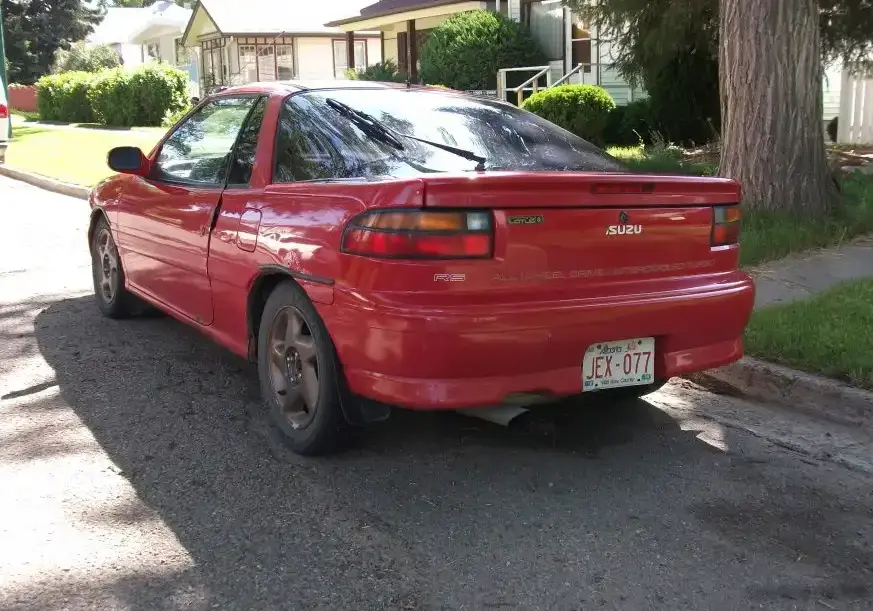
The Isuzu Impulse Coupe 1.6i, produced between 1990 and 1995, represented Isuzu’s foray into the affordable, sporty coupe market. Positioned as a competitor to vehicles like the Toyota Celica and Honda Prelude, the Impulse aimed to offer a blend of style, performance, and reliability. This particular 1.6-liter, 130 horsepower variant served as the entry point to the Impulse lineup, offering a balance between fuel efficiency and acceptable performance for the average driver. It was part of the first generation Impulse, known internally as the FJ series, and shared platform elements with the Geo Storm, a rebadged version sold primarily in the United States.
Technical Specifications
| Brand | Isuzu |
| Model | Impulse |
| Generation | Impulse Coupe |
| Type (Engine) | 1.6 i (130 Hp) |
| Start of production | 1990 |
| End of production | 1995 |
| Powertrain Architecture | Internal Combustion engine |
| Body type | Coupe |
| Seats | 4 |
| Doors | 2 |
| Fuel consumption (urban) | 13 l/100 km (18.1 US mpg, 21.7 UK mpg, 7.7 km/l) |
| Fuel consumption (extra urban) | 8 l/100 km (29.4 US mpg, 35.3 UK mpg, 12.5 km/l) |
| Fuel Type | Petrol (Gasoline) |
| Maximum speed | 200 km/h (124.27 mph) |
| Weight-to-power ratio | 7.8 kg/Hp, 128.7 Hp/tonne |
| Weight-to-torque ratio | 7.3 kg/Nm, 136.6 Nm/tonne |
| Power | 130 Hp @ 7000 rpm |
| Power per litre | 81.9 Hp/l |
| Torque | 138 Nm @ 5800 rpm (101.78 lb.-ft. @ 5800 rpm) |
| Engine layout | Front, Transverse |
| Engine displacement | 1588 cm3 (96.91 cu. in.) |
| Number of cylinders | 4 |
| Engine configuration | Inline |
| Cylinder Bore | 80 mm (3.15 in.) |
| Piston Stroke | 79 mm (3.11 in.) |
| Compression ratio | 9.8:1 |
| Number of valves per cylinder | 4 |
| Fuel injection system | Multi-port manifold injection |
| Engine aspiration | Naturally aspirated engine |
| Kerb Weight | 1010 kg (2226.67 lbs.) |
| Trunk (boot) space – minimum | 310 l (10.95 cu. ft.) |
| Trunk (boot) space – maximum | 620 l (21.9 cu. ft.) |
| Fuel tank capacity | 47 l (12.42 US gal | 10.34 UK gal) |
| Length | 4150 mm (163.39 in.) |
| Width | 1695 mm (66.73 in.) |
| Height | 1300 mm (51.18 in.) |
| Wheelbase | 2450 mm (96.46 in.) |
| Front track | 1430 mm (56.3 in.) |
| Rear (Back) track | 1405 mm (55.31 in.) |
| Drivetrain Architecture | The Internal combustion engine (ICE) drives the front wheels of the vehicle. |
| Drive wheel | Front wheel drive |
| Number of gears and type of gearbox | 5 gears, manual transmission |
| Front suspension | Coil spring |
| Rear suspension | Coil spring |
| Front brakes | Ventilated discs |
| Rear brakes | Drum |
| Assisting systems | ABS (Anti-lock braking system) |
| Steering type | Steering rack and pinion |
| Power steering | Hydraulic Steering |
| Tires size | 205/50 VR15 |
Powertrain & Engine Architecture
The heart of the Impulse 1.6i was the 4ZE1 engine, a 1.6-liter inline-four cylinder powerplant. This engine featured multi-port fuel injection, a relatively advanced system for its time, contributing to improved fuel efficiency and smoother power delivery. The engine utilized a single overhead camshaft (SOHC) design with four valves per cylinder. The 4ZE1 produced 130 horsepower at 7000 rpm and 138 Nm (101.78 lb-ft) of torque at 5800 rpm. The engine’s relatively high compression ratio of 9.8:1 helped extract maximum energy from the fuel. Paired with this engine was a five-speed manual transmission, providing drivers with direct control over the engine’s power. An optional four-speed automatic transmission was also available, though it impacted acceleration performance.
Driving Characteristics
The 1.6i Impulse offered a reasonably engaging driving experience, particularly with the manual transmission. While not a performance powerhouse, the engine provided adequate acceleration for everyday driving. The 0-60 mph time was estimated to be around 9-10 seconds. The automatic transmission, while offering convenience, noticeably dulled the car’s responsiveness. The front-wheel-drive configuration provided predictable handling, although it could exhibit some understeer when pushed hard. The suspension, tuned for comfort, absorbed bumps reasonably well, making it a suitable daily driver. Compared to the higher-performance 1.8-liter Turbo models, the 1.6i lacked the outright speed and aggressive character, but it offered better fuel economy and a more forgiving driving experience.
Equipment & Trim Levels
The base 1.6i Impulse typically came equipped with features such as power steering, a basic audio system, and cloth upholstery. Air conditioning was often an optional extra. Interior appointments were functional rather than luxurious, reflecting the car’s price point. Higher trim levels, though rare on the 1.6i, could include features like power windows, power locks, and upgraded audio systems. The dashboard layout was straightforward and driver-focused, with easy-to-read gauges. The rear seats, while present, were relatively cramped, making the Impulse more suited for two occupants on longer journeys.
Chassis & Braking
The Impulse Coupe utilized a front-engine, front-wheel-drive layout. The suspension consisted of coil springs and independent struts at the front, and a coil spring torsion beam setup at the rear. The braking system featured ventilated discs at the front and drum brakes at the rear. Anti-lock brakes (ABS) were available as an option, enhancing safety. The car’s relatively light weight (around 1010 kg or 2226.67 lbs) contributed to its nimble handling. The standard tire size was 205/50 VR15, providing a good balance between grip and ride comfort.
Market Reception & Comparison
The Isuzu Impulse 1.6i was generally well-received as an affordable and stylish coupe. Critics praised its fuel efficiency and comfortable ride, but some noted its lack of outright performance compared to competitors. The 1.6i was positioned as the entry-level model, appealing to buyers who prioritized economy and practicality over speed. Compared to the more powerful 1.8-liter Turbo models, the 1.6i offered significantly better fuel economy (around 29.4 US mpg combined) but lacked the Turbo’s exhilarating acceleration. Reliability was generally good, although some owners reported issues with the automatic transmission. The manual transmission proved to be more durable and offered a more engaging driving experience.
Legacy
The Isuzu Impulse, particularly the 1.6i variant, has developed a modest following among enthusiasts. While not as highly sought after as the Turbo models, the 1.6i offers a more affordable entry point into Impulse ownership. The 4ZE1 engine is known for its durability and relatively simple maintenance requirements. Finding parts can sometimes be challenging, as Isuzu has since withdrawn from the US market. However, many parts are interchangeable with those from other GM and Geo vehicles. Today, well-maintained examples of the Impulse 1.6i represent a unique and affordable slice of 1990s automotive history, offering a blend of style, practicality, and a touch of Japanese engineering.
