Technical Specifications
| Brand | Isuzu |
| Model | MU-X |
| Generation | MU-X (RF10) |
| Type (Engine) | 3.0d (177 Hp) 4×4 |
| Start of production | 2013 |
| End of production | 2017 |
| Powertrain Architecture | Internal Combustion engine |
| Body type | SUV |
| Seats | 5 |
| Doors | 5 |
| Fuel consumption (urban) | 10.7-10.8 l/100 km (22 – 21.8 US mpg) |
| Fuel consumption (extra urban) | 7.0-7.1 l/100 km (33.6 – 33.1 US mpg) |
| Fuel consumption (combined) | 8.4 l/100 km (28 US mpg) |
| CO2 emissions | 221-223 g/km |
| Fuel Type | Diesel |
| Emission standard | Euro 4 |
| Weight-to-power ratio | 11.2 kg/Hp |
| Weight-to-torque ratio | 5.2 kg/Nm |
| Power | 177 Hp @ 3600 rpm |
| Torque | 380 Nm @ 1800-2800 rpm (280.27 lb.-ft. @ 1800-2800 rpm) |
| Engine Model/Code | 4JJ1-TC |
| Engine displacement | 2999 cm3 (183.01 cu. in.) |
| Number of cylinders | 4 |
| Engine configuration | Inline |
| Cylinder Bore | 95.4 mm (3.76 in.) |
| Piston Stroke | 104.9 mm (4.13 in.) |
| Compression ratio | 17.3:1 |
| Number of valves per cylinder | 4 |
| Fuel injection system | Diesel Commonrail |
| Engine aspiration | Turbocharger, Intercooler |
| Valvetrain | DOHC |
| Engine oil capacity | 6.9 l (7.29 US qt | 6.07 UK qt) |
| Coolant capacity | 11.1 l (11.73 US qt | 9.77 UK qt) |
| Kerb Weight | 1985-2025 kg (4376.18 – 4464.36 lbs.) |
| Max. weight | 2750 kg (6062.71 lbs.) |
| Max load | 725-765 kg (1598.35 – 1686.54 lbs.) |
| Trunk (boot) space – minimum | 235 l (8.3 cu. ft.) |
| Trunk (boot) space – maximum | 1830 l (64.63 cu. ft.) |
| Fuel tank capacity | 65 l (17.17 US gal | 14.3 UK gal) |
| Permitted trailer load with brakes (12%) | 3000 kg (6613.87 lbs.) |
| Permitted trailer load without brakes | 750 kg (1653.47 lbs.) |
| Length | 4825 mm (189.96 in.) |
| Width | 1860 mm (73.23 in.) |
| Height | 1825-1830 mm (71.85 – 72.05 in.) |
| Wheelbase | 2845 mm (112.01 in.) |
| Front track | 1570 mm (61.81 in.) |
| Rear track | 1570 mm (61.81 in.) |
| Front overhang | 905 mm (35.63 in.) |
| Rear overhang | 1075 mm (42.32 in.) |
| Ride height (ground clearance) | 220-230 mm (8.66 – 9.06 in.) |
| Minimum turning circle | 11.6 m (38.06 ft.) |
| Approach angle | 29.5-30.1° |
| Departure angle | 24.6-25.1° |
| Ramp-over angle | 21.9-22.6° |
| Drive wheel | All wheel drive (4×4) |
| Number of gears and type of gearbox | 5 gears, manual transmission |
| Front suspension | Double wishbone |
| Rear suspension | Independent multi-link spring suspension with stabilizer |
| Front brakes | Ventilated discs |
| Rear brakes | Disc |
| Assisting systems | ABS (Anti-lock braking system) |
| Steering type | Steering rack and pinion |
| Power steering | Electric Steering |
| Tires size | 245/70 R16; 255/65 R17 |
| Wheel rims size | 7J x 16; 7J x 17 |
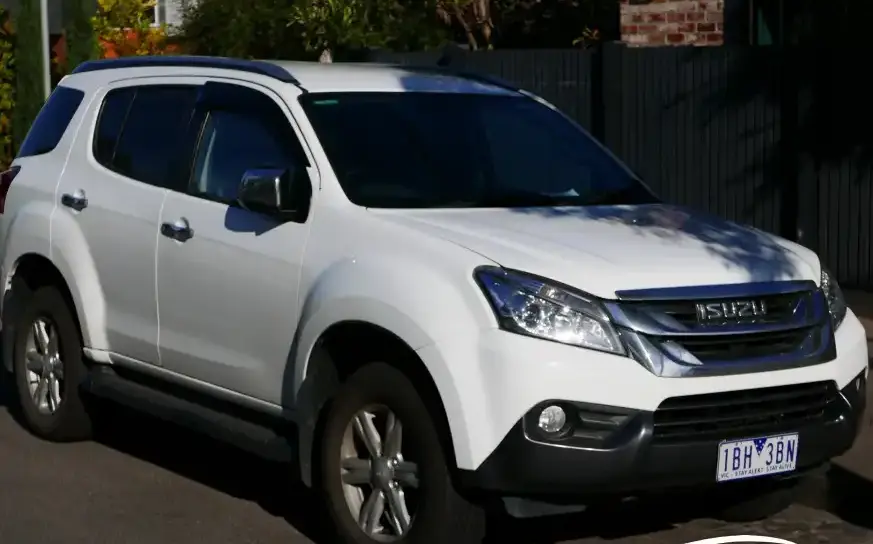
The Isuzu MU-X RF10, launched in 2013, was a significant step for Isuzu in expanding its SUV offerings. Derived from the Isuzu D-Max pickup truck, the MU-X aimed to provide a more comfortable and family-oriented alternative while retaining the ruggedness and reliability associated with the Isuzu brand. The 3.0d 4×4 variant, equipped with the 4JJ1-TC engine, was positioned as a versatile option, appealing to buyers who needed both on-road refinement and off-road capability. It served as a direct competitor to vehicles like the Toyota Fortuner, Mitsubishi Pajero Sport, and Ford Everest in key markets.
Powertrain & Engine Architecture
The heart of the MU-X 3.0d 4×4 is the 4JJ1-TC 3.0-liter inline-four cylinder diesel engine. This engine is a direct-injection common rail diesel, known for its durability and relatively smooth operation. The ‘TC’ designation indicates the presence of a turbocharger and intercooler, which significantly boost power and torque output. The 4JJ1 engine features a DOHC (Double Overhead Camshaft) valvetrain with four valves per cylinder, optimizing breathing and combustion efficiency. The common rail fuel injection system, operating at extremely high pressures, ensures precise fuel delivery and contributes to reduced emissions. This engine produced 177 horsepower at 3600 rpm and 380 Nm (280 lb-ft) of torque between 1800 and 2800 rpm. The engine’s robust construction and relatively simple design contribute to its long-term reliability. The 5-speed manual transmission was the standard offering for this variant, providing direct control and efficient power delivery.
Driving Characteristics
The MU-X 3.0d 4×4, with its 177 horsepower and 380 Nm of torque, offered adequate performance for everyday driving and moderate off-road excursions. While not a particularly sporty vehicle, the engine provided sufficient low-end torque for comfortable cruising and tackling inclines. The 5-speed manual transmission allowed drivers to maintain optimal engine speed for various driving conditions. Compared to higher-output versions of the MU-X, this variant felt less eager to accelerate, but it compensated with improved fuel economy. The manual transmission provided a more engaging driving experience than an automatic, offering greater control in challenging terrain. The 4×4 system, typically selectable via a rotary dial, provided part-time four-wheel drive with high and low range gearing, enhancing off-road traction.
Equipment & Trim Levels
The MU-X 3.0d 4×4 typically came equipped with a reasonable level of standard features. These included air conditioning, power windows, power door locks, and a basic audio system. Higher trim levels, often denoted by additional badging, added features such as alloy wheels, a more sophisticated audio system with Bluetooth connectivity, and rear parking sensors. Interior upholstery was typically cloth, with leather options available on higher-spec models. Optional extras could include a sunroof, navigation system, and upgraded sound systems. The dashboard layout was functional and straightforward, prioritizing usability over aesthetic flair.
Chassis & Braking
The MU-X RF10 utilized a traditional body-on-frame construction, providing a robust and durable platform. The front suspension consisted of a double wishbone setup, while the rear employed an independent multi-link spring suspension with a stabilizer bar. This suspension configuration aimed to balance ride comfort with handling stability. Braking duties were handled by ventilated discs at the front and solid discs at the rear, equipped with an Anti-lock Braking System (ABS) as standard. The relatively heavy weight of the vehicle (1985-2025 kg) meant that braking performance was adequate but not exceptional.
Market Reception & Comparison
The Isuzu MU-X 3.0d 4×4 was generally well-received in its target markets. Critics praised its ruggedness, reliability, and off-road capability. However, some reviewers noted that the interior felt somewhat basic compared to competitors, and the engine, while durable, lacked the refinement of some newer diesel engines. Compared to the higher-output versions of the MU-X, the 3.0d offered better fuel economy but less exhilarating performance. Against rivals like the Toyota Fortuner, the MU-X often presented a more affordable option, while the Ford Everest offered a more modern interior and driving experience.
Legacy
The Isuzu MU-X RF10 3.0d 4×4 has proven to be a reliable and durable vehicle in the used car market. The 4JJ1-TC engine is known for its longevity, and with proper maintenance, can withstand high mileage. While not without its flaws, the MU-X remains a popular choice for those seeking a capable and affordable SUV. Its body-on-frame construction and robust drivetrain make it well-suited for challenging conditions, and its relatively simple mechanicals make it easier and less expensive to maintain than some of its more technologically advanced competitors. Today, well-maintained examples of the RF10 MU-X continue to command reasonable prices, reflecting its reputation for reliability and practicality.