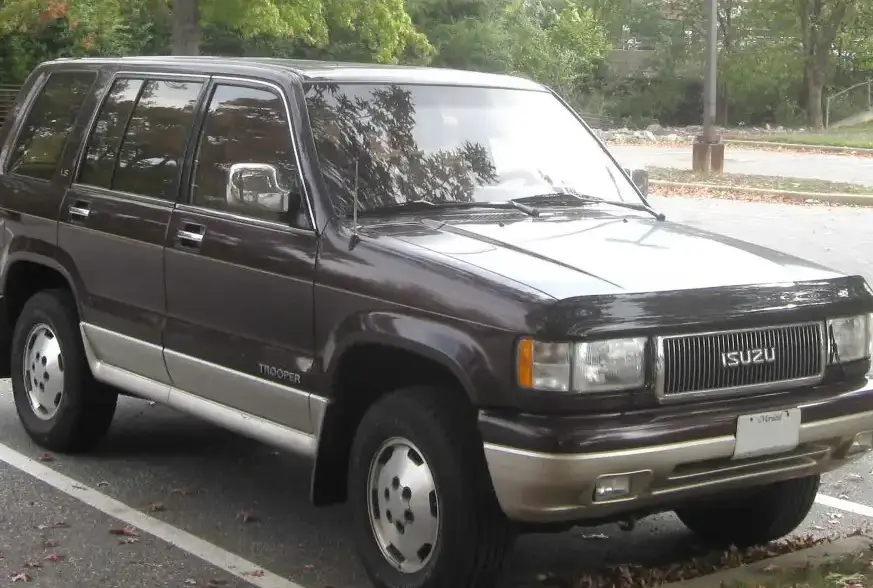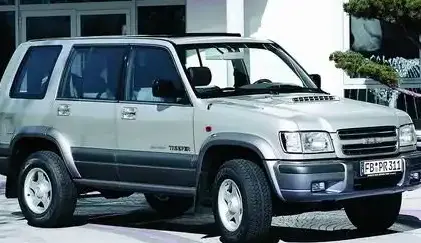
The Isuzu Trooper 3.0 DTI, produced between 2000 and 2002, represented a mid-cycle update to the second-generation Trooper (UBS series), known as the Rodeo in North American markets. This variant was primarily aimed at European and other international markets where diesel engines were favored for their fuel efficiency and torque. The 3.0 DTI slotted into the lineup as a more powerful and refined diesel option, positioned above the naturally aspirated diesel models and below the gasoline-powered V6 variants. It offered a blend of off-road capability, practicality, and a more sophisticated driving experience compared to its predecessors.
Technical Specifications
| Brand | Isuzu |
| Model | Trooper |
| Generation | Trooper (UBS Series) |
| Type (Engine) | 3.0 DTI (159 Hp) |
| Start of production | 2000 |
| End of production | 2002 |
| Powertrain Architecture | Internal Combustion engine |
| Body type | SUV |
| Seats | 5 |
| Doors | 3 |
| Fuel consumption (urban) | 13.6 l/100 km (17.3 US mpg, 20.8 UK mpg) |
| Fuel consumption (extra urban) | 8.7 l/100 km (27 US mpg, 32.5 UK mpg) |
| Fuel Type | Diesel |
| Acceleration 0 – 100 km/h | 15.8 sec |
| Acceleration 0 – 62 mph | 15.8 sec |
| Acceleration 0 – 60 mph | 15 sec |
| Maximum speed | 160 km/h (99.42 mph) |
| Weight-to-power ratio | 12.9 kg/Hp |
| Weight-to-torque ratio | 6.2 kg/Nm |
| Power | 159 Hp @ 3600 rpm |
| Power per litre | 53 Hp/l |
| Torque | 333 Nm @ 2000 rpm (245.61 lb.-ft. @ 2000 rpm) |
| Engine layout | Front, Longitudinal |
| Engine Model/Code | 4JX1 |
| Engine displacement | 2999 cm3 (183.01 cu. in.) |
| Number of cylinders | 4 |
| Engine configuration | Inline |
| Cylinder Bore | 95.4 mm (3.76 in.) |
| Piston Stroke | 104.9 mm (4.13 in.) |
| Compression ratio | 19:1 |
| Number of valves per cylinder | 4 |
| Fuel injection system | Diesel Commonrail |
| Engine aspiration | Turbocharger |
| Engine oil capacity | 6 l (6.34 US qt | 5.28 UK qt) |
| Kerb Weight | 2050 kg (4519.48 lbs.) |
| Max. weight | 2810 kg (6194.99 lbs.) |
| Max load | 760 kg (1675.51 lbs.) |
| Trunk (boot) space – minimum | 770 l (27.19 cu. ft.) |
| Trunk (boot) space – maximum | 2070 l (73.1 cu. ft.) |
| Fuel tank capacity | 85 l (22.45 US gal | 18.7 UK gal) |
| Length | 4365 mm (171.85 in.) |
| Width | 1835 mm (72.24 in.) |
| Height | 1835 mm (72.24 in.) |
| Wheelbase | 2330 mm (91.73 in.) |
| Front track | 1530 mm (60.24 in.) |
| Rear (Back) track | 1545 mm (60.83 in.) |
| Drive wheel | All wheel drive (4×4) |
| Number of gears and type of gearbox | 5 gears, manual transmission |
| Front suspension | Torsion |
| Rear suspension | Coil spring |
| Front brakes | Ventilated discs |
| Rear brakes | Disc |
| Assisting systems | ABS (Anti-lock braking system) |
| Power steering | Hydraulic Steering |
| Tires size | 215/80 R16 |
Powertrain & Engine Architecture
The heart of the Trooper 3.0 DTI is the 4JX1-T engine, a 2.999-liter (183.01 cubic inches) inline-four cylinder diesel. This engine utilizes a direct injection common rail system, a significant advancement over earlier diesel designs. Common rail injection allows for multiple injection events per combustion cycle, resulting in smoother operation, reduced noise, and improved fuel efficiency. The 4JX1-T also features a turbocharger with an intercooler, boosting power output to 159 horsepower at 3600 rpm and 333 Nm (245.61 lb-ft) of torque at 2000 rpm. The engine’s robust construction and relatively simple design contribute to its durability. The 5-speed manual transmission was the standard offering, providing a balance between fuel economy and drivability. The transmission’s gear ratios were tuned to take advantage of the engine’s strong low-end torque, making it well-suited for both on-road cruising and off-road challenges.
Driving Characteristics
The 3.0 DTI Trooper offered a noticeable improvement in performance over the earlier, naturally aspirated diesel versions. While not a sports car, the engine provided sufficient power for comfortable highway cruising and confident overtaking. The turbocharger provided a boost in mid-range acceleration, but the engine did exhibit some turbo lag. The manual transmission allowed for precise control, and the gear ratios were well-matched to the engine’s torque curve. Compared to the gasoline-powered V6 models, the 3.0 DTI offered superior fuel economy and a more relaxed driving experience, albeit with less outright power. The Trooper’s four-wheel-drive system, typically selectable between 2H, 4H, and 4L, provided excellent traction in various conditions.
Equipment & Trim Levels
The Trooper 3.0 DTI typically came with a reasonable level of standard equipment, reflecting its position as a mid-range offering. Standard features often included air conditioning, power windows, central locking, and an AM/FM radio. Higher trim levels, often denoted by specific packages, could add features such as alloy wheels, upgraded interior upholstery, a sunroof, and a more sophisticated audio system. The interior design was functional and durable, with a focus on practicality rather than luxury. The dashboard layout was straightforward, with easy-to-read gauges and logically placed controls.
Chassis & Braking
The Trooper’s chassis featured a body-on-frame construction, providing a robust and durable platform for off-road use. The front suspension utilized torsion bars, while the rear suspension employed coil springs. This setup offered a good balance between ride comfort and off-road capability. Braking duties were handled by ventilated discs at the front and discs at the rear, providing adequate stopping power for the vehicle’s weight. An anti-lock braking system (ABS) was standard, enhancing safety during emergency braking situations. The steering was hydraulically assisted, providing a reasonable level of feedback and ease of use.
Market Reception & Comparison
The Isuzu Trooper 3.0 DTI was generally well-received in markets where diesel engines were popular. Critics praised its fuel efficiency, strong torque, and off-road capability. However, some reviewers noted the engine’s relatively noisy operation and the presence of turbo lag. Compared to competitors such as the Mitsubishi Pajero and the Nissan Terrano, the Trooper offered a competitive package in terms of price, performance, and features. The 3.0 DTI’s fuel economy was notably better than that of the gasoline-powered V6 models, making it an attractive option for drivers who prioritized efficiency.
Legacy
The Isuzu Trooper 3.0 DTI has proven to be a relatively reliable vehicle, particularly the engine itself. The 4JX1-T engine is known for its durability and longevity, provided it is properly maintained. Common issues include wear and tear on suspension components and potential problems with the turbocharger. In the used car market, the Trooper 3.0 DTI remains a popular choice for those seeking a capable and affordable SUV. Its robust construction, fuel efficiency, and off-road capability continue to appeal to a wide range of buyers. However, potential buyers should be aware of the vehicle’s age and the possibility of requiring maintenance on older components.