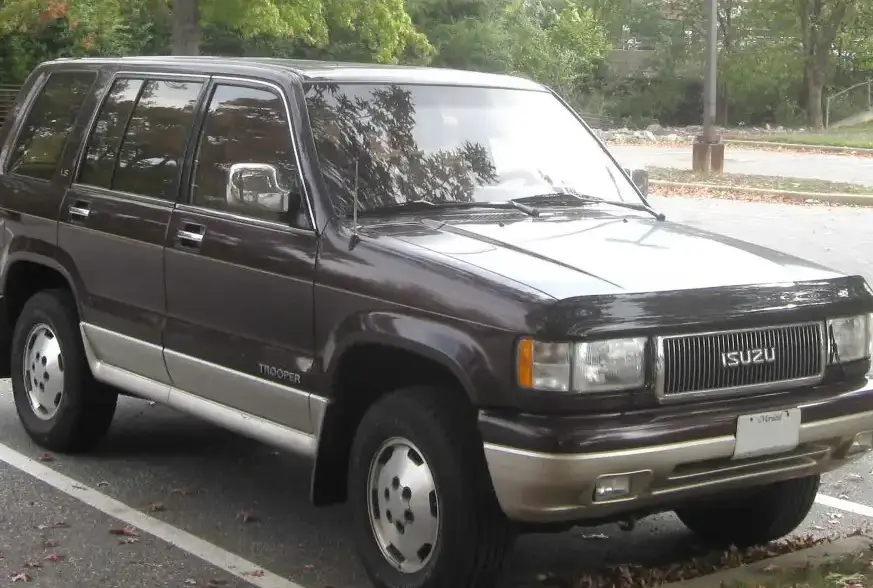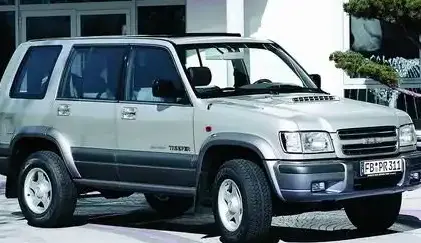
The Isuzu Trooper 3.0 DTI Wagon, produced between 2000 and 2002, represented a mid-cycle update to the second-generation Trooper (UBS series). This variant, powered by the 4JX1 3.0-liter turbocharged diesel engine producing 159 horsepower, was primarily aimed at the European and Australian markets where diesel SUVs were highly favored. In the United States, the Trooper had already been discontinued by this point, making this version a relatively rare sight. The 3.0 DTI Wagon occupied a position in the lineup offering a balance between fuel efficiency and reasonable performance for those needing a capable, full-size SUV.
Technical Specifications
| Brand | Isuzu |
| Model | Trooper |
| Generation | Trooper (UBS Series) |
| Type (Engine) | 3.0 DTI Wagon (159 Hp) |
| Start of production | 2000 |
| End of production | 2002 |
| Powertrain Architecture | Internal Combustion Engine |
| Body type | SUV |
| Seats | 5 |
| Doors | 5 |
| Fuel consumption (urban) | 13.6 l/100 km (17.3 US mpg, 20.8 UK mpg) |
| Fuel consumption (extra urban) | 8.7 l/100 km (27 US mpg, 32.5 UK mpg) |
| Fuel Type | Diesel |
| Acceleration 0 – 100 km/h | 16.5 sec |
| Acceleration 0 – 62 mph | 16.5 sec |
| Acceleration 0 – 60 mph | 15.7 sec |
| Maximum speed | 160 km/h (99.42 mph) |
| Weight-to-power ratio | 13.5 kg/Hp |
| Weight-to-torque ratio | 6.4 kg/Nm |
| Power | 159 Hp @ 3900 rpm |
| Power per litre | 53 Hp/l |
| Torque | 333 Nm @ 2000 rpm (245.61 lb.-ft. @ 2000 rpm) |
| Engine layout | Front, Longitudinal |
| Engine Model/Code | 4JX1 |
| Engine displacement | 2999 cm3 (183.01 cu. in.) |
| Number of cylinders | 4 |
| Engine configuration | Inline |
| Cylinder Bore | 95.4 mm (3.76 in.) |
| Piston Stroke | 104.9 mm (4.13 in.) |
| Compression ratio | 19:1 |
| Number of valves per cylinder | 4 |
| Fuel injection system | Diesel Commonrail |
| Engine aspiration | Turbocharger |
| Valvetrain | DOHC |
| Engine oil capacity | 6 l (6.34 US qt | 5.28 UK qt) |
| Kerb Weight | 2145 kg (4728.92 lbs.) |
| Max. weight | 2810 kg (6194.99 lbs.) |
| Max load | 665 kg (1466.07 lbs.) |
| Trunk (boot) space – minimum | 1190 l (42.02 cu. ft.) |
| Trunk (boot) space – maximum | 2746 l (96.97 cu. ft.) |
| Fuel tank capacity | 85 l (22.45 US gal | 18.7 UK gal) |
| Length | 4795 mm (188.78 in.) |
| Width | 1835 mm (72.24 in.) |
| Height | 1840 mm (72.44 in.) |
| Wheelbase | 2760 mm (108.66 in.) |
| Front track | 1515 mm (59.65 in.) |
| Rear (Back) track | 1520 mm (59.84 in.) |
| Drive wheel | All wheel drive (4×4) |
| Number of gears and type of gearbox | 5 gears, manual transmission |
| Front suspension | Torsion |
| Rear suspension | Coil spring |
| Front brakes | Ventilated discs |
| Rear brakes | Disc |
| Assisting systems | ABS (Anti-lock braking system) |
| Power steering | Hydraulic Steering |
| Tires size | 245/70 R16 |
Powertrain & Engine Architecture
The heart of the 3.0 DTI Wagon is the Isuzu 4JX1 engine, a 2.999-liter inline-four cylinder diesel. This engine utilizes a direct injection common rail system, a significant advancement over earlier diesel designs. Common rail injection allowed for more precise fuel delivery, resulting in improved combustion efficiency, reduced noise, and lower emissions. The 4JX1 is turbocharged, boosting power output to 159 hp at 3900 rpm and 333 Nm (245.61 lb-ft) of torque at 2000 rpm. The engine features a double overhead camshaft (DOHC) valvetrain with four valves per cylinder, contributing to its relatively high specific output for a diesel engine of its era. The 5-speed manual transmission was the standard offering, providing a balance between fuel economy and usability. While an automatic transmission was available in some markets, it was less common with this engine.
Driving Characteristics
The 3.0 DTI Wagon, equipped with the 5-speed manual transmission, offered a driving experience geared towards practicality and durability rather than outright performance. Acceleration was modest, taking around 16.5 seconds to reach 100 km/h (62 mph). The engine’s strength lay in its torque, providing adequate pulling power for towing and off-road driving. The manual gearbox allowed for greater control over the engine’s power delivery, especially useful when navigating challenging terrain. Compared to the gasoline-powered Trooper variants, the 3.0 DTI offered significantly better fuel economy, making it a more economical choice for long-distance travel. However, it lacked the responsiveness and higher revving nature of the petrol engines.
Equipment & Trim Levels
Trim levels for the 3.0 DTI Wagon varied depending on the market. Generally, standard equipment included air conditioning, power windows, central locking, and an AM/FM radio. Higher trim levels often added features such as alloy wheels, a sunroof, and upgraded interior upholstery. The interior design was functional and durable, prioritizing practicality over luxury. The rear seats could be folded down to increase cargo space, making the Trooper a versatile vehicle for families and those needing to transport large items. Safety features typically included ABS brakes and, in some markets, driver and passenger airbags.
Chassis & Braking
The Trooper 3.0 DTI Wagon utilized a body-on-frame construction, providing a robust and durable chassis. The front suspension consisted of torsion bars, while the rear featured coil springs. This setup offered a comfortable ride quality, although it could feel somewhat body-roll during cornering. The braking system employed ventilated discs on the front wheels and solid discs on the rear. ABS was standard, enhancing braking performance and stability, particularly on slippery surfaces. The 4×4 system offered selectable four-wheel drive, allowing drivers to switch between two-wheel drive for on-road efficiency and four-wheel drive for improved traction in off-road conditions.
Market Reception & Comparison
The Isuzu Trooper 3.0 DTI Wagon was generally well-received in markets where diesel SUVs were popular. Critics praised its fuel efficiency, durability, and off-road capability. However, some noted its relatively slow acceleration and somewhat dated interior compared to newer competitors. Compared to the gasoline-powered Trooper variants, the 3.0 DTI offered superior fuel economy and torque, making it a more practical choice for many buyers. It also proved to be more reliable than some of the more complex gasoline engine options. Against competitors like the Mitsubishi Pajero and Toyota Land Cruiser, the Trooper offered a competitive price point and a good balance of features.
Legacy
The Isuzu Trooper 3.0 DTI Wagon, while not a high-performance vehicle, has proven to be a durable and reliable SUV. The 4JX1 engine, when properly maintained, is known for its longevity. Today, these vehicles can be found in the used car market, often with high mileage but still in good working condition. They appeal to buyers seeking a capable and affordable SUV for off-road adventures or as a workhorse vehicle. Parts availability can be a concern, but a dedicated community of owners and enthusiasts helps to keep these vehicles on the road. The 3.0 DTI Wagon represents a solid and dependable offering from Isuzu, cementing its place as a capable and practical SUV of its era.