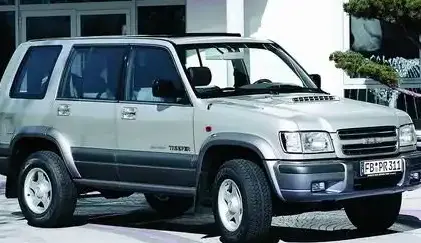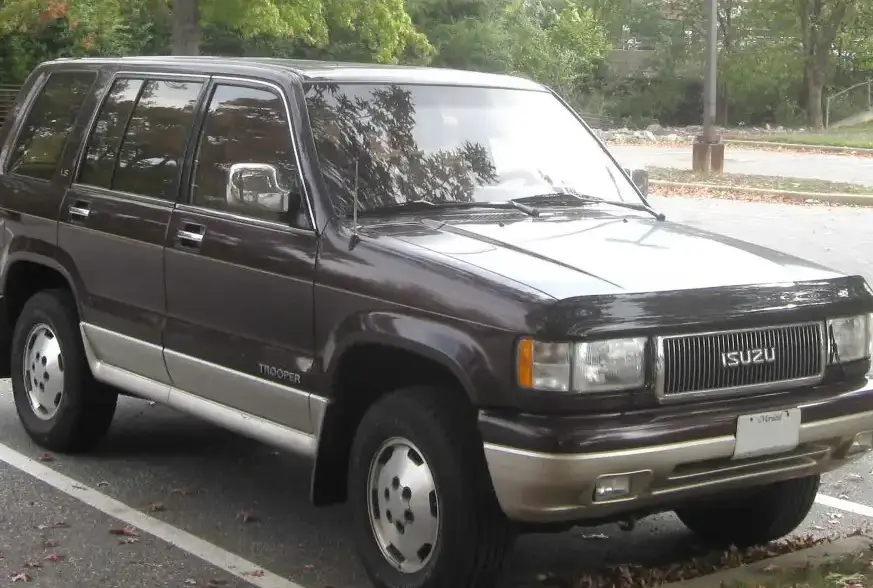
The Isuzu Trooper (LS) 3.1 TD, producing 125 horsepower, was a significant variant of the second-generation Trooper, manufactured from 1992 to 2000. This model occupied a middle ground within the Trooper lineup, offering a diesel-powered option for buyers prioritizing fuel economy and torque over outright speed. It was primarily marketed in Europe, Australia, and other regions outside of North America, where the gasoline-powered versions were more common. The Trooper (LS) series, internally designated as the UBS series, represented Isuzu’s attempt to compete directly with established SUV offerings from Toyota, Nissan, and Mitsubishi, offering a blend of off-road capability and on-road comfort.
Technical Specifications
| Brand | Isuzu |
| Model | Trooper |
| Generation | Trooper (LS) |
| Type (Engine) | 3.1 TD (125 Hp) |
| Start of production | 1992 |
| End of production | 2000 |
| Powertrain Architecture | Internal Combustion engine |
| Body type | SUV |
| Seats | 5 |
| Doors | 5 |
| Fuel consumption (urban) | 12 l/100 km (19.6 US mpg) |
| Fuel consumption (extra urban) | 8 l/100 km (29.4 US mpg) |
| Fuel consumption (combined) | 10 l/100 km (23.5 US mpg) |
| Fuel Type | Diesel |
| Maximum speed | 150 km/h (93.21 mph) |
| Weight-to-power ratio | 15.6 kg/Hp |
| Weight-to-torque ratio | 7.1 kg/Nm |
| Power | 125 Hp @ 3600 rpm |
| Power per litre | 40.9 Hp/l |
| Torque | 275 Nm @ 2000 rpm (202.83 lb.-ft. @ 2000 rpm) |
| Engine layout | Front, Longitudinal |
| Engine Model/Code | 4JG2 |
| Engine displacement | 3059 cm3 (186.67 cu. in.) |
| Number of cylinders | 4 |
| Engine configuration | Inline |
| Cylinder Bore | 95.4 mm (3.76 in.) |
| Piston Stroke | 107 mm (4.21 in.) |
| Compression ratio | 20:1 |
| Number of valves per cylinder | 2 |
| Fuel injection system | Direct injection |
| Engine aspiration | Turbocharger |
| Engine oil capacity | 6 l (6.34 US qt | 5.28 UK qt) |
| Kerb Weight | 1955 kg (4310.04 lbs.) |
| Max. weight | 2600 kg (5732.02 lbs.) |
| Max load | 645 kg (1421.98 lbs.) |
| Fuel tank capacity | 85 l (22.45 US gal | 18.7 UK gal) |
| Length | 4545 mm (178.94 in.) |
| Width | 1745 mm (68.7 in.) |
| Height | 1850 mm (72.83 in.) |
| Wheelbase | 2760 mm (108.66 in.) |
| Front track | 1490 mm (58.66 in.) |
| Rear track | 1495 mm (58.86 in.) |
| Drive wheel | All wheel drive (4×4) |
| Number of gears and type of gearbox | 5 gears, manual transmission |
| Front suspension | Double wishbone |
| Rear suspension | Coil spring |
| Front brakes | Ventilated discs |
| Rear brakes | Disc |
| Assisting systems | ABS (Anti-lock braking system) |
| Steering type | Worm-reduction unit |
| Power steering | Hydraulic Steering |
| Tires size | 245/75 R16 |
Powertrain & Engine Architecture
The heart of the Trooper 3.1 TD was the 4JG2 engine, a 3.1-liter inline-four cylinder diesel. This engine utilized direct injection, a technology that improved fuel efficiency and reduced emissions compared to older indirect injection systems. The 4JG2 was turbocharged, providing a significant boost in power and torque. The turbocharger, coupled with an intercooler, helped to increase air density entering the engine, further enhancing performance. The engine featured a cast iron block and an aluminum cylinder head, a common configuration for diesel engines of this era. The valve train employed two valves per cylinder (SOHC), a relatively simple design that contributed to the engine’s robustness. The 3.1 TD was paired with a robust, but not particularly sophisticated, five-speed manual transmission. This transmission was chosen for its durability and ability to handle the engine’s torque output. An automatic transmission was available in some markets, but the manual was more common with this engine.
Driving Characteristics
The 125 hp and 275 Nm (202.83 lb-ft) of torque delivered by the 3.1 TD engine provided a usable, if not exhilarating, driving experience. Acceleration was modest, but the engine’s strong low-end torque made it well-suited for towing and off-road driving. The five-speed manual transmission allowed drivers to keep the engine in its optimal power band, but the gear ratios were relatively widely spaced. Compared to the gasoline-powered Trooper variants, the 3.1 TD offered significantly better fuel economy, but at the expense of outright speed. The diesel’s torque advantage also made it more capable in challenging terrain, particularly when combined with the Trooper’s four-wheel-drive system.
Equipment & Trim Levels
The Trooper 3.1 TD (LS) typically came equipped with a reasonable level of standard features, though the exact specifications varied depending on the market. Common features included power steering, air conditioning, and basic audio systems. Interior upholstery was typically cloth, with options for leather in some markets. Higher trim levels offered additional features such as power windows, power door locks, and upgraded audio systems. The LS designation generally indicated a mid-range trim level, positioned above the base models but below the more luxurious variants.
Chassis & Braking
The Trooper (LS) featured a body-on-frame construction, providing a robust and durable platform. The front suspension utilized a double wishbone design, while the rear suspension employed coil springs. This suspension setup provided a reasonable balance between ride comfort and off-road capability. Braking duties were handled by ventilated discs at the front and discs at the rear. An Anti-lock Braking System (ABS) was standard on many models, enhancing safety and control during emergency braking situations. The steering system utilized a worm-reduction unit, which provided a direct and responsive feel.
Market Reception & Comparison
The Isuzu Trooper 3.1 TD was generally well-received in markets where diesel-powered SUVs were popular. Critics praised its fuel economy, torque, and off-road capability. However, some reviewers noted its relatively slow acceleration and somewhat agricultural engine noise. Compared to other Trooper variants, the 3.1 TD offered a more economical and practical option for buyers who prioritized fuel efficiency and towing capacity over performance. The gasoline-powered versions, particularly those with the 3.5-liter V6 engine, offered more power but at the cost of significantly higher fuel consumption. The 3.1 TD also compared favorably to competitors such as the Mitsubishi Pajero and Nissan Patrol in terms of value for money.
Legacy
The Isuzu Trooper 3.1 TD has proven to be a relatively reliable and durable vehicle, particularly when properly maintained. The 4JG2 engine is known for its longevity, and many examples are still on the road today. However, like any older vehicle, the Trooper 3.1 TD is susceptible to age-related issues such as rust and wear and tear on suspension components. In the used car market, these Troopers are often sought after by enthusiasts and those looking for a capable and affordable off-road vehicle. Parts availability can be a challenge in some regions, but a dedicated community of owners and suppliers helps to keep these vehicles running. The Trooper 3.1 TD represents a significant chapter in Isuzu’s history, showcasing the company’s commitment to building rugged and reliable SUVs.