
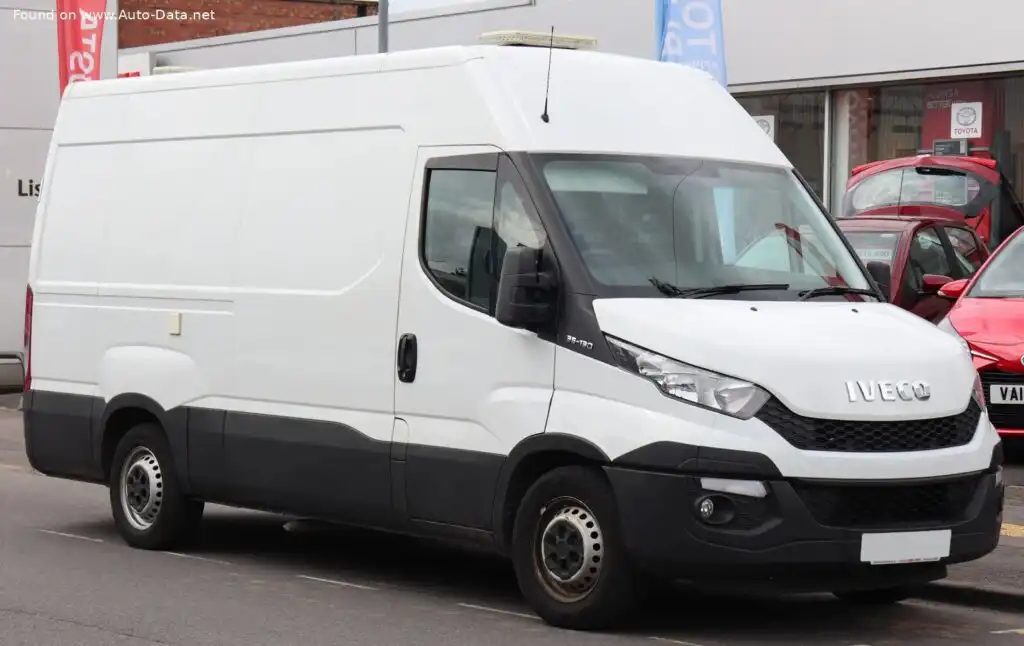
The Iveco Daily III Panel Van 2.3 Multijet (126 Hp) L1H1, produced between April 2014 and April 2016, represents a key iteration within the third generation of Iveco’s popular commercial vehicle range. Positioned as a versatile light commercial van, the L1H1 configuration – denoting a short wheelbase and low roof height – was designed to balance cargo capacity with maneuverability, making it suitable for a wide range of urban and regional delivery tasks. This specific variant, powered by the 2.3-liter Multijet engine producing 126 horsepower, served as a mid-range offering within the Daily III lineup, bridging the gap between more basic, lower-powered models and the higher-performance, larger-capacity options.
Technical Specifications
| Brand | Iveco |
| Model | Daily |
| Generation | Daily III Panel Van |
| Type (Engine) | 2.3 Multijet (126 Hp) L1H1 |
| Start of production | April, 2014 |
| End of production | April, 2016 |
| Powertrain Architecture | Internal Combustion engine |
| Body type | Van |
| Seats | 3 |
| Doors | 4-5 |
| Fuel consumption (urban) | 7.9-8.5 l/100 km (29.8 – 27.7 US mpg) |
| Fuel consumption (extra urban) | 6.7-7.6 l/100 km (35.1 – 30.9 US mpg) |
| Fuel consumption (combined) | 7.1-7.9 l/100 km (33.1 – 29.8 US mpg) |
| CO2 emissions | 199-209 g/km |
| Fuel Type | Diesel |
| Emission standard | Euro 5 |
| Weight-to-power ratio | 16.9 kg/Hp |
| Weight-to-torque ratio | 6.6 kg/Nm |
| Power | 126 Hp @ 3250-3600 rpm |
| Torque | 320 Nm @ 1800-2500 rpm (236.02 lb.-ft.) |
| Engine layout | Front, Longitudinal |
| Engine Model/Code | F1AFL411B |
| Engine displacement | 2287 cm3 (139.56 cu. in.) |
| Number of cylinders | 4 |
| Engine configuration | Inline |
| Cylinder Bore | 88 mm (3.46 in.) |
| Piston Stroke | 94 mm (3.7 in.) |
| Number of valves per cylinder | 4 |
| Fuel injection system | Diesel Commonrail |
| Engine aspiration | Turbocharger, Intercooler |
| Valvetrain | DOHC |
| Engine oil capacity | 4.3 l (4.54 US qt | 3.78 UK qt) |
| Coolant capacity | 16 l (16.91 US qt | 14.08 UK qt) |
| Kerb Weight | 2124-2141 kg (4682.62 – 4720.1 lbs.) |
| Max. weight | 3300-3500 kg (7275.25 – 7716.18 lbs.) |
| Max load | 1176-1359 kg (2592.64 – 2996.08 lbs.) |
| Trunk (boot) space | 7300 l (257.8 cu. ft.) |
| Fuel tank capacity | 70 l (18.49 US gal | 15.4 UK gal) |
| Max. roof load | 150 kg (330.69 lbs.) |
| Permitted trailer load (braked) | 3300 kg (7275.25 lbs.) |
| Permitted trailer load (unbraked) | 750 kg (1653.47 lbs.) |
| Permitted towbar download | 132 kg (291.01 lbs.) |
| Length | 5149 mm (202.72 in.) |
| Width | 2010 mm (79.13 in.) |
| Height | 2200 mm (86.61 in.) |
| Wheelbase | 3000 mm (118.11 in.) |
| Front track | 1740 mm (68.5 in.) |
| Rear track | 1704 mm (67.09 in.) |
| Front overhang | 1008 mm (39.69 in.) |
| Rear overhang | 1141 mm (44.92 in.) |
| Ride height | 180 mm (7.09 in.) |
| Drag coefficient (Cd) | 0.316 |
| Turning circle | 10.5 m (34.45 ft.) |
| Drivetrain | Rear wheel drive |
| Number of gears | 6 |
| Gearbox type | Manual |
| Front suspension | Double wishbone, Transverse stabilizer, Leaf spring |
| Rear suspension | Rigid axle suspension, Transverse stabilizer, Leaf spring |
| Front brakes | Ventilated discs, 300 mm |
| Rear brakes | Disc, 296 mm |
| Assisting systems | ABS |
| Steering type | Steering rack and pinion |
| Power steering | Hydraulic |
| Tires size | 215/65 R16; 225/65 R16; 235/65 R16 |
| Wheel rims size | 6.5J x 16 |
INTRODUCTION
The Iveco Daily is a cornerstone of the European light commercial vehicle market, renowned for its robust construction, adaptability, and wide range of configurations. The Daily III, launched in 2006, continued this tradition, offering a significant upgrade in terms of technology, safety, and comfort. The 2.3 Multijet (126 Hp) L1H1 variant, introduced in 2014, was a popular choice for businesses requiring a dependable and efficient van for deliveries, service calls, and other commercial applications. Its compact dimensions made it particularly well-suited for navigating congested city streets, while its payload capacity remained competitive within its class.
Powertrain & Engine Architecture
At the heart of the Daily III 2.3 Multijet lies the F1AFL411B, a 2.3-liter inline four-cylinder diesel engine. This engine is a member of Iveco’s well-regarded Multijet family, utilizing common-rail direct injection technology to optimize fuel combustion and reduce emissions. The engine features a turbocharger with an intercooler, enhancing power output and torque delivery. The 126 horsepower peak is achieved at 3250-3600 rpm, while the 320 Nm (236 lb-ft) of torque is available from 1800-2500 rpm. This broad torque curve provides good low-end grunt, making it suitable for carrying loads and navigating varied terrain. The engine employs a double overhead camshaft (DOHC) valvetrain with four valves per cylinder, contributing to its efficiency and responsiveness. The engine is longitudinally mounted in the chassis, driving the rear wheels. The 6-speed manual transmission provides a good balance between fuel economy and performance, with gear ratios tailored for commercial use.
Driving Characteristics
The 2.3 Multijet 126 Hp variant of the Daily III offers a practical and functional driving experience. While not designed for outright speed, it provides sufficient power for most urban and regional delivery tasks. The engine’s strong low-end torque makes it easy to pull away from a standstill, even when fully loaded. The 6-speed manual transmission allows the driver to keep the engine within its optimal operating range, maximizing fuel efficiency and minimizing noise. Compared to higher-powered Daily models, this variant feels less strained when climbing hills or carrying heavy loads, but acceleration is noticeably slower. The rear-wheel-drive configuration provides good traction in most conditions, although careful driving is required on slippery surfaces. The steering is precise and responsive, making it easy to maneuver in tight spaces.
Equipment & Trim Levels
The Daily III Panel Van 2.3 Multijet (126 Hp) L1H1 typically came equipped with a functional, no-frills interior focused on durability and practicality. Standard features included a driver’s airbag, ABS brakes, power steering, and a basic audio system. The cabin typically featured durable plastic trim and hard-wearing upholstery. Optional extras included air conditioning, electric windows, a passenger airbag, and a more advanced audio system with Bluetooth connectivity. The L1H1 configuration offered a generous cargo space of 7300 liters (257.8 cu. ft.), making it suitable for a wide range of goods. The van’s load capacity was approximately 1176-1359 kg (2592.64 – 2996.08 lbs.), depending on the specific configuration.
Chassis & Braking
The Daily III chassis is built around a robust ladder frame construction, providing a solid foundation for the van’s body. The front suspension utilizes a double wishbone setup with a transverse stabilizer and leaf springs, while the rear suspension employs a rigid axle with leaf springs and an optional air suspension system. The braking system consists of ventilated discs at the front and discs at the rear, providing adequate stopping power for the van’s weight. ABS (Anti-lock Braking System) is standard, enhancing safety and stability during emergency braking.
Market Reception & Comparison
The Iveco Daily III 2.3 Multijet (126 Hp) L1H1 was generally well-received by critics and operators alike. It was praised for its reliability, fuel efficiency, and versatility. Compared to other light commercial vans in its class, such as the Mercedes-Benz Sprinter and the Ford Transit, the Daily offered a compelling combination of performance, payload capacity, and durability. The 126 Hp engine provided a good balance between power and economy, making it a popular choice for businesses looking to minimize operating costs. However, some critics noted that the interior was somewhat basic compared to some of its competitors.
Legacy
The Iveco Daily III 2.3 Multijet (126 Hp) L1H1 remains a common sight on European roads today. The F1AFL411B engine is known for its durability and relatively low maintenance costs, making it a popular choice in the used commercial vehicle market. While newer Daily models offer more advanced technology and features, the Daily III continues to provide a reliable and cost-effective solution for businesses requiring a dependable light commercial van. Its robust construction and readily available parts ensure that it will remain a viable option for years to come.
