
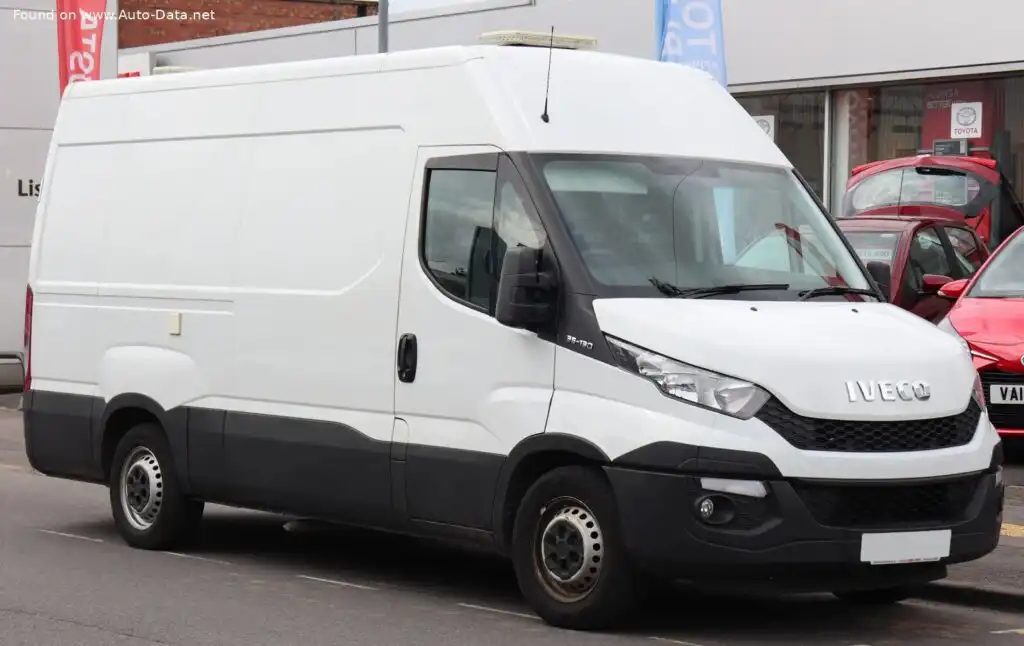
The Iveco Daily III Panel Van 2.3 Multijet (126 Hp) L2H1 represents a significant iteration in Iveco’s long-standing Daily commercial vehicle line. Produced from April 2014 to April 2016, this variant occupied a crucial middle ground within the Daily III range, offering a balance between payload capacity, fuel efficiency, and operational cost for businesses. The “L2H1” designation refers to the vehicle’s body length and roof height – a medium length and standard height configuration – making it a versatile choice for a wide array of commercial applications. This particular model was primarily sold in European and international markets, where the Daily has consistently been a popular choice for light-duty commercial transport.
Technical Specifications
| Brand | Iveco |
| Model | Daily |
| Generation | Daily III Panel Van |
| Type (Engine) | 2.3 Multijet (126 Hp) L2H1 |
| Start of production | April, 2014 |
| End of production | April, 2016 |
| Powertrain Architecture | Internal Combustion engine |
| Body type | Van |
| Seats | 3 |
| Doors | 4-5 |
| Fuel consumption (economy) – urban (NEDC) | 7.9-8.5 l/100 km (29.8 – 27.7 US mpg, 35.8 – 33.2 UK mpg, 12.7 – 11.8 km/l) |
| Fuel consumption (economy) – extra urban (NEDC) | 6.7-7.6 l/100 km (35.1 – 30.9 US mpg, 42.2 – 37.2 UK mpg, 14.9 – 13.2 km/l) |
| Fuel consumption (economy) – combined (NEDC) | 7.1-7.9 l/100 km (33.1 – 29.8 US mpg, 39.8 – 35.8 UK mpg, 14.1 – 12.7 km/l) |
| CO2 emissions (NEDC) | 199-209 g/km |
| Fuel Type | Diesel |
| Emission standard | Euro 5 |
| Weight-to-power ratio | 17.2 kg/Hp, 58.3 Hp/tonne |
| Weight-to-torque ratio | 6.8 kg/Nm, 147.9 Nm/tonne |
| Power | 126 Hp @ 3250-3600 rpm |
| Power per litre | 55.1 Hp/l |
| Torque | 320 Nm @ 1800-2500 rpm (236.02 lb.-ft. @ 1800-2500 rpm) |
| Engine layout | Front, Longitudinal |
| Engine Model/Code | F1AFL411B |
| Engine displacement | 2287 cm3 (139.56 cu. in.) |
| Number of cylinders | 4 |
| Engine configuration | Inline |
| Cylinder Bore | 88 mm (3.46 in.) |
| Piston Stroke | 94 mm (3.7 in.) |
| Number of valves per cylinder | 4 |
| Fuel injection system | Diesel Commonrail |
| Engine aspiration | Turbocharger, Intercooler |
| Valvetrain | DOHC |
| Engine oil capacity | 4.3 l (4.54 US qt | 3.78 UK qt) |
| Coolant | 16 l (16.91 US qt | 14.08 UK qt) |
| Kerb Weight | 2163-2180 kg (4768.6 – 4806.08 lbs.) |
| Max. weight | 3300-3500 kg (7275.25 – 7716.18 lbs.) |
| Max load | 1137-1320 kg (2506.66 – 2910.1 lbs.) |
| Trunk (boot) space – minimum | 9000 l (317.83 cu. ft.) |
| Fuel tank capacity | 70 l (18.49 US gal | 15.4 UK gal) |
| Max. roof load | 150 kg (330.69 lbs.) |
| Permitted trailer load with brakes (12%) | 3300 kg (7275.25 lbs.) |
| Permitted trailer load without brakes | 750 kg (1653.47 lbs.) |
| Permitted towbar download | 132 kg (291.01 lbs.) |
| Length | 5669 mm (223.19 in.) |
| Width | 2010 mm (79.13 in.) |
| Height | 2200 mm (86.61 in.) |
| Wheelbase | 3520 mm (138.58 in.) |
| Front track | 1740 mm (68.5 in.) |
| Rear (Back) track | 1704 mm (67.09 in.) |
| Front overhang | 1008 mm (39.69 in.) |
| Rear overhang | 1141 mm (44.92 in.) |
| Ride height (ground clearance) | 180 mm (7.09 in.) |
| Minimum turning circle (turning diameter) | 12.08 m (39.63 ft.) |
| Drivetrain Architecture | The Internal combustion engine (ICE) drives the rear wheels of the vehicle. |
| Drive wheel | Rear wheel drive |
| Number of gears and type of gearbox | 6 gears, manual transmission |
| Front suspension | Double wishbone, Transverse stabilizer, Leaf spring |
| Rear suspension | Rigid axle suspension, Transverse stabilizer, Leaf spring, Air Suspension – Optional |
| Front brakes | Ventilated discs, 300 mm |
| Rear brakes | Disc, 296 mm |
| Assisting systems | ABS (Anti-lock braking system) |
| Steering type | Steering rack and pinion |
| Power steering | Hydraulic Steering |
| Tires size | 215/65 R16; 225/65 R16; 235/65 R16 |
| Wheel rims size | 6.5J x 16 |
Powertrain & Engine Architecture
The heart of the Daily III 2.3 Multijet is the F1AFL411B engine, a 2.3-liter inline-four cylinder diesel. This engine is a member of Iveco’s well-regarded Multijet family, known for its efficiency and durability. The 126 horsepower output is achieved at 3250-3600 rpm, while peak torque of 320 Nm (236 lb-ft) is delivered between 1800-2500 rpm. This engine utilizes a common rail direct injection system, allowing for precise fuel delivery and optimized combustion. A turbocharger with an intercooler further enhances performance and efficiency. The engine features a double overhead camshaft (DOHC) valvetrain, contributing to improved breathing and power delivery. The engine is longitudinally mounted in the chassis, driving the rear wheels. This configuration is typical for light commercial vehicles prioritizing load-carrying capacity and rear-wheel drive traction.
Driving Characteristics
The 126 hp 2.3 Multijet, paired with a 6-speed manual transmission, provides adequate performance for typical commercial duties. While not designed for outright speed, it offers sufficient power for highway cruising and navigating urban environments with a moderate load. The engine’s torque curve is relatively flat, providing good pulling power from low engine speeds. The 6-speed gearbox allows for efficient cruising at highway speeds, while also providing enough gear ratios for tackling steep inclines or carrying heavy loads. Compared to higher-output versions of the 2.3 Multijet, or the larger 3.0-liter engines available in the Daily III range, this variant prioritizes fuel economy over outright performance. The manual transmission provides the driver with full control over gear selection, which is preferred by many commercial drivers for its responsiveness and efficiency.
Equipment & Trim Levels
The Daily III Panel Van 2.3 Multijet L2H1 typically came equipped with a functional, no-frills interior focused on durability and practicality. Standard features included a driver’s air bag, power steering, and a basic audio system. The cabin typically featured durable plastic trim and hard-wearing upholstery. Optional extras included air conditioning, electric windows, a passenger airbag, and more advanced audio systems. The L2H1 configuration offered a substantial cargo volume of approximately 9000 liters (317.83 cubic feet), making it suitable for a wide range of commercial applications.
Chassis & Braking
The Daily III utilizes a robust ladder-frame chassis, providing a solid foundation for carrying heavy loads. The front suspension consists of independent double wishbones with a transverse stabilizer and leaf springs, while the rear suspension employs a rigid axle setup with leaf springs and an optional air suspension system. The braking system features ventilated discs on the front wheels and discs on the rear, along with ABS (Anti-lock Braking System) as standard. The suspension is tuned to prioritize load-carrying capacity and stability, rather than outright comfort.
Market Reception & Comparison
The Iveco Daily III 2.3 Multijet (126 Hp) L2H1 was generally well-received by commercial vehicle operators. Critics praised its fuel efficiency, reliability, and load-carrying capacity. Compared to the higher-powered versions of the Daily III, this variant offered a lower purchase price and reduced running costs, making it an attractive option for businesses operating on a tight budget. Its fuel economy figures of 7.1-7.9 l/100 km (33.1 – 29.8 US mpg) were competitive within its class. Compared to competitors like the Mercedes-Benz Sprinter and Volkswagen Crafter, the Daily III offered a compelling combination of price, performance, and durability.
Legacy
The Iveco Daily III 2.3 Multijet (126 Hp) L2H1 remains a common sight on European roads today. The F1AFL411B engine is known for its robustness and longevity, and with proper maintenance, can reliably accumulate high mileage. In the used commercial vehicle market, this variant represents a good value proposition, offering a dependable and economical workhorse for businesses of all sizes. While newer generations of the Daily have introduced more advanced technologies and features, the Daily III continues to be appreciated for its simplicity, durability, and practicality.
