
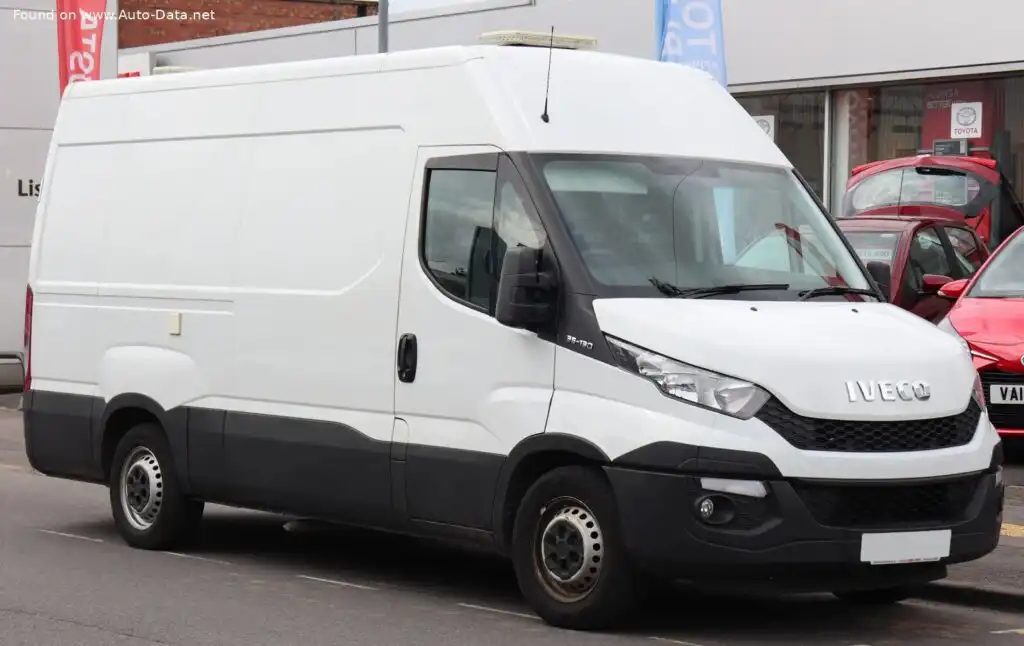
The Iveco Daily III Panel Van 2.3 Multijet (126 Hp) L3H3 represents a significant iteration in Iveco’s long-standing Daily commercial vehicle line. Produced from April 2014 to April 2016, this variant occupied a crucial middle ground within the Daily III range, offering a balance between payload capacity, fuel efficiency, and operational cost. The “L3H3” designation indicates a long wheelbase and high roof configuration, maximizing cargo volume. This specific model was primarily aimed at businesses and tradespeople requiring a versatile and robust van for deliveries, mobile workshops, or specialized transport applications within the European market, though limited grey market imports reached North America.
Technical Specifications
| Brand | Iveco |
| Model | Daily |
| Generation | Daily III Panel Van |
| Type (Engine) | 2.3 Multijet (126 Hp) L3H3 |
| Start of production | April, 2014 |
| End of production | April, 2016 |
| Powertrain Architecture | Internal Combustion engine |
| Body type | Van |
| Seats | 3 |
| Doors | 4-5 |
| Fuel consumption (economy) – urban (NEDC) | 7.9-8.5 l/100 km (29.8 – 27.7 US mpg, 35.8 – 33.2 UK mpg, 12.7 – 11.8 km/l) |
| Fuel consumption (economy) – extra urban (NEDC) | 6.7-7.6 l/100 km (35.1 – 30.9 US mpg, 42.2 – 37.2 UK mpg, 14.9 – 13.2 km/l) |
| Fuel consumption (economy) – combined (NEDC) | 7.1-7.9 l/100 km (33.1 – 29.8 US mpg, 39.8 – 35.8 UK mpg, 14.1 – 12.7 km/l) |
| CO2 emissions (NEDC) | 199-209 g/km |
| Fuel Type | Diesel |
| Emission standard | Euro 5 |
| Weight-to-power ratio | 17.9 kg/Hp, 55.8 Hp/tonne |
| Weight-to-torque ratio | 7.1 kg/Nm, 141.8 Nm/tonne |
| Power | 126 Hp @ 3250-3600 rpm |
| Power per litre | 55.1 Hp/l |
| Torque | 320 Nm @ 1800-2500 rpm (236.02 lb.-ft. @ 1800-2500 rpm) |
| Engine layout | Front, Longitudinal |
| Engine Model/Code | F1AFL411B |
| Engine displacement | 2287 cm3 (139.56 cu. in.) |
| Number of cylinders | 4 |
| Engine configuration | Inline |
| Cylinder Bore | 88 mm (3.46 in.) |
| Piston Stroke | 94 mm (3.7 in.) |
| Number of valves per cylinder | 4 |
| Fuel injection system | Diesel Commonrail |
| Engine aspiration | Turbocharger, Intercooler |
| Valvetrain | DOHC |
| Engine oil capacity | 4.3 l (4.54 US qt | 3.78 UK qt) |
| Coolant | 16 l (16.91 US qt | 14.08 UK qt) |
| Kerb Weight | 2257-2266 kg (4975.83 – 4995.67 lbs.) |
| Max. weight | 3500 kg (7716.18 lbs.) |
| Max load | 1234-1243 kg (2720.5 – 2740.35 lbs.) |
| Trunk (boot) space – minimum | 13400 l (473.22 cu. ft.) |
| Fuel tank capacity | 70 l (18.49 US gal | 15.4 UK gal) |
| Permitted trailer load with brakes (12%) | 3500 kg (7716.18 lbs.) |
| Permitted trailer load without brakes | 750 kg (1653.47 lbs.) |
| Permitted towbar download | 140 kg (308.65 lbs.) |
| Length | 6069 mm (238.94 in.) |
| Width | 2010 mm (79.13 in.) |
| Height | 2780 mm (109.45 in.) |
| Wheelbase | 3520 mm (138.58 in.) |
| Front track | 1740 mm (68.5 in.) |
| Rear (Back) track | 1704 mm (67.09 in.) |
| Front overhang | 1008 mm (39.69 in.) |
| Rear overhang | 1541 mm (60.67 in.) |
| Ride height (ground clearance) | 180 mm (7.09 in.) |
| Minimum turning circle (turning diameter) | 12.08 m (39.63 ft.) |
| Drivetrain Architecture | The Internal combustion engine (ICE) drives the rear wheels of the vehicle. |
| Drive wheel | Rear wheel drive |
| Number of gears and type of gearbox | 6 gears, manual transmission |
| Front suspension | Double wishbone, Transverse stabilizer, Leaf spring |
| Rear suspension | Rigid axle suspension, Transverse stabilizer, Leaf spring, Air Suspension – Optional |
| Front brakes | Ventilated discs, 300 mm |
| Rear brakes | Disc, 296 mm |
| Assisting systems | ABS (Anti-lock braking system) |
| Steering type | Steering rack and pinion |
| Power steering | Hydraulic Steering |
| Tires size | 225/65 R16; 235/65 R16 |
| Wheel rims size | 6.5J x 16 |
Powertrain & Engine Architecture
The heart of the Daily III 2.3 Multijet is the F1AFL411B, a 2.3-liter inline-four cylinder diesel engine. This engine is part of Iveco’s well-regarded Multijet family, utilizing common-rail direct injection technology. This system, supplied by Bosch, allows for multiple injections per combustion cycle, optimizing fuel atomization and combustion efficiency. The engine features a turbocharger with an intercooler, boosting power output and improving torque delivery. The DOHC (Double Overhead Camshaft) valvetrain, with four valves per cylinder, further enhances breathing and contributes to the engine’s overall performance. The 126 horsepower peak is achieved between 3250 and 3600 rpm, while the 320 Nm (236 lb-ft) of torque is available from 1800 to 2500 rpm. The engine is longitudinally mounted in the chassis, driving the rear wheels through a standard six-speed manual transmission. While an automated manual transmission (AMT) was available on some Daily III models, it was not typically paired with this specific engine and power output.
Driving Characteristics
The 2.3 Multijet 126 Hp variant of the Daily III offers a practical and economical driving experience. While not designed for outright speed, the engine provides sufficient power for everyday commercial tasks. The six-speed manual transmission allows for efficient gear selection, keeping the engine within its optimal torque band. Acceleration is modest, but the van is capable of maintaining highway speeds when loaded. The rear-wheel-drive configuration provides good traction, especially when carrying a load. Compared to higher-output versions of the Daily III, such as those equipped with the 3.0-liter engine, this variant prioritizes fuel economy and lower operating costs over sheer performance. The manual transmission, while requiring more driver involvement than an automatic, offers greater control and potentially better fuel efficiency.
Equipment & Trim Levels
The Daily III Panel Van 2.3 Multijet (126 Hp) L3H3 typically came with a functional, work-oriented interior. Standard features included a driver’s air bag, power steering, and a basic audio system. The cabin was designed for durability and ease of cleaning, with hard-wearing plastics and vinyl upholstery. Trim levels were relatively basic, focusing on functionality rather than luxury. Optional extras included air conditioning, electric windows, a passenger air bag, and various cargo area configurations. The L3H3 configuration provided a substantial cargo volume of 13.4 cubic meters, making it suitable for a wide range of commercial applications.
Chassis & Braking
The Daily III utilizes a robust ladder-frame chassis, providing a solid foundation for heavy loads. The front suspension consists of independent double wishbones with a transverse stabilizer and leaf springs, while the rear suspension employs a rigid axle with leaf springs and an optional air suspension system. The braking system features ventilated discs on the front wheels and discs on the rear, along with ABS (Anti-lock Braking System) as standard. The steering is rack and pinion with hydraulic power assistance. The tires are typically 225/65 R16 or 235/65 R16, mounted on 6.5J x 16 steel wheels.
Market Reception & Comparison
The Iveco Daily III 2.3 Multijet (126 Hp) L3H3 was generally well-received by commercial vehicle operators. Critics praised its fuel efficiency, reliability, and load-carrying capacity. Compared to other vans in its class, such as the Mercedes-Benz Sprinter and the Volkswagen Crafter, the Daily III offered a competitive combination of features and price. The 2.3-liter engine provided a good balance between performance and economy, making it a popular choice for businesses seeking a cost-effective van. However, some reviewers noted that the interior was somewhat basic compared to some of its rivals.
Legacy
The Iveco Daily III 2.3 Multijet (126 Hp) L3H3 remains a common sight on European roads today. The F1AFL411B engine is known for its durability and relatively low maintenance costs. While older examples may require attention to wear and tear items, the engine itself is generally reliable. In the used commercial vehicle market, this variant represents a good value proposition, offering a practical and dependable van at an affordable price. Its robust construction and efficient engine continue to make it a popular choice for businesses and tradespeople.
