
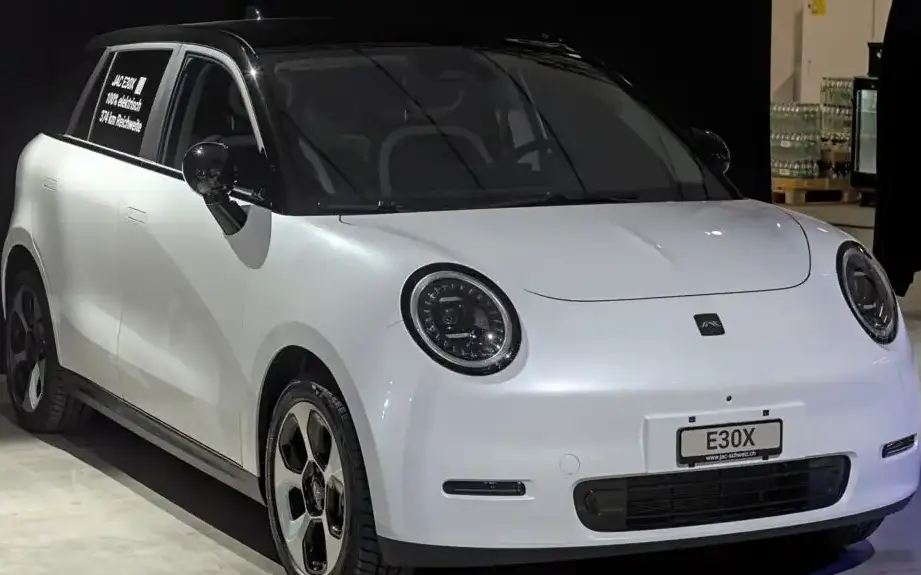
The JAC E30X 41 kWh, producing 136 horsepower, is a battery electric vehicle (BEV) hatchback introduced by the Anhui Jianghuai Automobile Group (JAC Motors) in 2023. Positioned as an entry-level electric vehicle, the E30X aims to provide affordable and practical transportation in a rapidly growing EV market, primarily targeting urban commuters. It represents JAC’s commitment to expanding its electric vehicle offerings and competing with other compact EVs available globally. The E30X is built on a dedicated electric vehicle platform, designed to maximize interior space and battery efficiency.
Technical Specifications
| Brand | JAC |
| Model | E30X |
| Generation | E30X |
| Type (Engine) | 41 kWh (136 Hp) |
| Start of production | 2023 |
| Powertrain Architecture | BEV (Electric Vehicle) |
| Body type | Hatchback |
| Seats | 5 |
| Doors | 5 |
| Fuel Type | Electricity |
| Maximum speed | 150 km/h (93.21 mph) |
| Weight-to-power ratio | 10 kg/Hp, 99.6 Hp/tonne |
| Weight-to-torque ratio | 7.8 kg/Nm, 128.2 Nm/tonne |
| Gross battery capacity | 41 kWh |
| Battery technology | Lithium iron phosphate (LiFePO4) |
| Battery location | Below the floor |
| All-electric range (WLTP) | 281 km (174.61 mi) |
| All-electric range (CLTC) | 405 km (251.66 mi) |
| Electric motor power | 136 Hp |
| Electric motor Torque | 175 Nm (129.07 lb.-ft.) |
| Electric motor location | Front axle, Transverse |
| Electric motor type | Synchronous |
| System power | 136 Hp |
| System torque | 175 Nm (129.07 lb.-ft.) |
| Kerb Weight | 1365-1395 kg (3009.31 – 3075.45 lbs.) |
| Max. weight | 1740-1820 kg (3836.04 – 4012.41 lbs.) |
| Max load | 375-425 kg (826.73 – 936.96 lbs.) |
| Trunk (boot) space – minimum | 310 l (10.95 cu. ft.) |
| Length | 4025 mm (158.46 in.) |
| Width | 1770 mm (69.69 in.) |
| Height | 1560 mm (61.42 in.) |
| Wheelbase | 2620 mm (103.15 in.) |
| Minimum turning circle | 9.9 m (32.48 ft.) |
| Drivetrain Architecture | One electric motor drives the front wheels. |
| Drive wheel | Front wheel drive |
| Number of gears | 1 |
| Gearbox type | Automatic transmission |
| Front suspension | Independent, type McPherson with coil spring and anti-roll bar |
| Rear suspension | Torsion |
| Front brakes | Ventilated discs |
| Rear brakes | Disc |
| Assisting systems | ABS (Anti-lock braking system) |
| Steering type | Steering rack and pinion |
| Power steering | Electric Steering |
| Tires size | 205/55 R17 |
| Wheel rims size | 17 |
Powertrain & Engine Architecture
The JAC E30X is powered by a single synchronous electric motor located on the front transverse axle. This motor delivers a peak power output of 136 horsepower and 175 Nm (129.07 lb.-ft.) of torque. The vehicle utilizes a 41 kWh lithium iron phosphate (LiFePO4) battery pack positioned under the floor, contributing to a lower center of gravity and improved handling. LiFePO4 batteries are known for their thermal stability and longer lifespan compared to other lithium-ion chemistries, although they generally offer slightly lower energy density. The E30X employs a single-speed automatic transmission, typical for electric vehicles, providing seamless acceleration. The battery supports charging via standard charging ports, though specific charging times vary depending on the charger type.
Driving Characteristics
The E30X offers a typical electric vehicle driving experience, characterized by instant torque and smooth acceleration. While not designed for high-performance driving, the 136 hp motor provides adequate power for urban and suburban commuting. The single-speed automatic transmission ensures a linear power delivery, without the gear changes associated with internal combustion engines. The vehicle’s weight, ranging from 1365 to 1395 kg (3009.31 – 3075.45 lbs.), impacts acceleration and handling, making it feel reasonably nimble in city traffic. The WLTP range of 281 km (174.61 mi) is suitable for daily commutes and short trips, but may require more frequent charging for longer journeys.
Equipment & Trim Levels
As an entry-level EV, the JAC E30X typically comes equipped with a standard set of features designed for practicality and convenience. These generally include air conditioning, power windows, a basic infotainment system with a touchscreen display, and standard safety features like ABS. Interior upholstery is typically cloth, and the dashboard design is functional rather than luxurious. Optional extras may include features like a rearview camera, parking sensors, and upgraded infotainment systems with smartphone connectivity. Specific trim levels and available options vary depending on the market.
Chassis & Braking
The E30X utilizes a McPherson strut independent suspension system at the front, providing a comfortable ride and decent handling characteristics. The rear suspension employs a torsion beam setup, which is a cost-effective solution for compact vehicles. The braking system consists of ventilated discs at the front and solid discs at the rear, coupled with an Anti-lock Braking System (ABS) for enhanced safety. The vehicle is equipped with electric power steering, offering light and responsive steering feel. It rides on 17-inch wheels with 205/55 R17 tires.
Market Reception & Comparison
The JAC E30X has been positioned as a competitively priced EV, aiming to attract budget-conscious buyers. Reviews have generally praised its affordability and practicality, but some critics have noted its relatively limited range and basic interior compared to more expensive EVs. Compared to other trims within the JAC lineup (if available), the E30X represents the entry point, offering a more accessible price point in exchange for reduced range and performance. Its main competitors include other small electric hatchbacks from Chinese manufacturers, as well as gasoline-powered vehicles in the same price segment.
Legacy
The JAC E30X represents a significant step for JAC Motors in the electric vehicle market. Its long-term reliability will depend on the durability of its battery pack and electric motor. The use of LiFePO4 batteries suggests a potentially longer lifespan compared to some other EV battery chemistries. As the used EV market matures, the E30X is likely to become a popular choice for buyers seeking an affordable and practical electric vehicle for urban transportation. Its success will contribute to the broader adoption of electric vehicles and the transition towards a more sustainable transportation future.
