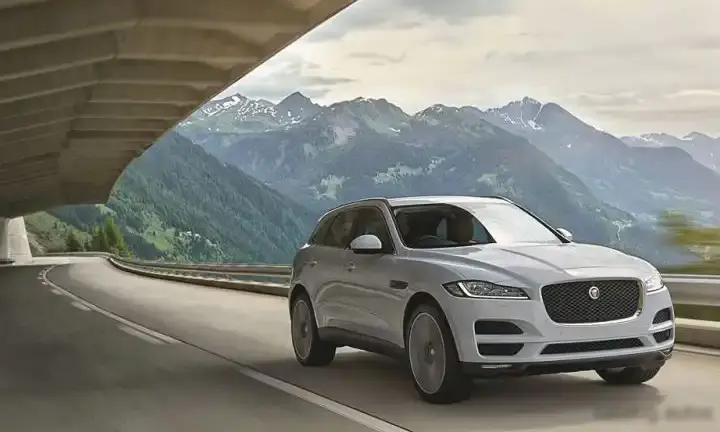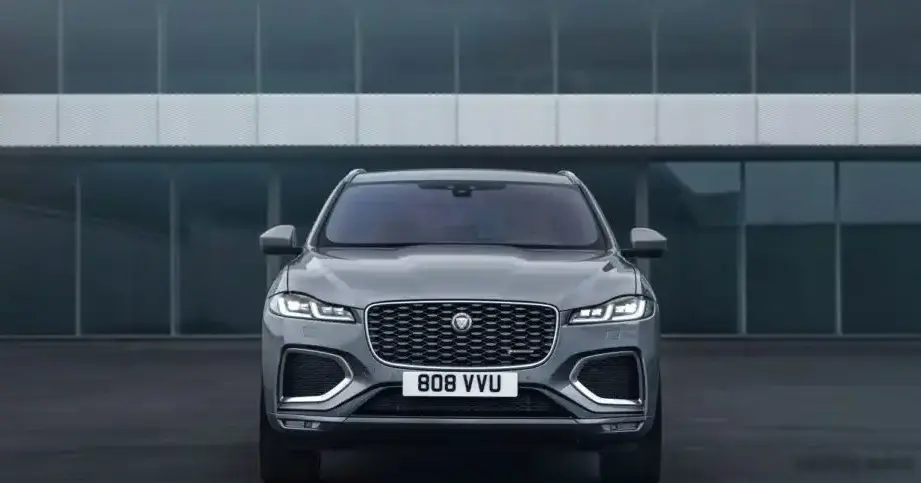
The Jaguar F-Pace, launched in 2016, marked Jaguar’s entry into the burgeoning luxury compact SUV segment. The 2020 facelift brought significant updates to the exterior styling, interior technology, and powertrain options. The 2.0i (250 hp) AWD Automatic variant, introduced with the facelift in September 2020, served as a key volume model, offering a balance of performance, efficiency, and standard features. It positioned itself as the entry point to the F-Pace range for buyers prioritizing a refined driving experience and all-weather capability over outright performance offered by the higher-spec engines.
Technical Specifications
| Brand | Jaguar |
| Model | F-Pace |
| Generation | F-Pace (facelift 2020) |
| Type (Engine) | 2.0i (250 Hp) AWD Automatic |
| Start of production | September, 2020 |
| Powertrain Architecture | Internal Combustion engine |
| Body type | SUV |
| Seats | 5 |
| Doors | 5 |
| Combined fuel consumption (WLTP) | 9.3-10.1 l/100 km |
| Combined fuel consumption (US mpg) | 25.3 – 23.3 |
| CO2 emissions (WLTP) | 209-228 g/km |
| Fuel Type | Petrol (Gasoline) |
| Acceleration 0 – 100 km/h | 7.3 sec |
| Acceleration 0 – 62 mph | 7.3 sec |
| Acceleration 0 – 60 mph | 6.9 sec |
| Maximum speed | 217 km/h (134.84 mph) |
| Emission standard | Euro 6d |
| Weight-to-power ratio | 7.6 kg/Hp, 131.8 Hp/tonne |
| Weight-to-torque ratio | 5.2 kg/Nm, 192.4 Nm/tonne |
| Power | 250 Hp @ 5500 rpm |
| Power per litre | 125.2 Hp/l |
| Torque | 365 Nm @ 1300-4500 rpm (269.21 lb.-ft. @ 1300-4500 rpm) |
| Engine layout | Front, Longitudinal |
| Engine Model/Code | Ingenium / PT204 |
| Engine displacement | 1997 cm3 (121.86 cu. in.) |
| Number of cylinders | 4 |
| Engine configuration | Inline |
| Cylinder Bore | 83.01 mm (3.27 in.) |
| Piston Stroke | 92.29 mm (3.63 in.) |
| Compression ratio | 10.5:1 |
| Number of valves per cylinder | 4 |
| Fuel injection system | Direct injection |
| Engine aspiration | Turbocharger, Intercooler |
| Engine oil capacity | 7 l (7.4 US qt | 6.16 UK qt) |
| Coolant | 9.05 l (9.56 US qt | 7.96 UK qt) |
| Kerb Weight | 1897 kg (4182.17 lbs.) |
| Trunk (boot) space – minimum | 793 l (28 cu. ft.) |
| Trunk (boot) space – maximum | 1842 l (65.05 cu. ft.) |
| Fuel tank capacity | 82 l (21.66 US gal | 18.04 UK gal) |
| Permitted trailer load with brakes (12%) | 2400 kg (5291.09 lbs.) |
| Permitted trailer load without brakes | 750 kg (1653.47 lbs.) |
| Length | 4747 mm (186.89 in.) |
| Width with mirrors folded | 2071 mm (81.54 in.) |
| Width including mirrors | 2175 mm (85.63 in.) |
| Height | 1664 mm (65.51 in.) |
| Wheelbase | 2874 mm (113.15 in.) |
| Front track | 1640 mm (64.57 in.) |
| Rear (Back) track | 1656 mm (65.2 in.) |
| Front overhang | 845 mm (33.27 in.) |
| Rear overhang | 1028 mm (40.47 in.) |
| Ride height (ground clearance) | 213 mm (8.39 in.) |
| Drag coefficient (Cd) | 0.32 |
| Minimum turning circle (turning diameter) | 11.93 m (39.14 ft.) |
| Approach angle | 22.5° |
| Departure angle | 22.9° |
| Ramp-over (brakeover) angle | 19.0° |
| Wading depth | 500 mm (19.69 in.) |
| Drivetrain Architecture | The Internal combustion engine (ICE) drives the rear wheels permanently, and the front wheels are driven through an electrically or mechanically operated clutch if necessary. |
| Drive wheel | All wheel drive (4×4) |
| Number of gears and type of gearbox | 8 gears, automatic transmission ZF |
| Front suspension | Double wishbone |
| Rear suspension | Independent multi-link suspension |
| Front brakes | Ventilated discs, 350 mm |
| Rear brakes | Ventilated discs, 325 mm |
| Assisting systems | ABS (Anti-lock braking system) |
| Steering type | Steering rack and pinion |
| Power steering | Electric Steering |
| Tires size | 255/55 R19; 255/50 R20; 265/45 R21 |
| Wheel rims size | 8.5J x 19; 8.5J x 20; 9J x 21 |
Powertrain & Engine Architecture
The 2.0i variant utilizes Jaguar Land Rover’s Ingenium engine family, specifically the PT204 code. This is a turbocharged, direct-injection four-cylinder engine displacing 1997cc. The engine features a single twin-scroll turbocharger and an intercooler to enhance performance and efficiency. The direct injection system allows for precise fuel delivery, optimizing combustion and reducing emissions. The engine produces 250 horsepower at 5500 rpm and 365 Nm (269.21 lb-ft) of torque between 1300 and 4500 rpm. The engine is longitudinally mounted in the front of the vehicle. The powertrain is paired with an 8-speed automatic transmission sourced from ZF, known for its smooth shifting and responsiveness. This transmission is a staple in many premium vehicles and contributes significantly to the F-Pace’s refined driving experience.
Driving Characteristics
The 2.0i AWD Automatic F-Pace delivers a comfortable and capable driving experience. While not as overtly sporty as the higher-powered six-cylinder models, it provides ample power for everyday driving and highway cruising. The 0-60 mph acceleration time of 6.9 seconds is respectable for a vehicle of this size and weight. The ZF 8-speed automatic transmission is well-tuned, offering smooth and quick gear changes. The all-wheel-drive system provides excellent traction in various weather conditions. Compared to the manual transmission options (available on other F-Pace variants), the automatic prioritizes convenience and ease of use. The gear ratios are optimized for a balance of acceleration and fuel economy, with a relatively tall final drive to improve highway efficiency. The engine’s torque curve is relatively flat, providing good responsiveness across a wide range of engine speeds.
Equipment & Trim Levels
The 2.0i variant typically came equipped with a generous level of standard features. These included leather upholstery, a touchscreen infotainment system with Apple CarPlay and Android Auto compatibility, a rearview camera, front and rear parking sensors, and automatic climate control. Optional extras included a panoramic sunroof, heated and ventilated front seats, a premium sound system, and advanced driver-assistance systems such as adaptive cruise control and blind-spot monitoring. Trim levels varied by market, but generally offered increasing levels of luxury and technology. Interior color options typically included black, grey, and beige leather.
Chassis & Braking
The F-Pace utilizes an aluminum-intensive chassis to reduce weight and improve rigidity. The front suspension features a double wishbone design, while the rear suspension employs an independent multi-link setup. This configuration provides a good balance of ride comfort and handling precision. The 2.0i variant typically came equipped with ventilated disc brakes on all four wheels, providing ample stopping power. ABS (Anti-lock Braking System) is standard. The suspension tuning is geared towards comfort, with a focus on absorbing bumps and providing a smooth ride. Stabilizer bars are fitted to both the front and rear axles to reduce body roll during cornering.
Market Reception & Comparison
The 2.0i F-Pace was generally well-received by automotive critics. It was praised for its comfortable ride, refined interior, and user-friendly technology. Fuel economy was considered competitive for its class, although not class-leading. Compared to the more powerful F-Pace variants, the 2.0i offered a more affordable entry point into the model range. However, some critics noted that the engine could feel strained when pushed hard, particularly when fully loaded. Compared to rivals like the Porsche Macan and BMW X3, the F-Pace 2.0i offered a compelling value proposition, with a more spacious interior and a more comfortable ride.
Legacy
The Ingenium engine family has proven to be relatively reliable, although some owners have reported issues with the timing chain tensioners. The ZF 8-speed automatic transmission is known for its durability and smooth operation. On the used car market, the 2020 F-Pace 2.0i represents a good value for buyers seeking a luxurious and capable SUV. Maintenance costs are generally reasonable, although it’s important to follow the manufacturer’s recommended service schedule. The F-Pace’s blend of style, comfort, and technology has ensured its continued popularity in the used car market.