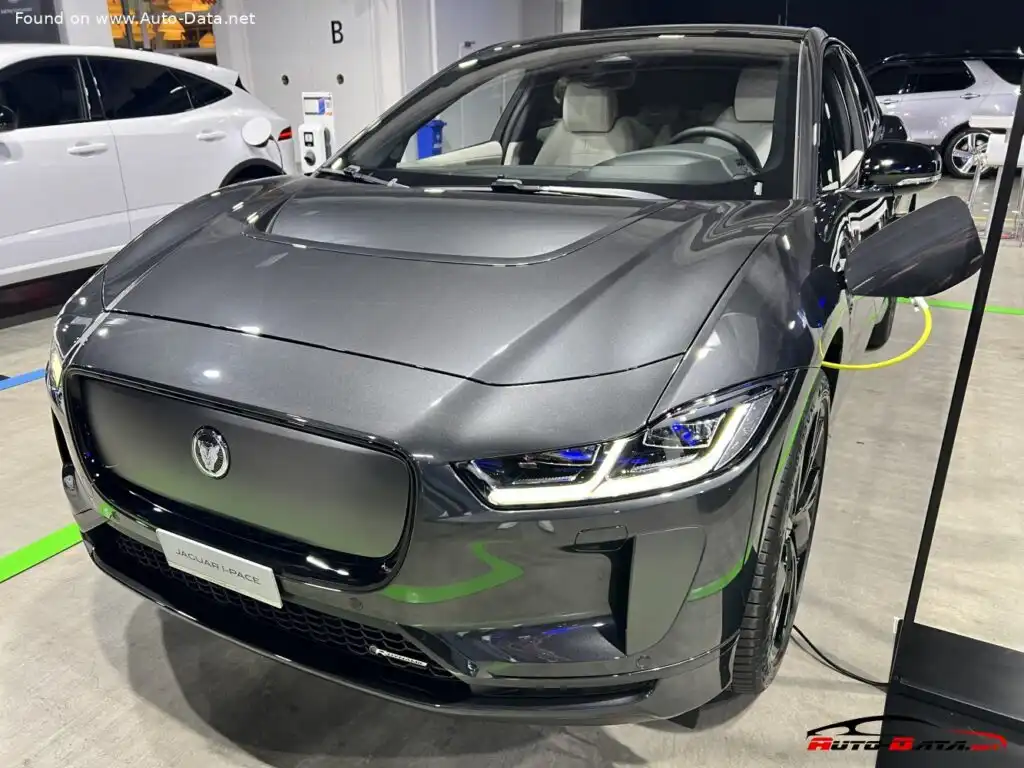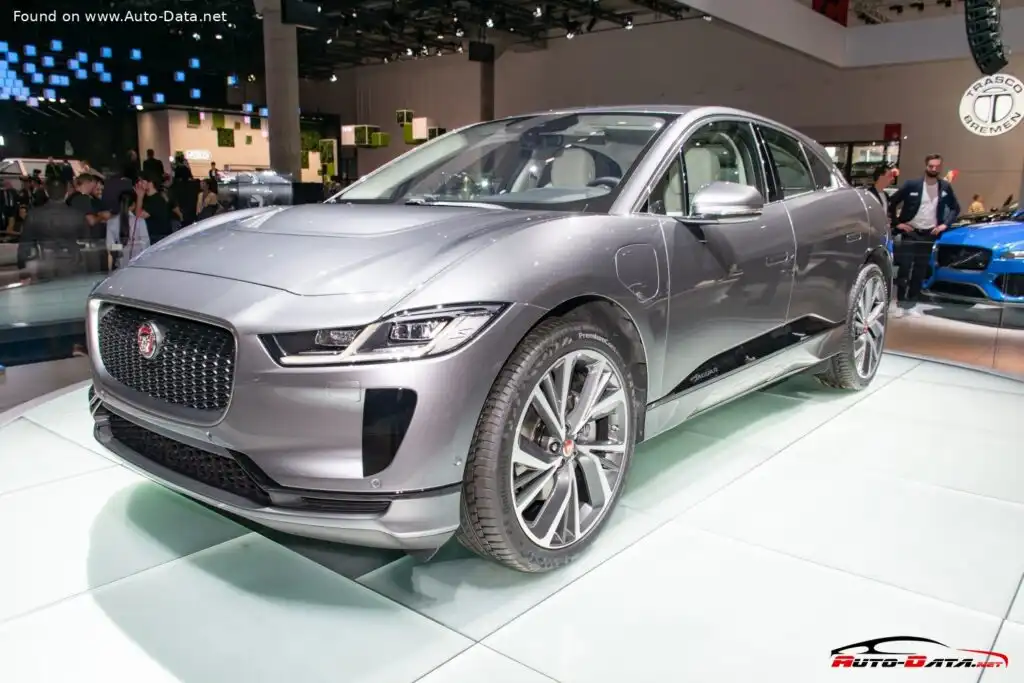
The Jaguar I-Pace EV400 90 kWh, producing 400 horsepower, represents Jaguar’s initial foray into the all-electric vehicle market. Introduced in March 2018 and continuing production through January 2023, the I-Pace aimed to blend the performance and luxury Jaguar is known for with the burgeoning demand for electric SUVs. Positioned as a premium crossover, the EV400 trim was the primary configuration offered throughout the I-Pace’s production run, establishing the model’s performance benchmark. It competed directly with vehicles like the Tesla Model X and the Porsche Taycan, aiming to offer a more traditional luxury experience within the electric SUV segment.
Technical Specifications
| Brand | Jaguar |
| Model | I-Pace |
| Generation | I-Pace |
| Type (Engine) | EV400 90 kWh (400 Hp) AWD |
| Start of production | March, 2018 |
| End of production | January, 2023 |
| Powertrain Architecture | BEV (Electric Vehicle) |
| Body type | SUV, Crossover |
| Seats | 5 |
| Doors | 5 |
| Fuel Type | Electricity |
| Acceleration 0 – 100 km/h | 4.8 sec |
| Acceleration 0 – 62 mph | 4.8 sec |
| Acceleration 0 – 60 mph | 4.5 sec |
| Maximum speed | 200 km/h (124.27 mph) |
| Weight-to-power ratio | 5.3 kg/Hp, 187.5 Hp/tonne |
| Weight-to-torque ratio | 3.1 kg/Nm, 326.3 Nm/tonne |
| Gross battery capacity | 90 kWh |
| Net (usable) battery capacity | 84.7 kWh |
| Battery voltage | 389 V |
| Battery technology | Lithium-ion (Li-Ion) |
| Battery weight | 606 kg (1336 lbs) |
| Battery location | Below the floor |
| All-electric range (WLTP) | 407-470 km (252.9 – 292.04 mi) |
| Average Energy consumption (WLTP) | 22-25.2 kWh/100 km (35.41 – 40.56 kWh/100 mi) |
| MPGe | 95 – 83 |
| km/kWh | 4.5 – 4 |
| mi/kWh | 2.8 – 2.5 |
| Electric motor power (each) | 200 Hp |
| Electric motor Torque (each) | 348 Nm (256.67 lb.-ft.) |
| Electric motor model/code | TZ204XSA |
| Maximum revolutions of the electric motor | 13000 rpm |
| Electric motor location | Front axle, Transverse & Rear axle, Transverse |
| Electric motor type | Synchronous |
| System power | 400 Hp |
| System torque | 696 Nm (513.34 lb.-ft.) |
| Kerb Weight | 2133 kg (4702.46 lbs) |
| Max. weight | 2670 kg (5886.34 lbs) |
| Max load | 537 kg (1183.88 lbs) |
| Trunk (boot) space – minimum | 505 l (17.83 cu. ft.) |
| Trunk (boot) space – maximum | 1163 l (41.07 cu. ft.) |
| Max. roof load | 75 kg (165.35 lbs) |
| Length | 4682 mm (184.33 in) |
| Width with mirrors folded | 2011 mm (79.17 in) |
| Width including mirrors | 2139 mm (84.21 in) |
| Height | 1565 mm (61.61 in) |
| Wheelbase | 2990 mm (117.72 in) |
| Front track | 1641-1643 mm (64.61 – 64.69 in) |
| Rear (Back) track | 1660-1662 mm (65.35 – 65.43 in) |
| Ride height (ground clearance) | 174 mm (6.85 in) |
| Drag coefficient (Cd) | 0.29 |
| Minimum turning circle (turning diameter) | 12.39 m (40.65 ft) |
| Approach angle | 16° |
| Departure angle | 19° |
| Ramp-over (brakeover) angle | 11.95° |
| Wading depth | 500 mm (19.69 in) |
| Drivetrain Architecture | One electric motor drives the front wheels, one electric motor drives the rear wheels. |
| Drive wheel | All wheel drive (4×4) |
| Number of gears and type of gearbox | 1 gears, automatic transmission |
| Front suspension | Double wishbone |
| Rear suspension | Independent multi-link suspension |
| Front brakes | Ventilated discs, 350 mm |
| Rear brakes | Ventilated discs, 325 mm |
| Assisting systems | ABS (Anti-lock braking system) |
| Steering type | Steering rack and pinion |
| Power steering | Electric Steering |
| Tires size | 235/65 R18; 245/50 R20 |
| Wheel rims size | 7.5J x 18; 8J x 20 |
Powertrain & Engine Architecture
The I-Pace EV400 utilizes a dual-motor, all-wheel-drive (AWD) powertrain. Each axle is driven by a permanent magnet synchronous motor (PMSM) designated TZ204XSA, producing 200 horsepower and 348 Nm (256.67 lb-ft) of torque individually. Combined, these motors deliver a total system output of 400 horsepower and 696 Nm (513.34 lb-ft) of torque. The powertrain is powered by a 90 kWh lithium-ion battery pack located beneath the vehicle floor, providing a usable capacity of 84.7 kWh. The battery operates at 389 volts. The I-Pace employs a single-speed automatic transmission for each axle, typical of electric vehicle setups, prioritizing simplicity and efficiency. The electric motors are liquid-cooled, and the battery pack features a sophisticated thermal management system to maintain optimal operating temperatures and prolong battery life.
Driving Characteristics
The I-Pace EV400 delivers brisk acceleration, achieving 0-60 mph in approximately 4.5 seconds. The instant torque characteristic of electric motors provides immediate responsiveness, making for a surprisingly engaging driving experience for an SUV. The AWD system ensures excellent traction in various conditions. While the single-speed transmission simplifies operation, it lacks the gear changes that can provide a sense of progression in traditional internal combustion engine vehicles. The I-Pace’s weight (2133 kg / 4702.46 lbs) is noticeable, particularly during cornering, but the low center of gravity due to the battery pack’s placement contributes to relatively stable handling. Regenerative braking is adjustable, allowing drivers to tailor the level of deceleration when lifting off the throttle, enhancing efficiency and extending range.
Equipment & Trim Levels
The EV400 trim came standard with a comprehensive suite of features, including leather upholstery, heated and ventilated front seats, a panoramic sunroof, a 15-speaker Meridian sound system, and a 10-inch touchscreen infotainment system with Apple CarPlay and Android Auto compatibility. Standard safety features included adaptive cruise control, lane keep assist, blind-spot monitoring, and automatic emergency braking. Optional extras included a head-up display, a digital instrument cluster, and various exterior styling enhancements. Interior color options were relatively limited, focusing on darker shades to convey a sense of luxury.
Chassis & Braking
The I-Pace utilizes a double-wishbone suspension setup at the front and an independent multi-link suspension at the rear, tuned for a balance between comfort and handling. Ventilated disc brakes are fitted to all four wheels, with 350mm rotors at the front and 325mm rotors at the rear. The braking system is augmented by an anti-lock braking system (ABS) and electronic brake-force distribution. The I-Pace’s relatively low ride height (174 mm / 6.85 in) contributes to its stability, although it limits off-road capability.
Market Reception & Comparison
The Jaguar I-Pace was generally well-received by critics, praised for its performance, handling, and luxurious interior. However, its range was often cited as a limitation compared to some competitors, particularly the Tesla Model X. Fuel economy, expressed as MPGe, ranged from 83 to 95, and energy consumption varied between 22-25.2 kWh/100 km. Compared to a hypothetical gasoline-powered Jaguar F-Pace, the I-Pace offered significantly lower running costs due to the reduced price of electricity versus gasoline, but the initial purchase price was considerably higher. Reliability reports were mixed, with some owners experiencing issues with the infotainment system and battery management system.
Legacy
The Jaguar I-Pace EV400 played a crucial role in establishing Jaguar as a contender in the electric vehicle market. While production has ceased, the I-Pace remains a desirable used car, offering a blend of performance, luxury, and technology. The powertrain, while not without its reported issues, has proven generally durable, and the availability of replacement parts is currently good. The I-Pace’s design and engineering paved the way for Jaguar’s future electric models, solidifying the brand’s commitment to electrification.