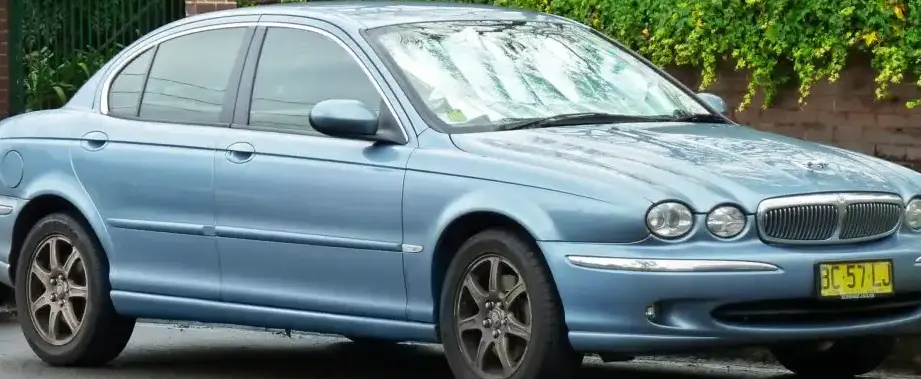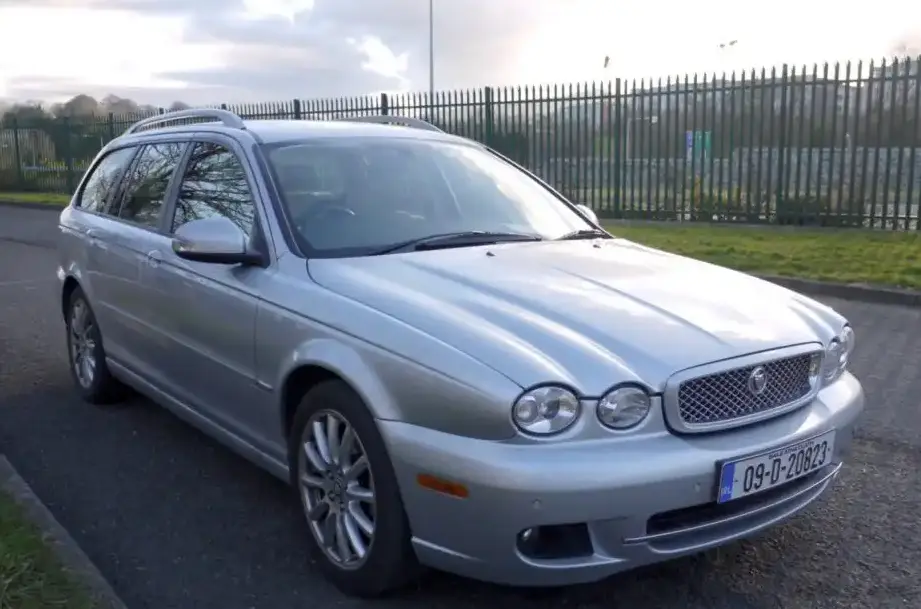
The Jaguar X-Type Estate 2.2 D, produced between 2005 and 2009, represented Jaguar’s entry into the compact executive estate (station wagon) market. Positioned as a more practical alternative to the X-Type sedan, the Estate offered increased cargo capacity while retaining the Jaguar brand’s emphasis on luxury and driving refinement. This particular variant, powered by the 2.2-liter diesel engine producing 155 horsepower, was a key model in the X-Type range, aimed at buyers seeking a balance between fuel efficiency, performance, and practicality. It was built on the Jaguar X400 platform, sharing its underpinnings with the Ford Mondeo, but distinguished by its upscale interior and Jaguar-specific tuning.
Technical Specifications
| Brand | Jaguar |
| Model | X-type |
| Generation | X-Type Estate |
| Type (Engine) | 2.2 D (155 Hp) |
| Start of production | 2005 year |
| End of production | 2009 year |
| Powertrain Architecture | Internal Combustion engine |
| Body type | Station wagon (estate) |
| Seats | 5 |
| Doors | 5 |
| Fuel consumption (economy) – urban | 8.4 l/100 km (28 US mpg, 33.6 UK mpg, 11.9 km/l) |
| Fuel consumption (economy) – extra urban | 4.9 l/100 km (48 US mpg, 57.6 UK mpg, 20.4 km/l) |
| Fuel Type | Diesel |
| Acceleration 0 – 100 km/h | 9.3 sec |
| Acceleration 0 – 62 mph | 9.3 sec |
| Acceleration 0 – 60 mph | 8.8 sec |
| Maximum speed | 215 km/h (133.59 mph) |
| Weight-to-power ratio | 10.2 kg/Hp, 98.4 Hp/tonne |
| Weight-to-torque ratio | 4.4 kg/Nm, 228.6 Nm/tonne |
| Power | 155 Hp @ 3500 rpm |
| Power per litre | 70.5 Hp/l |
| Torque | 360 Nm @ 1800 rpm (265.52 lb.-ft. @ 1800 rpm) |
| Engine layout | Front, Transverse |
| Engine Model/Code | QJBA |
| Engine displacement | 2198 cm3 (134.13 cu. in.) |
| Number of cylinders | 4 |
| Engine configuration | Inline |
| Cylinder Bore | 86 mm (3.39 in.) |
| Piston Stroke | 94.6 mm (3.72 in.) |
| Compression ratio | 17.5:1 |
| Number of valves per cylinder | 4 |
| Fuel injection system | Diesel Commonrail |
| Engine aspiration | Turbocharger, Intercooler |
| Engine oil capacity | 6 l (6.34 US qt | 5.28 UK qt) |
| Coolant | 10 l (10.57 US qt | 8.8 UK qt) |
| Kerb Weight | 1575 kg (3472.28 lbs.) |
| Max. weight | 2050 kg (4519.48 lbs.) |
| Max load | 475 kg (1047.2 lbs.) |
| Trunk (boot) space – minimum | 445 l (15.72 cu. ft.) |
| Trunk (boot) space – maximum | 1415 l (49.97 cu. ft.) |
| Fuel tank capacity | 61 l (16.11 US gal | 13.42 UK gal) |
| Length | 4716 mm (185.67 in.) |
| Width | 1789 mm (70.43 in.) |
| Height | 1483 mm (58.39 in.) |
| Wheelbase | 2710 mm (106.69 in.) |
| Front track | 1522 mm (59.92 in.) |
| Rear (Back) track | 1537 mm (60.51 in.) |
| Drivetrain Architecture | The Internal combustion engine (ICE) drives the front wheels of the vehicle. |
| Drive wheel | Front wheel drive |
| Number of gears and type of gearbox | 6 gears, manual transmission |
| Front suspension | Spring Strut |
| Rear suspension | Coil spring |
| Front brakes | Ventilated discs |
| Rear brakes | Disc |
| Assisting systems | ABS (Anti-lock braking system) |
| Steering type | Steering rack and pinion |
| Tires size | 205/55 R16 |
Powertrain & Engine Architecture
The heart of the X-Type Estate 2.2 D is the QJBA engine, a 2.2-liter inline-four cylinder diesel. This engine is part of Jaguar’s ‘AJ-D’ family of diesel engines, developed in collaboration with PSA Peugeot Citroën. It features a common rail direct injection system, delivering fuel at extremely high pressure for improved combustion efficiency and reduced emissions. A turbocharger with an intercooler further enhances performance, boosting power and torque. The engine produces 155 horsepower at 3500 rpm and a substantial 360 Nm (265 lb-ft) of torque at just 1800 rpm. This torque output is a key characteristic, providing strong pulling power from low engine speeds. The engine utilizes four valves per cylinder and a compression ratio of 17.5:1. The X-Type Estate 2.2 D was exclusively offered with a six-speed manual transmission, providing precise gear changes and contributing to the vehicle’s fuel efficiency.
Driving Characteristics
The 2.2 D engine, coupled with the six-speed manual gearbox, delivers a respectable driving experience. While not overtly sporty, the engine provides ample power for everyday driving and comfortable cruising. Acceleration from 0-60 mph takes around 8.8 seconds, and the car has a top speed of 133.59 mph. The high torque output means that overtaking maneuvers are executed with ease, and the engine feels responsive even when fully loaded. The gear ratios are well-chosen, providing a balance between acceleration and fuel economy. Compared to the higher-powered 3.0-liter V6 versions of the X-Type, the 2.2 D offers a more economical and refined driving experience, albeit with less outright performance. The manual transmission allows for greater driver engagement than an automatic would, but requires more effort in stop-and-go traffic.
Equipment & Trim Levels
The X-Type Estate 2.2 D typically came equipped with a reasonable level of standard features, reflecting Jaguar’s commitment to luxury. Standard equipment included climate control, electric windows and mirrors, a CD stereo system, and alloy wheels. Safety features such as ABS, traction control, and front airbags were also standard. Higher trim levels, such as the ‘SE’ and ‘Sport’ models, added features like leather upholstery, upgraded audio systems, and wood trim. Optional extras included satellite navigation, heated seats, and a sunroof. The interior design was generally well-appointed, with a focus on comfort and quality materials, although some critics noted that the interior felt somewhat dated compared to more modern rivals.
Chassis & Braking
The X-Type Estate’s chassis is based on the Ford EUCD platform, shared with the Ford Mondeo. The front suspension utilizes MacPherson struts, while the rear suspension employs a multi-link setup. This configuration provides a comfortable ride quality and good handling characteristics. The 2.2 D models typically featured ventilated front disc brakes and solid rear discs. ABS (Anti-lock Braking System) was standard, providing enhanced braking performance and stability. The steering is rack and pinion, offering precise control and a reasonable level of feedback. The suspension tuning was geared towards comfort rather than outright sportiness, making the X-Type Estate a pleasant car for long journeys.
Market Reception & Comparison
The Jaguar X-Type Estate 2.2 D was generally well-received by critics, who praised its practicality, refinement, and fuel efficiency. However, some reviewers criticized its relatively modest performance compared to rivals such as the BMW 3 Series Touring and Audi A4 Avant. Fuel economy was a strong point, with the 2.2 D achieving around 48 mpg on the extra-urban cycle. Reliability was generally good, although some owners reported issues with the diesel particulate filter (DPF) and the electronic parking brake. Compared to the petrol-powered X-Type models, the 2.2 D offered significantly better fuel economy and lower running costs, making it a more sensible choice for high-mileage drivers.
Legacy
The Jaguar X-Type Estate 2.2 D remains a relatively affordable and practical used car today. The QJBA engine is generally considered to be reliable, although regular maintenance is essential. The diesel particulate filter (DPF) can be a potential source of problems, particularly on cars that have spent a lot of time doing short journeys. The X-Type Estate’s blend of luxury, practicality, and fuel efficiency continues to appeal to buyers looking for a distinctive and well-equipped estate car. While it may not be as dynamically engaging as some of its rivals, the X-Type Estate 2.2 D offers a comfortable and refined driving experience, making it a worthy contender in the used car market.