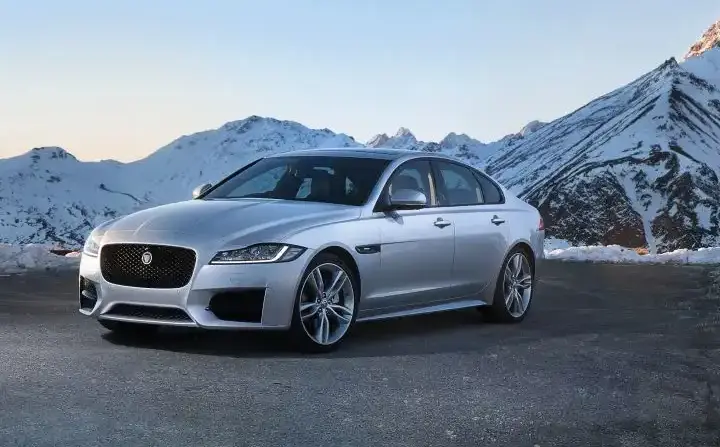
The Jaguar XF (X260) 2.0d, produced between 2015 and 2018, represented a significant step forward for Jaguar’s mid-size executive sedan. Positioned as an entry-level offering within the X260 range, it aimed to broaden the XF’s appeal by providing a more fuel-efficient and accessible option alongside the more powerful supercharged gasoline variants. This model utilized Jaguar’s all-new Ingenium engine family, marking a departure from Ford-sourced powertrains previously used. The 2.0d, with its 180 horsepower output and eight-speed automatic transmission, was primarily targeted at European and Asian markets where diesel engines held a strong preference, though it was also available in limited numbers in the United States.
Technical Specifications
| Brand | Jaguar |
| Model | XF |
| Generation | XF (X260) |
| Type (Engine) | 2.0d (180 Hp) Automatic |
| Start of production | 2015 |
| End of production | 2018 |
| Powertrain Architecture | Internal Combustion engine |
| Body type | Sedan |
| Seats | 5 |
| Doors | 4 |
| Fuel consumption (urban) | 5.1 l/100 km (46.1 US mpg) |
| Fuel consumption (extra urban) | 3.8 l/100 km (61.9 US mpg) |
| Fuel consumption (combined) | 4.3 l/100 km (54.7 US mpg) |
| CO2 emissions | 114 g/km |
| Fuel Type | Diesel |
| Acceleration 0 – 100 km/h | 8.1 sec |
| Acceleration 0 – 62 mph | 8.1 sec |
| Acceleration 0 – 60 mph | 7.7 sec |
| Maximum speed | 229 km/h (142.29 mph) |
| Emission standard | Euro 6 |
| Weight-to-power ratio | 8.9 kg/Hp |
| Weight-to-torque ratio | 3.7 kg/Nm |
| Power | 180 Hp @ 4000 rpm |
| Torque | 430 Nm @ 1750-2500 rpm (317.15 lb.-ft.) |
| Engine layout | Front, Longitudinal |
| Engine Model/Code | Ingenium / 204DTH |
| Engine displacement | 1999 cm3 (121.99 cu. in.) |
| Number of cylinders | 4 |
| Engine configuration | Inline |
| Cylinder Bore | 83 mm (3.27 in.) |
| Piston Stroke | 92.35 mm (3.64 in.) |
| Compression ratio | 15.5:1 |
| Number of valves per cylinder | 4 |
| Fuel injection system | Diesel Commonrail |
| Engine aspiration | Turbocharger, Intercooler |
| Engine oil capacity | 6.5 l (6.87 US qt | 5.72 UK qt) |
| Kerb Weight | 1595 kg (3516.37 lbs.) |
| Max. weight | 2250 kg (4960.4 lbs.) |
| Max load | 655 kg (1444.03 lbs.) |
| Trunk (boot) space – minimum | 505 l (17.83 cu. ft.) |
| Fuel tank capacity | 66 l (17.44 US gal | 14.52 UK gal) |
| Length | 4954 mm (195.04 in.) |
| Width | 1987 mm (78.23 in.) |
| Width including mirrors | 2091 mm (82.32 in.) |
| Height | 1457 mm (57.36 in.) |
| Wheelbase | 2960 mm (116.54 in.) |
| Front track | 1605 mm (63.19 in.) |
| Rear (Back) track | 1594 mm (62.76 in.) |
| Ride height (ground clearance) | 116 mm (4.57 in.) |
| Minimum turning circle | 11.61 m (38.09 ft.) |
| Drivetrain Architecture | Rear wheel drive |
| Number of gears | 8 |
| Gearbox type | Automatic transmission |
| Front brakes | Ventilated discs |
| Rear brakes | Ventilated discs |
Powertrain & Engine Architecture
The heart of the XF 2.0d is Jaguar’s Ingenium engine family. The 204DTH specifically is a 2.0-liter inline-four cylinder diesel engine. This engine was designed and built in-house by Jaguar Land Rover, representing a significant investment in powertrain technology. It features a cast aluminum block, direct injection, and a single turbocharger with an intercooler. The common rail direct injection system operates at a maximum pressure of 2,200 bar, optimizing fuel atomization and combustion efficiency. The engine utilizes a variable geometry turbocharger (VGT) to enhance low-end torque and responsiveness. The eight-speed automatic transmission, sourced from ZF, is a crucial component of the powertrain. It provides smooth and efficient gear changes, contributing to the car’s refined driving experience. The transmission features a wide gear ratio spread, optimizing both acceleration and fuel economy.
Driving Characteristics
The 180 horsepower and 430 Nm (317 lb-ft) of torque delivered by the 2.0d engine provide adequate performance for everyday driving. Acceleration from 0-60 mph takes approximately 7.7 to 8.1 seconds, depending on testing conditions. While not as exhilarating as the supercharged six-cylinder models, the 2.0d offers a comfortable and relaxed driving experience. The eight-speed automatic transmission is well-programmed, providing seamless shifts and contributing to a smooth ride. Compared to the manual transmission options available on other XF models, the automatic prioritizes convenience and ease of use. The rear-wheel-drive configuration provides a balanced handling characteristic, though it lacks the all-wheel-drive stability offered on higher-spec models. The engine’s torque is readily available from low RPMs, making it well-suited for overtaking maneuvers on the highway.
Equipment & Trim Levels
The XF 2.0d typically came equipped with a generous level of standard features. These included leather upholstery, dual-zone climate control, an 8-inch touchscreen infotainment system, and a suite of safety features such as autonomous emergency braking and lane departure warning. Optional extras included a panoramic sunroof, premium sound system, heated seats, and adaptive cruise control. Trim levels varied by market, but generally, the 2.0d served as the entry point to the XF range, with higher trims offering more luxurious appointments and additional technology. Interior upholstery was typically leather, though the specific grade and color options varied. The dashboard layout was consistent across the XF range, featuring a clean and modern design.
Chassis & Braking
The XF 2.0d utilizes a sophisticated chassis design, featuring an aluminum double wishbone front suspension and a multi-link rear suspension. This setup provides a comfortable ride while maintaining good handling characteristics. Braking duties are handled by ventilated discs on all four wheels, providing ample stopping power. Anti-lock Braking System (ABS) and Electronic Stability Control (ESC) are standard features, enhancing safety. The suspension tuning is geared towards comfort, but the XF still offers a reasonably engaging driving experience. Stabilizer bars are fitted front and rear to reduce body roll during cornering.
Market Reception & Comparison
The XF 2.0d was generally well-received by automotive critics. It was praised for its fuel efficiency, comfortable ride, and refined interior. However, some reviewers noted that the engine lacked the outright performance of the higher-spec models. Compared to the XF 3.0d (with its more powerful diesel engine), the 2.0d offered a more affordable entry point into the XF range, but at the expense of performance. Against competitors such as the BMW 5 Series and Audi A6, the XF 2.0d offered a compelling combination of style, comfort, and value. Fuel economy was a key selling point, with the 2.0d achieving combined fuel consumption figures of around 54.7 US mpg.
Legacy
The Ingenium engine family proved to be a reliable and durable powertrain. The 2.0d variant, while not the most powerful XF engine, has demonstrated good long-term reliability. In the used car market, the XF 2.0d represents a relatively affordable option for those seeking a luxurious and comfortable executive sedan. Maintenance costs are generally reasonable, and parts availability is good. The XF 2.0d’s success helped to establish Jaguar as a serious competitor in the mid-size executive car segment, and the Ingenium engine family continues to power many of Jaguar Land Rover’s current models.