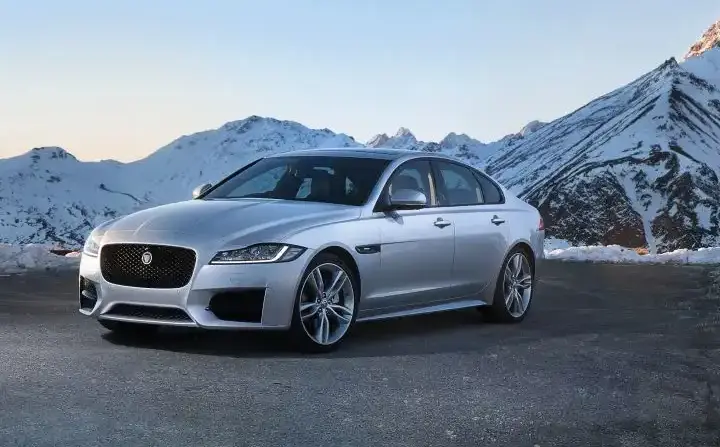
The Jaguar XF (X260) E-Performance 2.0d, produced from 2019 to October 2020, represented a key entry point into the second-generation XF lineup. Positioned as a more fuel-efficient alternative to the higher-powered six-cylinder models, this variant aimed to broaden the XF’s appeal in the executive sedan segment, particularly in European markets where diesel engines remained popular. It utilized Jaguar Land Rover’s Ingenium engine family and an eight-speed automatic transmission, offering a balance of performance and economy within the XF range. This model served as a bridge between luxury and practicality, targeting buyers seeking a refined driving experience without the higher running costs associated with larger engines.
Technical Specifications
| Brand | Jaguar |
| Model | XF |
| Generation | XF (X260) |
| Type (Engine) | E-Performance 2.0d (163 Hp) Automatic |
| Start of production | 2019 |
| End of production | October, 2020 |
| Powertrain Architecture | Internal Combustion engine |
| Body type | Sedan |
| Seats | 5 |
| Doors | 4 |
| Fuel consumption (urban) | 6.5 l/100 km (36.2 US mpg, 43.5 UK mpg, 15.4 km/l) |
| Fuel consumption (extra urban) | 4.3 l/100 km (54.7 US mpg, 65.7 UK mpg, 23.3 km/l) |
| Fuel consumption (combined) | 5.1 l/100 km (46.1 US mpg, 55.4 UK mpg, 19.6 km/l) |
| CO2 emissions | 135 g/km |
| Fuel Type | Diesel |
| Acceleration 0 – 100 km/h | 9.1 sec |
| Acceleration 0 – 62 mph | 9.1 sec |
| Acceleration 0 – 60 mph | 8.6 sec |
| Maximum speed | 227 km/h (141.05 mph) |
| Emission standard | Euro 6d-Temp |
| Weight-to-power ratio | 10.1 kg/Hp, 99.1 Hp/tonne |
| Weight-to-torque ratio | 4.3 kg/Nm, 231 Nm/tonne |
| Power | 163 Hp @ 4000 rpm |
| Power per litre | 81.5 Hp/l |
| Torque | 380 Nm @ 1750-2500 rpm (280.27 lb.-ft. @ 1750-2500 rpm) |
| Engine layout | Front, Longitudinal |
| Engine Model/Code | Ingenium / 204DTD |
| Engine displacement | 1999 cm3 (121.99 cu. in.) |
| Number of cylinders | 4 |
| Engine configuration | Inline |
| Cylinder Bore | 83 mm (3.27 in.) |
| Piston Stroke | 92.4 mm (3.64 in.) |
| Compression ratio | 15.5:1 |
| Number of valves per cylinder | 4 |
| Fuel injection system | Diesel Commonrail |
| Engine aspiration | Turbocharger, Intercooler |
| Engine oil capacity | 6.5 l (6.87 US qt | 5.72 UK qt) |
| Kerb Weight | 1645 kg (3626.6 lbs.) |
| Max. weight | 2230 kg (4916.31 lbs.) |
| Max load | 585 kg (1289.7 lbs.) |
| Fuel tank capacity | 55 l (14.53 US gal | 12.1 UK gal) |
| Permitted trailer load with brakes (12%) | 1600 kg (3527.4 lbs.) |
| Permitted trailer load without brakes | 750 kg (1653.47 lbs.) |
| Length | 4954 mm (195.04 in.) |
| Width | 1987 mm (78.23 in.) |
| Width including mirrors | 2091 mm (82.32 in.) |
| Height | 1457 mm (57.36 in.) |
| Wheelbase | 2960 mm (116.54 in.) |
| Front track | 1605 mm (63.19 in.) |
| Rear (Back) track | 1594 mm (62.76 in.) |
| Ride height (ground clearance) | 116 mm (4.57 in.) |
| Minimum turning circle (turning diameter) | 11.94 m (39.17 ft.) |
| Drivetrain Architecture | The Internal combustion engine (ICE) drives the rear wheels of the vehicle. |
| Drive wheel | Rear wheel drive |
| Number of gears and type of gearbox | 8 gears, automatic transmission |
| Front brakes | Disc |
| Rear brakes | Disc |
| Assisting systems | ABS (Anti-lock braking system) |
| Tires size | 225/55 R17; 245/45R18 |
| Wheel rims size | 7.5J x 17; 8J x 18 |
INTRODUCTION
The Jaguar XF (X260) E-Performance 2.0d, launched in 2019 as part of the X260 series facelift, offered a more accessible entry point into the XF range. Built on the Jaguar’s aluminum-intensive architecture, the X260 generation aimed to combine sporting dynamics with luxurious comfort. This 2.0d variant, powered by the Ingenium engine, was specifically designed to appeal to buyers prioritizing fuel efficiency and lower running costs. It occupied the lower-mid range of the XF lineup, sitting below the more powerful 2.0i petrol and 3.0d diesel models. The X260 series represented a significant update to the original XF, with revised styling, enhanced technology, and a focus on improving the overall driving experience.
Powertrain & Engine Architecture
At the heart of the XF 2.0d lies Jaguar Land Rover’s Ingenium engine family. Specifically, it utilizes the 204DTD code, a 2.0-liter inline-four cylinder diesel engine. This engine features a sophisticated turbocharger and direct injection system, delivering 163 horsepower at 4000 rpm and 380 Nm (280 lb-ft) of torque between 1750 and 2500 rpm. The engine employs a common-rail diesel injection system operating at extremely high pressures to optimize combustion efficiency and reduce emissions. The Ingenium engine is notable for its modular design, allowing for flexibility in manufacturing and future development. Paired with the engine is a ZF-sourced eight-speed automatic transmission, known for its smooth shifts and efficiency. This transmission is electronically controlled and adapts to driving conditions, optimizing gear selection for performance or fuel economy. The transmission’s gear ratios are tuned to maximize the engine’s torque output, providing responsive acceleration in everyday driving situations.
Driving Characteristics
The XF 2.0d Automatic delivers a comfortable and refined driving experience, prioritizing smoothness and ease of use over outright performance. While not as quick as its higher-powered siblings, the 2.0d offers sufficient power for most driving scenarios. Acceleration from 0-60 mph takes approximately 8.6 seconds, and the car reaches a top speed of 141 mph. The eight-speed automatic transmission contributes to a relaxed cruising experience, with well-spaced gear ratios minimizing engine noise at highway speeds. Compared to the manual transmission versions (not widely available in the US market), the automatic offers greater convenience, particularly in urban traffic. However, it does slightly diminish the sense of driver engagement. Compared to the 3.0d models, the 2.0d feels less urgent in its acceleration, but the difference is often negligible in real-world driving conditions. The rear-wheel-drive configuration provides a balanced handling characteristic, contributing to the XF’s overall composure on the road.
Equipment & Trim Levels
The XF 2.0d typically came equipped with a generous level of standard features. These included leather upholstery, a touchscreen infotainment system with navigation, automatic climate control, and a suite of safety features such as autonomous emergency braking and lane departure warning. Trim levels varied depending on the market, but generally included SE, HSE, and Portfolio options. Higher trim levels added features like premium leather, upgraded audio systems, and adaptive cruise control. Optional extras included a panoramic sunroof, heated seats, and a head-up display. The interior design of the XF 2.0d focused on creating a luxurious and comfortable environment, with high-quality materials and a well-designed dashboard layout. The standard dashboard configuration featured analog gauges complemented by a digital display screen.
Chassis & Braking
The XF 2.0d utilizes a sophisticated chassis design, featuring an aluminum suspension and a lightweight body structure. The front suspension employs double wishbones, while the rear suspension utilizes a multi-link setup. This configuration provides a good balance of ride comfort and handling precision. The braking system consists of disc brakes on all four wheels, providing ample stopping power. Anti-lock Braking System (ABS) and Electronic Stability Control (ESC) are standard features, enhancing safety and control. The XF 2.0d typically came equipped with 17 or 18-inch alloy wheels, depending on the trim level. The suspension tuning is geared towards providing a comfortable ride, but it also offers a reasonable level of body control in corners. Stabilizer bars are fitted to both the front and rear axles to reduce body roll.
Market Reception & Comparison
The Jaguar XF 2.0d was generally well-received by automotive critics, who praised its fuel efficiency, comfortable ride, and refined interior. However, some reviewers noted that the engine lacked the punch of the higher-powered alternatives. Compared to its rivals, such as the BMW 5 Series and Mercedes-Benz E-Class, the XF 2.0d offered a compelling combination of luxury, performance, and value. In terms of fuel economy, the XF 2.0d consistently outperformed its six-cylinder competitors. Reliability reports suggest that the Ingenium engine is generally reliable, although some owners have reported minor issues with the diesel particulate filter (DPF). The 2.0d was positioned as a more practical and economical alternative to the more expensive XF models, appealing to buyers who prioritized fuel efficiency and lower running costs.
Legacy
The Jaguar XF 2.0d, while not the most iconic version of the XF, played a crucial role in broadening the model’s appeal. The Ingenium engine proved to be a reliable and efficient powerplant, and the XF 2.0d remains a popular choice in the used car market. Its combination of luxury, comfort, and fuel economy makes it an attractive option for buyers seeking a refined executive sedan. As with any diesel vehicle, proper maintenance of the DPF is essential to ensure long-term reliability. Today, well-maintained examples of the XF 2.0d can be found at reasonable prices, offering a compelling value proposition for those seeking a sophisticated and comfortable driving experience.