Technical Specifications
| Brand | Jaguar |
| Model | XJ |
| Generation | XJ (X350) |
| Type (Engine) | 4.2 V8 32V (400 Hp) Automatic |
| Start of production | 2003 |
| End of production | 2006 |
| Powertrain Architecture | Internal Combustion engine |
| Body type | Sedan |
| Seats | 5 |
| Doors | 4 |
| Fuel consumption (economy) – urban | 18.6 l/100 km (12.6 US mpg, 15.2 UK mpg, 5.4 km/l) |
| Fuel consumption (economy) – extra urban | 9 l/100 km (26.1 US mpg, 31.4 UK mpg, 11.1 km/l) |
| Fuel consumption (economy) – combined | 12.3 l/100 km (19.1 US mpg, 23 UK mpg, 8.1 km/l) |
| Fuel Type | Petrol (Gasoline) |
| Acceleration 0 – 100 km/h | 5.3 sec |
| Acceleration 0 – 62 mph | 5.3 sec |
| Acceleration 0 – 60 mph | 5 sec |
| Maximum speed | 250 km/h (155.34 mph) |
| Weight-to-power ratio | 4.2 kg/Hp, 240.2 Hp/tonne |
| Weight-to-torque ratio | 3.1 kg/Nm, 324.9 Nm/tonne |
| Power | 400 Hp @ 6100 rpm |
| Power per litre | 95.3 Hp/l |
| Torque | 541 Nm @ 3500 rpm (399.02 lb.-ft. @ 3500 rpm) |
| Engine layout | Front, Longitudinal |
| Engine Model/Code | AJ33S, AJ34S |
| Engine displacement | 4196 cm3 (256.06 cu. in.) |
| Number of cylinders | 8 |
| Engine configuration | V-engine |
| Cylinder Bore | 86 mm (3.39 in.) |
| Piston Stroke | 90.3 mm (3.56 in.) |
| Compression ratio | 9.1:1 |
| Number of valves per cylinder | 4 |
| Fuel injection system | Multi-port manifold injection |
| Engine aspiration | Supercharger, Intercooler |
| Engine oil capacity | 6 l (6.34 US qt | 5.28 UK qt) |
| Coolant | 9.45 l (9.99 US qt | 8.31 UK qt) |
| Kerb Weight | 1665 kg (3670.7 lbs.) |
| Max. weight | 2250 kg (4960.4 lbs.) |
| Max load | 585 kg (1289.7 lbs.) |
| Trunk (boot) space – minimum | 470 l (16.6 cu. ft.) |
| Fuel tank capacity | 85 l (22.45 US gal | 18.7 UK gal) |
| Length | 5090 mm (200.39 in.) |
| Width | 1860 mm (73.23 in.) |
| Height | 1448 mm (57.01 in.) |
| Wheelbase | 3034 mm (119.45 in.) |
| Front track | 1556 mm (61.26 in.) |
| Rear (Back) track | 1546 mm (60.87 in.) |
| Drivetrain Architecture | The Internal combustion engine (ICE) drives the rear wheels of the vehicle. |
| Drive wheel | Rear wheel drive |
| Number of gears and type of gearbox | 6 gears, automatic transmission |
| Front suspension | Hydro-pneumatic element |
| Rear suspension | Hydro-pneumatic element |
| Front brakes | Ventilated discs |
| Rear brakes | Ventilated discs |
| Assisting systems | ABS (Anti-lock braking system) |
| Steering type | Steering rack and pinion |
| Tires size | 255/40 R19 |
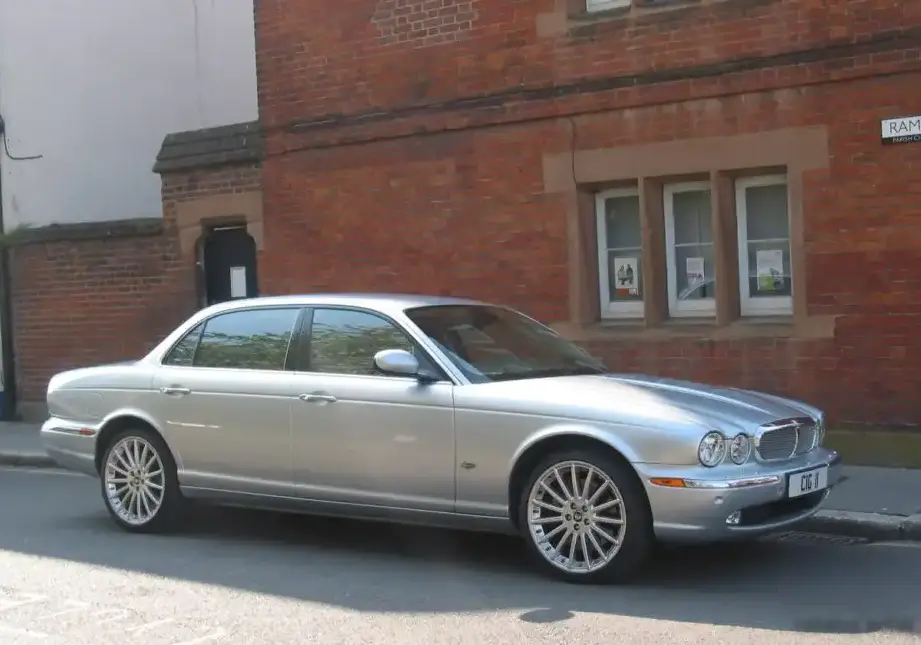
The Jaguar XJ (X350) 4.2 V8 32V, produced between 2003 and 2006, marked a significant leap forward for Jaguar’s flagship sedan. Positioned as a premium offering within the X350 generation (2003-2009), this variant blended traditional Jaguar luxury with cutting-edge technology. It was the initial launch engine for the X350, establishing the model’s sophisticated character. A key innovation was the move to a full aluminum body structure – a first for a volume production sedan – designed to reduce weight and enhance rigidity. This 4.2-liter V8, initially paired exclusively with a six-speed automatic transmission, catered to buyers seeking a powerful, refined, and technologically advanced luxury vehicle.
Powertrain & Engine Architecture
The heart of the XJ 4.2 V8 was the AJ33S engine, later superseded by the AJ34S. This 4.2-liter, naturally aspirated V8 engine featured a 90-degree V-angle, contributing to its inherently smooth operation. A crucial element was the addition of a supercharger, providing a substantial boost in both power and torque. The supercharger, a Lysholm-type twin-screw unit, delivered immediate response and a broad, usable torque curve. Fuel delivery was managed by a multi-port fuel injection system, ensuring precise fuel metering. The engine boasted four valves per cylinder, enhancing volumetric efficiency and contributing to its high specific output. The six-speed automatic transmission, a ZF 6HP26, was specifically calibrated to handle the engine’s considerable torque. This transmission offered smooth shifts and a wide range of gear ratios, optimizing both performance and fuel economy. The transmission incorporated a torque converter lock-up clutch, further improving efficiency during steady-state cruising.
Driving Characteristics
The combination of 400 horsepower and 399 lb-ft of torque, delivered by the 4.2 V8 and the six-speed automatic, resulted in brisk acceleration. The 0-60 mph sprint was consistently achieved in around 5 seconds, making it a genuinely quick luxury sedan for its time. The automatic transmission, while smooth, wasn’t particularly sporty in its default settings. However, the ‘Sport’ mode sharpened throttle response and held gears longer, providing a more engaging driving experience. Compared to the later 4.2-liter naturally aspirated (non-supercharged) versions, the supercharged model offered a substantial performance advantage. The supercharger effectively eliminated torque gaps, providing effortless acceleration at any speed. While the 4.2 V8 automatic wasn’t the most fuel-efficient option in its class, the performance benefits were generally considered a worthwhile trade-off by owners.
Equipment & Trim Levels
The XJ 4.2 V8 typically came generously equipped, reflecting its status as a flagship model. Standard features included leather upholstery, wood veneer trim, automatic climate control, a premium sound system, and power-adjustable seats. Optional extras included a rear seat entertainment system, upgraded leather options, and various exterior styling enhancements. The XJ range offered different trim levels, with the 4.2 V8 often serving as the foundation for higher-specification models. Interior color schemes were customizable, allowing buyers to personalize their vehicles. The dashboard layout was characterized by a blend of traditional analog gauges and a central information screen.
Chassis & Braking
The XJ (X350) benefited significantly from its all-aluminum body structure, which substantially reduced weight compared to previous generations. The suspension system utilized a sophisticated hydro-pneumatic setup, providing a remarkably smooth and comfortable ride. This system allowed for adjustable ride height and damping, adapting to varying road conditions. Braking duties were handled by ventilated disc brakes on all four wheels, coupled with an anti-lock braking system (ABS) and electronic brakeforce distribution (EBD). The XJ 4.2 V8 featured larger brake rotors and calipers compared to lower-spec models, providing enhanced stopping power.
Market Reception & Comparison
The XJ 4.2 V8 was generally well-received by automotive critics. Praise was directed towards its powerful engine, luxurious interior, and comfortable ride quality. However, some reviewers noted the relatively high fuel consumption and the complexity of the electronic systems. Compared to rivals such as the BMW 7 Series and Mercedes-Benz S-Class, the XJ offered a unique blend of British character and technological innovation. The supercharged 4.2 V8 offered a performance advantage over many of its competitors, but it also carried a higher price tag. Reliability was generally good, although the complex electronic systems could occasionally require attention.
Legacy
The Jaguar XJ (X350) 4.2 V8 32V remains a desirable classic among Jaguar enthusiasts. The AJ33S/AJ34S engine is known for its robustness when properly maintained, although the timing chain tensioners are a known weak point and often require preventative replacement. The aluminum body structure, while innovative, can be expensive to repair in the event of damage. Today, well-maintained examples command a premium in the used car market, appealing to buyers who appreciate the combination of luxury, performance, and British heritage. The X350 generation, and particularly the 4.2 V8 variant, represents a high point in Jaguar’s engineering and design history.