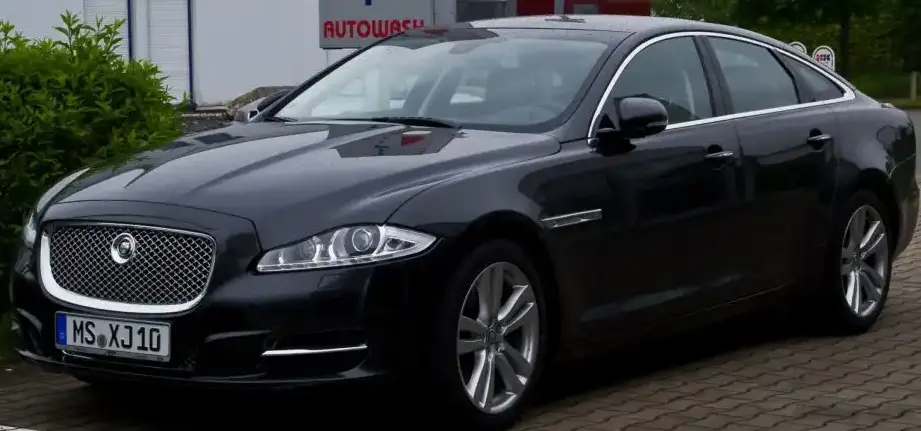
The Jaguar XJ (X351) 2.0, produced from 2012 to 2015, represented a significant shift for the flagship Jaguar sedan. While traditionally powered by larger displacement engines, Jaguar introduced a turbocharged 2.0-liter four-cylinder option to broaden the XJ’s appeal and improve fuel efficiency. This variant, producing 240 horsepower, was primarily aimed at markets where taxation favored smaller engines, and offered a more economical entry point into XJ ownership without entirely sacrificing the luxury and refinement the model was known for. It sat as the entry-level engine option in the X351 range, below the supercharged 3.0-liter V6 and the range-topping 5.0-liter V8 models.
Technical Specifications
| Brand | Jaguar |
| Model | XJ |
| Generation | XJ (X351) |
| Type (Engine) | 2.0 (240 Hp) Automatic |
| Start of production | 2012 |
| End of production | 2015 |
| Powertrain Architecture | Internal Combustion engine |
| Body type | Sedan |
| Seats | 5 |
| Doors | 4 |
| Fuel consumption (economy) – urban | 11.7 l/100 km (20.1 US mpg, 24.1 UK mpg, 8.5 km/l) |
| Fuel consumption (economy) – extra urban | 6.7 l/100 km (35.1 US mpg, 42.2 UK mpg, 14.9 km/l) |
| Fuel consumption (economy) – combined | 8.5 l/100 km (27.7 US mpg, 33.2 UK mpg, 11.8 km/l) |
| CO2 emissions | 199 g/km |
| Fuel Type | Petrol (Gasoline) |
| Acceleration 0 – 100 km/h | 7.5 sec |
| Acceleration 0 – 62 mph | 7.5 sec |
| Acceleration 0 – 60 mph | 7.1 sec |
| Maximum speed | 241 km/h (149.75 mph) |
| Weight-to-power ratio | 6.9 kg/Hp, 144.6 Hp/tonne |
| Weight-to-torque ratio | 4.9 kg/Nm, 204.8 Nm/tonne |
| Power | 240 Hp @ 5500 rpm |
| Power per litre | 120.1 Hp/l |
| Torque | 340 Nm @ 2000-4000 rpm (250.77 lb.-ft. @ 2000-4000 rpm) |
| Engine layout | Front, Longitudinal |
| Engine Model/Code | EcoBoost / 204PT |
| Engine displacement | 1999 cm3 (121.99 cu. in.) |
| Number of cylinders | 4 |
| Engine configuration | Inline |
| Cylinder Bore | 87.5 mm (3.44 in.) |
| Piston Stroke | 83.1 mm (3.27 in.) |
| Fuel injection system | Direct injection |
| Engine aspiration | Turbocharger, Intercooler |
| Engine oil capacity | 5.4 l (5.71 US qt | 4.75 UK qt) |
| Coolant | 8.1 l (8.56 US qt | 7.13 UK qt) |
| Kerb Weight | 1660 kg (3659.67 lbs.) |
| Max. weight | 2260 kg (4982.45 lbs.) |
| Max load | 600 kg (1322.77 lbs.) |
| Trunk (boot) space – minimum | 520 l (18.36 cu. ft.) |
| Fuel tank capacity | 82 l (21.66 US gal | 18.04 UK gal) |
| Length | 5127 mm (201.85 in.) |
| Width | 1899 mm (74.76 in.) |
| Width including mirrors | 2105 mm (82.87 in.) |
| Height | 1456 mm (57.32 in.) |
| Wheelbase | 3032 mm (119.37 in.) |
| Front track | 1626 mm (64.02 in.) |
| Rear (Back) track | 1604 mm (63.15 in.) |
| Minimum turning circle | 11.9 m (39.04 ft.) |
| Drivetrain Architecture | Rear wheel drive |
| Drive wheel | Rear wheel drive |
| Number of gears and type of gearbox | 8 gears, automatic transmission |
| Front brakes | Ventilated discs |
| Rear brakes | Ventilated discs |
| Assisting systems | ABS (Anti-lock braking system) |
| Steering type | Steering rack and pinion |
| Wheel rims size | 8.0J x 18; 9.0J x 19; 9.0J x 20 |
Powertrain & Engine Architecture
The XJ 2.0 utilized Ford’s EcoBoost 2.0-liter inline-four cylinder engine, a powerplant also found in various Ford and Lincoln models. This engine, designated as 204PT by Jaguar, featured direct fuel injection and a single twin-scroll turbocharger with an intercooler. The engine’s aluminum block and cylinder head contributed to its relatively lightweight design. The engine produced its peak power of 240 hp at 5500 rpm and 340 Nm (250.77 lb-ft) of torque between 2000 and 4000 rpm. This torque band was designed to provide ample power for everyday driving and overtaking maneuvers. The engine was paired exclusively with an eight-speed automatic transmission, sourced from ZF. This transmission offered smooth shifts and contributed to the XJ’s refined driving experience. The transmission’s gear ratios were tuned to balance performance and fuel economy, with a relatively tall final drive to aid efficiency.
Driving Characteristics
The 2.0-liter XJ offered a different driving experience compared to its six and eight-cylinder siblings. While it didn’t possess the outright acceleration of the higher-powered models, it still delivered a respectable 0-60 mph time of around 7.1 seconds. The turbocharger provided a noticeable boost in power, but some turbo lag was present, particularly at lower engine speeds. The eight-speed automatic transmission generally shifted smoothly and responsively, but could occasionally feel hesitant during quick downshifts. Compared to the manual transmissions available on other XJ models (though not with this engine), the automatic prioritized comfort and ease of use over driver engagement. The weight distribution, typical of a front-engine, rear-wheel-drive sedan, contributed to balanced handling, but the 2.0-liter XJ felt less eager to change direction than the lighter, more powerful variants.
Equipment & Trim Levels
The 2.0-liter XJ typically came well-equipped, reflecting Jaguar’s commitment to luxury. Standard features included leather upholstery, wood veneer trim, a touchscreen infotainment system, automatic climate control, and a suite of safety features like ABS, traction control, and multiple airbags. Optional extras included a panoramic sunroof, upgraded audio systems (often by Meridian), rear-seat entertainment, and various driver-assistance technologies. Trim levels varied by market, but generally followed a progression from base models to more luxurious Portfolio or Premium trims. Higher trims offered more extensive leather coverage, upgraded interior materials, and additional features as standard.
Chassis & Braking
The XJ (X351) utilized an aluminum monocoque chassis, a pioneering feature for a production sedan at the time, contributing to its relatively low weight. The suspension system consisted of double wishbones at the front and a multi-link setup at the rear, providing a comfortable and controlled ride. The 2.0-liter models typically featured ventilated disc brakes on all four wheels, providing adequate stopping power. ABS (Anti-lock Braking System) was standard. Stabilizer bars were fitted front and rear to reduce body roll during cornering, though the thickness of these bars was often slightly smaller on the 2.0-liter models compared to the higher-performance variants.
Market Reception & Comparison
The 2.0-liter XJ received mixed reviews. Critics acknowledged its improved fuel economy and lower price point compared to the other XJ models, but some questioned whether the four-cylinder engine was a suitable fit for a flagship luxury sedan. The fuel economy, averaging around 27.7 US mpg combined, was a significant improvement over the V6 and V8 models. However, some reviewers found the engine lacked the refinement and effortless power expected of an XJ. Compared to rivals like the BMW 5 Series and Mercedes-Benz E-Class, the XJ 2.0 offered a unique combination of luxury and efficiency, but often lagged behind in terms of outright performance.
Legacy
The 2.0-liter XJ (X351) represents an interesting chapter in the XJ’s history. While it wasn’t a massive sales success, it demonstrated Jaguar’s willingness to adapt to changing market demands and offer a more fuel-efficient option. On the used car market, these models are generally more affordable than their six and eight-cylinder counterparts. The EcoBoost engine has proven to be relatively reliable, although regular maintenance is crucial. Potential buyers should be aware of potential issues with the turbocharger and fuel injectors. Overall, the XJ 2.0 offers a compelling value proposition for those seeking a luxurious and refined sedan with reasonable running costs.