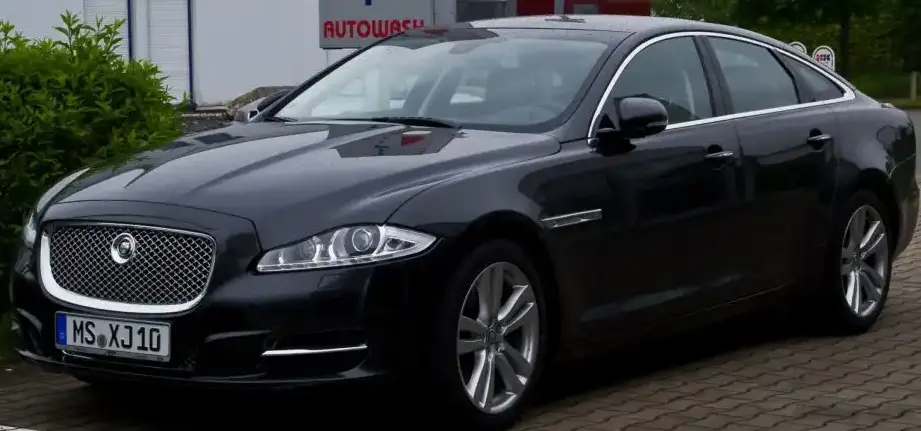
The Jaguar XJ (X351) 3.0 V6 Supercharged Automatic, produced from 2012 to 2015, represented a significant evolution of Jaguar’s flagship sedan. Part of the third generation (X351) XJ series, this variant occupied a key position in the lineup, offering a compelling blend of performance, luxury, and technology. It served as a bridge between the entry-level naturally aspirated models and the high-performance XJR, appealing to buyers seeking a refined yet spirited driving experience. The X351 generation marked a departure from the traditional XJ aesthetic, embracing a more modern and streamlined design while retaining the model’s inherent elegance.
Technical Specifications
| Brand | Jaguar |
| Model | XJ |
| Generation | XJ (X351) |
| Type (Engine) | 3.0 V6 Supercharged (340 Hp) Automatic |
| Start of production | 2012 |
| End of production | 2015 |
| Powertrain Architecture | Internal Combustion engine |
| Body type | Sedan |
| Seats | 5 |
| Doors | 4 |
| Fuel consumption (economy) – urban (NEDC) | 13.5 l/100 km (17.4 US mpg, 20.9 UK mpg, 7.4 km/l) |
| Fuel consumption (economy) – extra urban (NEDC) | 7.4 l/100 km (31.8 US mpg, 38.2 UK mpg, 13.5 km/l) |
| Fuel consumption (economy) – combined (NEDC) | 9.6 l/100 km (24.5 US mpg, 29.4 UK mpg, 10.4 km/l) |
| CO2 emissions (NEDC) | 224 g/km |
| Fuel Type | Petrol (Gasoline) |
| Acceleration 0 – 100 km/h | 5.9 sec |
| Acceleration 0 – 62 mph | 5.9 sec |
| Acceleration 0 – 60 mph | 5.7 sec |
| Maximum speed | 250 km/h (155.34 mph), Electronically limited |
| Emission standard | Euro 5 |
| Weight-to-power ratio | 5.1 kg/Hp, 194.5 Hp/tonne |
| Weight-to-torque ratio | 3.9 kg/Nm, 257.4 Nm/tonne |
| Power | 340 Hp @ 6500 rpm |
| Power per litre | 113.5 Hp/l |
| Torque | 450 Nm @ 3500-5000 rpm (331.9 lb.-ft. @ 3500-5000 rpm) |
| Engine layout | Front, Longitudinal |
| Engine Model/Code | 306PS |
| Engine displacement | 2995 cm3 (182.77 cu. in.) |
| Number of cylinders | 6 |
| Engine configuration | V-engine |
| Cylinder Bore | 84.5 mm (3.33 in.) |
| Piston Stroke | 89 mm (3.5 in.) |
| Compression ratio | 10.5:1 |
| Number of valves per cylinder | 4 |
| Fuel injection system | Direct injection |
| Engine aspiration | Supercharger, Intercooler |
| Valvetrain | DOHC |
| Engine oil capacity | 7.25 l (7.66 US qt | 6.38 UK qt) |
| Coolant | 8.6 l (9.09 US qt | 7.57 UK qt) |
| Kerb Weight | 1748 kg (3853.68 lbs.) |
| Max. weight | 2350 kg (5180.86 lbs.) |
| Max load | 602 kg (1327.18 lbs.) |
| Trunk (boot) space – minimum | 520 l (18.36 cu. ft.) |
| Fuel tank capacity | 82 l (21.66 US gal | 18.04 UK gal) |
| Length | 5127 mm (201.85 in.) |
| Width | 1899 mm (74.76 in.) |
| Width with mirrors folded | 1950 mm (76.77 in.) |
| Width including mirrors | 2105 mm (82.87 in.) |
| Height | 1456 mm (57.32 in.) |
| Wheelbase | 3032 mm (119.37 in.) |
| Front track | 1626 mm (64.02 in.) |
| Rear (Back) track | 1604 mm (63.15 in.) |
| Minimum turning circle (turning diameter) | 11.9 m (39.04 ft.) |
| Drivetrain Architecture | The Internal combustion engine (ICE) drives the rear wheels of the vehicle. |
| Drive wheel | Rear wheel drive |
| Number of gears and type of gearbox | 8 gears, automatic transmission |
| Front suspension | Coil spring, Double wishbone, Transverse stabilizer |
| Rear suspension | Independent multi-link suspension, Air suspension, Transverse stabilizer |
| Front brakes | Ventilated discs, 355 mm |
| Rear brakes | Ventilated discs, 326 mm |
| Assisting systems | ABS (Anti-lock braking system) |
| Steering type | Steering rack and pinion |
| Power steering | Hydraulic Steering |
| Tires size | Front wheel tires: 245/45 R19; 245/40 R20Rear wheel tires: 275/40 R19; 275/35 R20 |
| Wheel rims size | Front wheel rims: 9J x 19; 9J x 20Rear wheel rims: 10J x 19; 10J x 20 |
Powertrain & Engine Architecture
At the heart of the XJ 3.0 V6 Supercharged lies Jaguar’s AJ306 engine, a 3.0-liter supercharged V6. This engine, part of the AJ-V6 family, utilizes a sixth-generation Eaton supercharger, providing near-instantaneous boost and a characteristic Jaguar power delivery. The engine features direct fuel injection, optimizing combustion efficiency and contributing to its 340 horsepower output at 6500 rpm and 450 Nm (331.9 lb-ft) of torque between 3500 and 5000 rpm. The engine’s architecture includes a 60-degree V-angle, a robust aluminum block and cylinder heads, and a double overhead camshaft (DOHC) valvetrain with four valves per cylinder. The engine is longitudinally mounted, driving the rear wheels. Paired with the engine is a ZF 8HP80 eight-speed automatic transmission, known for its smooth shifts and efficiency. This transmission offered a wide range of gear ratios, contributing to both performance and fuel economy.
Driving Characteristics
The 3.0 V6 Supercharged Automatic offered a distinctly refined driving experience. Acceleration from 0 to 60 mph took approximately 5.7 seconds, making it a genuinely quick sedan. The supercharger provided ample low-end torque, resulting in strong acceleration in everyday driving situations. While not as overtly sporty as the XJR, the 3.0 V6 offered a satisfying balance between performance and comfort. The eight-speed automatic transmission was generally responsive, although some drivers noted a slight hesitation during kickdown maneuvers. Compared to the naturally aspirated 3.0-liter models, the supercharged variant provided a significant performance upgrade. It also offered a more engaging driving experience than the diesel-powered XJ models, which prioritized fuel economy over outright performance.
Equipment & Trim Levels
The XJ 3.0 V6 Supercharged typically came well-equipped as standard. Features included leather upholstery, wood veneer trim, a premium audio system, automatic climate control, and a touchscreen infotainment system. Optional extras included features like rear-seat entertainment, upgraded leather packages, and advanced driver-assistance systems such as adaptive cruise control and blind-spot monitoring. Trim levels varied slightly depending on the market, but generally, the 3.0 V6 Supercharged sat in the mid-range of the XJ lineup, offering a step up in performance and features compared to the base models.
Chassis & Braking
The XJ (X351) utilized an aluminum monocoque chassis, contributing to its relatively lightweight construction. The front suspension featured a double wishbone setup with coil springs and a transverse stabilizer bar, while the rear suspension employed an independent multi-link system with air suspension and a transverse stabilizer bar. This combination provided a comfortable ride and good handling characteristics. Braking duties were handled by ventilated discs on all four wheels, with larger discs at the front (355mm) compared to the rear (326mm). Anti-lock braking system (ABS) was standard.
Market Reception & Comparison
The Jaguar XJ 3.0 V6 Supercharged was generally well-received by automotive critics. It was praised for its refined engine, comfortable ride, and luxurious interior. Fuel economy, while not exceptional, was considered reasonable for a vehicle of its size and performance. Compared to its competitors, such as the BMW 7 Series and Mercedes-Benz S-Class, the XJ offered a unique blend of British style and driving dynamics. The 3.0 V6 Supercharged offered a compelling alternative to the more expensive and powerful XJR, appealing to buyers who prioritized refinement and efficiency over outright performance.
Legacy
The AJ306 engine proved to be a reliable and durable powerplant when properly maintained. The ZF 8HP80 transmission is also known for its longevity. In the used car market, the XJ 3.0 V6 Supercharged represents a good value proposition, offering a luxurious and well-equipped sedan at a relatively affordable price point. However, potential buyers should be aware of the potential for maintenance costs associated with a luxury vehicle of this age, including air suspension components and electronic systems. Overall, the XJ 3.0 V6 Supercharged remains a desirable and capable luxury sedan, offering a distinctive driving experience and a timeless design.