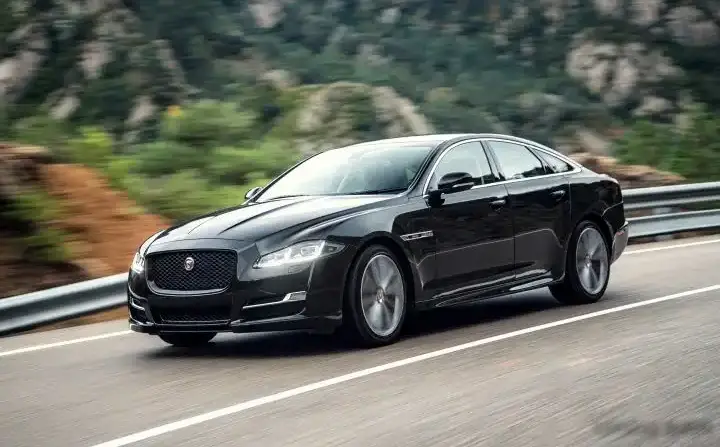
The Jaguar XJ (X351 facelift) 2.0, produced from 2015 to 2018, represented a significant shift for the flagship Jaguar sedan. While traditionally powered by larger displacement engines, Jaguar introduced a 2.0-liter turbocharged four-cylinder option to broaden the XJ’s appeal and improve fuel efficiency. This variant, producing 240 horsepower, occupied a mid-range position in the XJ lineup, slotting below the supercharged 3.0-liter V6 and the potent 5.0-liter V8 models. The X351 facelift brought updated styling, enhanced technology, and this new engine choice, aiming to attract a more diverse clientele to the XJ nameplate. It was primarily marketed in Europe and North America as a more accessible luxury option.
Technical Specifications
| Brand | Jaguar |
| Model | XJ |
| Generation | XJ (X351 facelift 2015) |
| Type (Engine) | 2.0 (240 Hp) Automatic |
| Start of production | 2015 |
| End of production | 2018 |
| Powertrain Architecture | Internal Combustion engine |
| Body type | Sedan |
| Seats | 5 |
| Doors | 4 |
| Fuel consumption (combined) | 8.4 l/100 km |
| Fuel consumption (US mpg) | 28 US mpg |
| Fuel consumption (UK mpg) | 33.6 UK mpg |
| Fuel consumption (km/l) | 11.9 km/l |
| CO2 emissions | 199 g/km |
| Fuel Type | Petrol (Gasoline) |
| Acceleration 0 – 100 km/h | 7.9 sec |
| Acceleration 0 – 62 mph | 7.9 sec |
| Acceleration 0 – 60 mph | 7.5 sec |
| Maximum speed | 241 km/h (149.75 mph) |
| Emission standard | Euro 6 |
| Weight-to-power ratio | 7.2 kg/Hp |
| Power | 240 Hp @ 5500 rpm |
| Power per litre | 120.1 Hp/l |
| Torque | 340 Nm @ 2000-4000 rpm (250.77 lb.-ft. @ 2000-4000 rpm) |
| Engine layout | Front, Longitudinal |
| Engine Model/Code | EcoBoost / 204PT |
| Engine displacement | 1999 cm3 (121.99 cu. in.) |
| Number of cylinders | 4 |
| Engine configuration | Inline |
| Cylinder Bore | 87.5 mm (3.44 in.) |
| Piston Stroke | 83.1 mm (3.27 in.) |
| Compression ratio | 10:1 |
| Number of valves per cylinder | 4 |
| Fuel injection system | Direct injection |
| Engine aspiration | Turbocharger, Intercooler |
| Valvetrain | DOHC |
| Engine oil capacity | 5.4 l (5.71 US qt | 4.75 UK qt) |
| Coolant capacity | 8.1 l (8.56 US qt | 7.13 UK qt) |
| Kerb Weight | 1735 kg (3825.02 lbs.) |
| Fuel tank capacity | 80 l (21.13 US gal | 17.6 UK gal) |
| Length | 5130 mm (201.97 in.) |
| Width | 1899 mm (74.76 in.) |
| Width including mirrors | 2105 mm (82.87 in.) |
| Height | 1460 mm (57.48 in.) |
| Wheelbase | 3032 mm (119.37 in.) |
| Front track | 1626 mm (64.02 in.) |
| Rear track | 1604 mm (63.15 in.) |
| Drivetrain | Rear wheel drive |
| Number of gears | 8 |
| Gearbox type | Automatic transmission |
| Front suspension | Double wishbone |
| Rear suspension | Double wishbone |
| Front brakes | Ventilated discs |
| Rear brakes | Ventilated discs |
| Steering type | Steering rack and pinion |
| Power steering | Electric |
Powertrain & Engine Architecture
The heart of the XJ 2.0 is Jaguar Land Rover’s Ingenium engine family. Specifically, it utilizes the 204PT, a 1999cc inline-four cylinder engine. This engine employs direct injection and is coupled with a twin-scroll turbocharger and intercooler to deliver a responsive driving experience. The Ingenium engines were designed for modularity and efficiency, featuring a low-friction design and sophisticated thermal management. The eight-speed automatic transmission, sourced from ZF, is a crucial component, offering smooth shifts and contributing to the car’s overall refinement. This transmission is known for its quick response and ability to adapt to driving conditions. The engine’s 10:1 compression ratio and DOHC valvetrain further enhance its performance and efficiency.
Driving Characteristics
The 240 hp output, while less than the larger engine options, provides adequate performance for most driving situations. Acceleration from 0-60 mph takes approximately 7.5 seconds, and the car feels composed and stable at highway speeds. The eight-speed automatic transmission is well-tuned, providing smooth and timely gear changes. Compared to the supercharged V6 or V8 models, the 2.0-liter XJ offers a more relaxed driving experience, prioritizing comfort and fuel economy over outright performance. The gear ratios are optimized for both acceleration and cruising, allowing the engine to operate efficiently at various speeds. While not a sports sedan, the 2.0-liter XJ delivers a refined and enjoyable driving experience, particularly for those prioritizing a comfortable ride.
Equipment & Trim Levels
The 2.0-liter XJ typically came standard with a generous array of features, reflecting the XJ’s luxury positioning. Standard equipment included leather upholstery, power-adjustable front seats, a touchscreen infotainment system, navigation, and a premium sound system. Trim levels varied by market, but generally included options for upgraded leather, wood veneers, and advanced driver-assistance systems such as adaptive cruise control, lane departure warning, and blind-spot monitoring. Optional extras could significantly enhance the interior, with features like rear-seat entertainment and massaging seats available. The dashboard configuration remained consistent across all XJ models, emphasizing a clean and elegant design.
Chassis & Braking
The XJ’s chassis utilizes a lightweight aluminum construction, contributing to its relatively low curb weight of 1735 kg (3825 lbs). The suspension system employs double wishbones at both the front and rear, providing a comfortable and controlled ride. Braking duties are handled by ventilated discs on all four wheels, offering ample stopping power. The XJ 2.0 typically featured a similar suspension setup to its higher-powered siblings, although stabilizer bar thicknesses might have been slightly adjusted to account for the lower weight and power output. ABS (Anti-lock braking system) is standard, enhancing safety and stability during emergency braking.
Market Reception & Comparison
The introduction of the 2.0-liter XJ was met with mixed reviews. Critics generally praised the improved fuel economy and accessibility it brought to the XJ lineup. However, some felt that the four-cylinder engine didn’t quite match the XJ’s traditional luxury image. Compared to the V6 and V8 models, the 2.0-liter XJ offered significantly better fuel economy – around 28 US mpg combined – but at the expense of performance. In terms of reliability, the Ingenium engine has proven to be generally robust, although some early models experienced minor software glitches. The 2.0-liter XJ appealed to buyers who prioritized efficiency and value without sacrificing the XJ’s core luxury attributes.
Legacy
The XJ 2.0 represented a strategic move by Jaguar to broaden the appeal of its flagship sedan. While it didn’t achieve the same sales volume as the larger-engined models, it demonstrated Jaguar’s commitment to efficiency and innovation. The Ingenium engine family has become a cornerstone of Jaguar Land Rover’s powertrain strategy, and the 2.0-liter variant continues to be a popular choice in other models. On the used car market, the XJ 2.0 offers a relatively affordable entry point into Jaguar ownership, providing a luxurious and refined driving experience at a competitive price. The powertrain, when properly maintained, has proven to be reliable, making it a viable option for buyers seeking a comfortable and well-equipped luxury sedan.