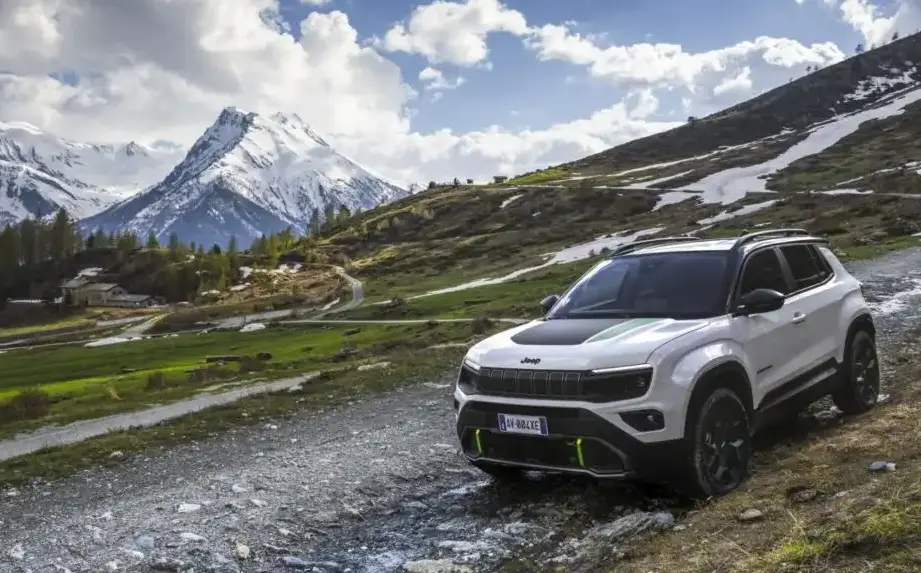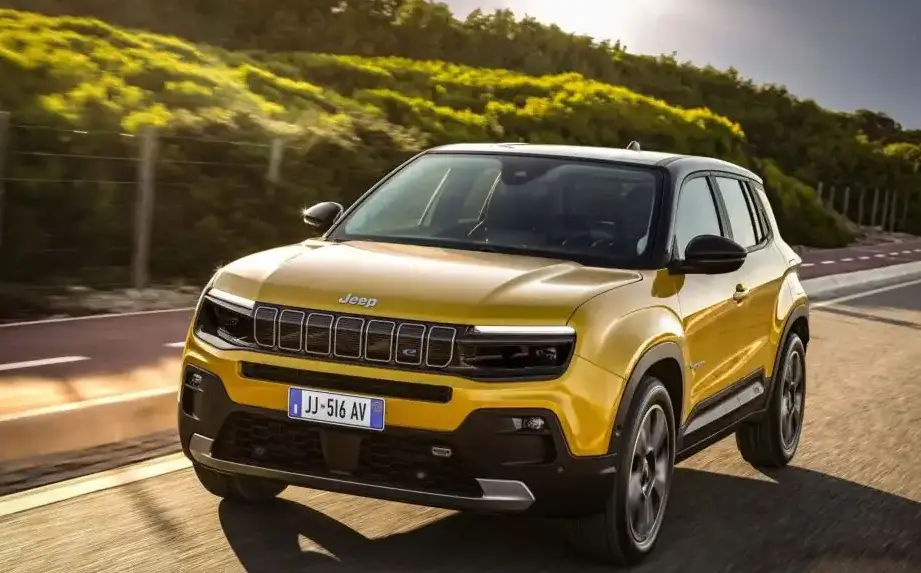
The Jeep Avenger 54 kWh (156 Hp) Electric, launched in December 2022, represents Jeep’s first foray into the fully electric subcompact SUV segment. Positioned as an entry-level offering within the Avenger lineup, it aims to provide an accessible and environmentally conscious option for urban drivers. The Avenger is built on the Stellantis CMP/e platform, shared with other compact vehicles like the Opel/Vauxhall Mokka-e and Peugeot e-2008, and is primarily targeted at the European market, though its potential for expansion to other regions exists. This variant, with its 54 kWh battery and single electric motor, is designed to balance range, performance, and affordability.
Technical Specifications
| Brand | Jeep |
| Model | Avenger |
| Generation | Avenger |
| Type (Engine) | 54 kWh (156 Hp) Electric |
| Start of production | December, 2022 |
| Powertrain Architecture | BEV (Electric Vehicle) |
| Body type | SUV |
| Seats | 5 |
| Doors | 5 |
| Fuel Type | Electricity |
| Acceleration 0 – 100 km/h | 9.0 sec |
| Acceleration 0 – 62 mph | 9.0 sec |
| Acceleration 0 – 60 mph | 8.6 sec |
| Maximum speed | 150 km/h (93.21 mph) |
| Weight-to-power ratio | 9.8 kg/Hp, 101.6 Hp/tonne |
| Weight-to-torque ratio | 5.9 kg/Nm, 169.3 Nm/tonne |
| Gross battery capacity | 54 kWh |
| Net (usable) battery capacity | 51 kWh |
| Battery technology | Lithium nickel manganese cobalt oxides (Li-NMC) |
| Battery location | Below the floor |
| All-electric range (WLTP) | 392 km (243.58 mi) |
| Average Energy consumption (WLTP) | 15.8 kWh/100 km (25.43 kWh/100 mi) |
| Average Energy consumption (MPGe) | 133 MPGe |
| Average Energy consumption (km/kWh) | 6.3 km/kWh |
| Average Energy consumption (mi/kWh) | 3.9 mi/kWh |
| Electric motor power | 156 Hp |
| Electric motor Torque | 260 Nm (191.77 lb.-ft.) |
| Electric motor location | Front axle, Transverse |
| Electric motor type | Synchronous |
| System power | 156 Hp |
| System torque | 260 Nm (191.77 lb.-ft.) |
| Kerb Weight | 1536 kg (3386.3 lbs.) |
| Max. weight | 2025 kg (4464.36 lbs.) |
| Max load | 489 kg (1078.06 lbs.) |
| Trunk (boot) space – minimum | 355 l (12.54 cu. ft.) |
| Length | 4080 mm (160.63 in.) |
| Width | 1778 mm (70 in.) |
| Height | 1528 mm (60.16 in.) |
| Wheelbase | 2562 mm (100.87 in.) |
| Ride height (ground clearance) | 209 mm (8.23 in.) |
| Minimum turning circle | 10.5 m (34.45 ft.) |
| Approach angle | 20° |
| Departure angle | 32° |
| Ramp-over angle | 20° |
| Drivetrain Architecture | One electric motor drives the front wheels. |
| Drive wheel | Front wheel drive |
| Number of gears | 1 |
| Gearbox type | Automatic transmission |
| Front brakes | Ventilated discs, 302×26 mm |
| Rear brakes | Disc, 268×12 mm |
| Assisting systems | ABS (Anti-lock braking system) |
| Steering type | Steering rack and pinion |
| Power steering | Electric Steering |
| Tires size | 215/65R16; 215/60R17; 215/55 R18 |
| Wheel rims size | 16; 17; 18 |
INTRODUCTION
The Jeep Avenger 54 kWh Electric is a significant departure for the brand, representing its first all-electric vehicle designed for the European market. Introduced in 2022, it’s built on the Stellantis CMP/e platform, a versatile architecture allowing for both internal combustion engine and electric powertrains. The Avenger aims to attract a new demographic to the Jeep brand – those seeking a compact, efficient, and technologically advanced SUV. This particular variant, equipped with the 54 kWh battery pack and a 156 horsepower electric motor, serves as the standard entry point into the Avenger range, offering a balance between range, performance, and price. It competes directly with other subcompact electric SUVs like the Renault Megane E-Tech Electric and the Peugeot e-2008.
Powertrain & Engine Architecture
The Avenger 54 kWh Electric utilizes a single, permanent magnet synchronous motor positioned on the front axle. This motor produces 156 horsepower (116 kW) and 260 Nm (192 lb-ft) of torque. The power is delivered through a single-speed automatic transmission, typical of most electric vehicles. The 54 kWh lithium-ion battery pack, utilizing Lithium Nickel Manganese Cobalt Oxide (Li-NMC) chemistry, is mounted under the floor of the vehicle, contributing to a low center of gravity and improved handling. The battery supports DC fast charging, allowing for an 80% charge in approximately 24 minutes using a compatible charger. The Avenger does not employ a traditional multi-stage fuel injection system or valvetrain, as it is a fully electric vehicle. The motor controller manages the power flow from the battery to the motor, optimizing efficiency and performance.
Driving Characteristics
The Avenger 54 kWh Electric offers a responsive and refined driving experience. Acceleration from 0 to 100 km/h (0-62 mph) takes approximately 9.0 seconds, which is competitive within its segment. The instant torque delivery characteristic of electric motors provides brisk acceleration in urban environments. While not as quick as higher-powered electric SUVs, the Avenger’s performance is adequate for everyday driving. The single-speed transmission provides seamless acceleration, and the regenerative braking system allows for one-pedal driving in certain conditions. Compared to potential future, more powerful Avenger variants, this 156 hp version prioritizes efficiency and smoothness over outright performance. The front-wheel-drive configuration provides predictable handling, although it may lack the all-weather capability of all-wheel-drive systems found in some other Jeep models.
Equipment & Trim Levels
The base Avenger 54 kWh Electric trim typically includes standard features such as a touchscreen infotainment system with Apple CarPlay and Android Auto compatibility, a digital instrument cluster, automatic climate control, and a suite of advanced driver-assistance systems (ADAS) including automatic emergency braking, lane departure warning, and traffic sign recognition. Interior upholstery is generally cloth, with options for upgraded materials available on higher trims. Optional extras include a larger touchscreen display, a panoramic sunroof, and premium audio system. The exterior styling is modern and rugged, incorporating Jeep’s signature design cues. Trim levels above the base model add features like keyless entry, heated seats, and parking sensors.
Chassis & Braking
The Avenger utilizes a McPherson strut front suspension and a torsion beam rear suspension. This configuration provides a good balance between ride comfort and handling. The front brakes are ventilated discs measuring 302x26mm, while the rear brakes are solid discs measuring 268x12mm. The Avenger is equipped with an electric power steering system, providing light and precise steering feel. ABS (Anti-lock Braking System) is standard, enhancing braking performance and stability. The relatively low weight of the vehicle, thanks to the battery pack’s placement and the use of lightweight materials, contributes to its agile handling characteristics. Stabilizer bars are included to reduce body roll during cornering.
Market Reception & Comparison
The Jeep Avenger 54 kWh Electric has been generally well-received by automotive critics, praised for its stylish design, comfortable interior, and efficient powertrain. However, some reviewers have noted its relatively limited range compared to some competitors. Fuel economy, expressed as energy consumption, is rated at 15.8 kWh/100 km (25.43 kWh/100 miles), translating to approximately 133 MPGe. Compared to the potential for a higher-performance, all-wheel-drive Avenger variant, this 54 kWh model offers a more affordable entry point, prioritizing efficiency and practicality. Its main competitors, such as the Renault Megane E-Tech Electric and Peugeot e-2008, offer similar range and performance characteristics, making the Avenger’s appeal largely dependent on brand preference and styling choices.
Legacy
The Jeep Avenger 54 kWh Electric represents a pivotal moment for the Jeep brand, signaling its commitment to electrification. The long-term reliability of the powertrain remains to be fully assessed, but the use of proven Li-NMC battery technology and a robust electric motor suggests a reasonable expectation of durability. On the used car market, the Avenger is expected to hold its value reasonably well, particularly as demand for electric vehicles continues to grow. The success of the Avenger will likely influence Jeep’s future electric vehicle offerings, potentially leading to a wider range of electric SUVs and crossovers in the years to come. The CMP/e platform’s flexibility also allows for potential future iterations with larger battery packs and more powerful motors.