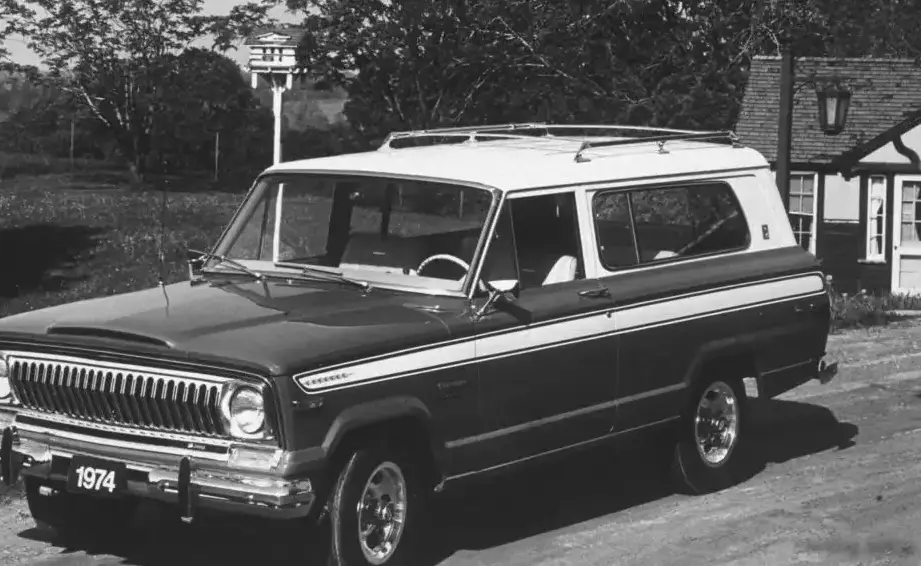
The Jeep Cherokee II (XJ) 3-door 4.0i Country, produced from 1993 to 1999, represented a significant iteration of the iconic Cherokee model line. Falling within the XJ generation, which ran from 1984 to 2001, the 3-door variant offered a more compact and maneuverable alternative to the five-door model, particularly appealing to buyers seeking a blend of off-road capability and everyday usability. The 4.0i Country trim, equipped with the 4.0-liter inline-six engine and an automatic transmission, occupied a mid-to-upper position in the Cherokee lineup, offering a balance of power, comfort, and features. It was a popular choice for those wanting a capable SUV without the expense of the more luxurious Limited trim.
Technical Specifications
| Brand | Jeep |
| Model | Cherokee |
| Generation | Cherokee II (XJ) 3-door |
| Type | 4.0 i Country (190 Hp) Automatic |
| Start of production | 1993 |
| End of production | 1999 |
| Powertrain Architecture | Internal Combustion engine |
| Body type | SUV |
| Seats | 5 |
| Doors | 3 |
| Fuel consumption (combined) | 12.4 l/100 km (19 US mpg, 22.8 UK mpg, 8.1 km/l) |
| Fuel Type | Petrol (Gasoline) |
| Weight-to-power ratio | 6.9 kg/Hp, 145.6 Hp/tonne |
| Weight-to-torque ratio | 4.3 kg/Nm, 233.7 Nm/tonne |
| Power | 190 Hp @ 4750 rpm |
| Power per litre | 48 Hp/l |
| Torque | 305 Nm @ 4000 rpm (224.96 lb.-ft. @ 4000 rpm) |
| Engine layout | Front, Longitudinal |
| Engine displacement | 3960 cm3 (241.65 cu. in.) |
| Number of cylinders | 6 |
| Engine configuration | Inline |
| Cylinder Bore | 98.5 mm (3.88 in.) |
| Piston Stroke | 86.7 mm (3.41 in.) |
| Compression ratio | 8.8:1 |
| Number of valves per cylinder | 2 |
| Fuel injection system | Multi-port manifold injection |
| Engine aspiration | Naturally aspirated |
| Engine oil capacity | 5.7 l (6.02 US qt | 5.02 UK qt) |
| Coolant capacity | 11.4 l (12.05 US qt | 10.03 UK qt) |
| Kerb Weight | 1305 kg (2877.03 lbs.) |
| Trunk (boot) space – minimum | 652 l (23.03 cu. ft.) |
| Trunk (boot) space – maximum | 1315 l (46.44 cu. ft.) |
| Fuel tank capacity | 76 l (20.08 US gal | 16.72 UK gal) |
| Length | 4288 mm (168.82 in.) |
| Width | 1720 mm (67.72 in.) |
| Height | 1621 mm (63.82 in.) |
| Wheelbase | 2575 mm (101.38 in.) |
| Front track | 1473 mm (57.99 in.) |
| Rear track | 1473 mm (57.99 in.) |
| Drivetrain Architecture | Rear wheel drive |
| Number of gears | 4 |
| Gearbox type | Automatic transmission |
| Front suspension | Coil spring |
| Rear suspension | Leaf spring |
| Front brakes | Ventilated discs |
| Rear brakes | Drum |
| Assisting systems | ABS (Anti-lock braking system), Hydraulic Power Steering |
| Tires size | 225/70 R15 S |
| Wheel rims size | 15 |
Powertrain & Engine Architecture
The heart of the Cherokee 4.0i Country was the 4.0-liter (3960 cc) inline-six cylinder engine, internally designated as the Renix 4.0L initially, and later the PowerTech engine. This engine was renowned for its durability and smooth power delivery. It featured a cast iron block and cylinder head, a 8.8:1 compression ratio, and a multi-port fuel injection system. The engine produced 190 horsepower at 4750 rpm and 305 Nm (224.96 lb-ft) of torque at 4000 rpm. The automatic transmission was typically a 42RE four-speed unit, known for its robustness but not its efficiency by modern standards. The transmission was electronically controlled, offering a relatively smooth shift quality for its time. The engine’s longitudinal front-mounted layout contributed to a balanced weight distribution, aiding in both on-road handling and off-road traction.
Driving Characteristics
The 4.0i Country, with its automatic transmission, offered a different driving experience compared to the manual transmission or the higher-output versions of the Cherokee. While the manual transmission provided more direct control and slightly better acceleration, the automatic offered convenience and ease of use, particularly in urban environments. The 42RE transmission’s gear ratios were optimized for torque delivery, making it well-suited for towing and off-road driving. Acceleration was adequate, but not particularly brisk, with a 0-60 mph time estimated around 9-10 seconds. The engine’s torque curve provided ample power for passing maneuvers and climbing hills. The rear-wheel-drive configuration, combined with the automatic transmission, could sometimes lead to wheelspin on slippery surfaces, but the available limited-slip differential helped mitigate this issue.
Equipment & Trim Levels
The “Country” trim level signified a step up in features and refinement. Standard equipment typically included air conditioning, power windows and locks, cruise control, and an upgraded interior with cloth upholstery. The Country trim also featured exterior enhancements such as unique badging, body-colored fender flares, and alloy wheels. Optional extras included a sunroof, upgraded sound system, leather upholstery, and a heavy-duty towing package. The interior layout was functional and straightforward, prioritizing usability over luxury. The dashboard featured a simple instrument cluster and easy-to-reach controls.
Chassis & Braking
The Cherokee II (XJ) utilized a body-on-frame construction, providing a robust and durable platform. The front suspension consisted of coil springs and a stabilizer bar, while the rear suspension employed leaf springs. This setup provided a comfortable ride quality, particularly on rough roads. The braking system featured ventilated discs on the front wheels and drum brakes on the rear. Anti-lock brakes (ABS) were standard, enhancing safety and control during emergency braking situations. The steering was hydraulically assisted, providing relatively light and precise steering feel. The 3-door Cherokee’s shorter wheelbase compared to the five-door model contributed to improved maneuverability in tight spaces.
Market Reception & Comparison
The Cherokee 4.0i Country was generally well-received by automotive critics and consumers alike. It was praised for its combination of off-road capability, on-road comfort, and reliability. Compared to the base Cherokee models, the 4.0i Country offered a significant performance upgrade and a more refined driving experience. Compared to the five-door Cherokee, the 3-door model was seen as more sporty and agile, but with less interior space. Fuel economy was a common criticism, averaging around 19 mpg in combined driving. However, this was typical for SUVs of its era. The 4.0-liter engine proved to be exceptionally durable, with many examples exceeding 200,000 miles with proper maintenance.
Legacy
The Jeep Cherokee II (XJ) 4.0i Country has become a highly sought-after vehicle in the used car market, particularly among enthusiasts and off-roaders. Its robust construction, reliable powertrain, and capable four-wheel-drive system have earned it a reputation as a classic SUV. The 4.0-liter inline-six engine is considered one of the most reliable engines ever produced by Jeep. While maintenance costs can increase with age, the availability of aftermarket parts and a strong community of enthusiasts ensures that these vehicles can be kept running for many years to come. The Cherokee XJ remains a popular choice for restoration projects and off-road modifications, cementing its place in automotive history.