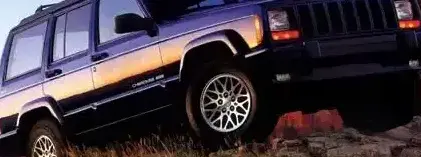
The Jeep Cherokee II (XJ) 5-door 2.5 i Jamboree, produced between 1991 and 1995, represented a popular configuration within the highly successful XJ Cherokee line. Positioned as a mid-range offering, the Jamboree trim aimed to balance affordability with a degree of off-road capability and comfort. This variant utilized a 2.5-liter inline-four engine paired with a five-speed manual transmission, making it a common sight in both on- and off-road environments across North America. The XJ Cherokee, as a whole, was a pivotal model for Jeep, solidifying its reputation for ruggedness and practicality in a more compact and fuel-efficient package than its larger Wagoneer sibling.
Technical Specifications
| Brand | Jeep |
| Model | Cherokee |
| Generation | Cherokee II (XJ) 5-door |
| Type (Engine) | 2.5 i Jamboree (122 Hp) |
| Start of production | 1991 |
| End of production | 1995 |
| Powertrain Architecture | Internal Combustion engine |
| Body type | SUV |
| Seats | 5 |
| Doors | 5 |
| Fuel consumption (combined) | 11.1 l/100 km |
| Fuel consumption (US mpg) | 21.2 US mpg |
| Fuel consumption (UK mpg) | 25.4 UK mpg |
| Fuel consumption (km/l) | 9 km/l |
| Fuel Type | Petrol (Gasoline) |
| Weight-to-power ratio | 10.7 kg/Hp |
| Hp/tonne | 93.5 Hp/tonne |
| Weight-to-torque ratio | 6.5 kg/Nm |
| Nm/tonne | 153.3 Nm/tonne |
| Power | 122 Hp @ 5300 rpm |
| Power per litre | 49.4 Hp/l |
| Torque | 200 Nm @ 3200 rpm |
| Torque (lb.-ft.) | 147.51 lb.-ft. @ 3200 rpm |
| Engine layout | Front, Longitudinal |
| Engine Model/Code | EPE |
| Engine displacement | 2469 cm3 |
| Engine displacement (cu. in.) | 150.67 cu. in. |
| Number of cylinders | 4 |
| Engine configuration | Inline |
| Cylinder Bore | 98.5 mm |
| Cylinder Bore (in.) | 3.88 in. |
| Piston Stroke | 81 mm |
| Piston Stroke (in.) | 3.19 in. |
| Compression ratio | 9.1:1 |
| Number of valves per cylinder | 2 |
| Fuel injection system | Multi-port manifold injection |
| Engine aspiration | Naturally aspirated engine |
| Engine oil capacity | 3.8 l |
| Engine oil capacity (US qt) | 4.02 US qt |
| Engine oil capacity (UK qt) | 3.34 UK qt |
| Coolant | 9.5 l |
| Coolant (US qt) | 10.04 US qt |
| Coolant (UK qt) | 8.36 UK qt |
| Kerb Weight | 1305 kg |
| Kerb Weight (lbs.) | 2877.03 lbs. |
| Trunk (boot) space – minimum | 652 l |
| Trunk (boot) space – minimum (cu. ft.) | 23.03 cu. ft. |
| Trunk (boot) space – maximum | 1315 l |
| Trunk (boot) space – maximum (cu. ft.) | 46.44 cu. ft. |
| Fuel tank capacity | 76 l |
| Fuel tank capacity (US gal) | 20.08 US gal |
| Fuel tank capacity (UK gal) | 16.72 UK gal |
| Length | 4288 mm |
| Length (in.) | 168.82 in. |
| Width | 1720 mm |
| Width (in.) | 67.72 in. |
| Height | 1621 mm |
| Height (in.) | 63.82 in. |
| Wheelbase | 2575 mm |
| Wheelbase (in.) | 101.38 in. |
| Front track | 1473 mm |
| Front track (in.) | 57.99 in. |
| Rear (Back) track | 1473 mm |
| Rear (Back) track (in.) | 57.99 in. |
| Drive wheel | All wheel drive (4×4) |
| Number of gears | 5 |
| Gearbox type | manual transmission |
| Front suspension | Coil spring |
| Rear suspension | Leaf spring |
| Front brakes | Ventilated discs |
| Rear brakes | Drum |
| Assisting systems | ABS (Anti-lock braking system) |
| Power steering | Hydraulic Steering |
| Tires size | 215/75 R15 S |
Powertrain & Engine Architecture
The heart of the Cherokee 2.5 i Jamboree was the 2.5-liter (2469 cc) inline-four cylinder engine, designated the EPE code. This engine was a relatively simple design, featuring a cast iron block and aluminum cylinder head. It employed a multi-port fuel injection system, which improved fuel efficiency and drivability compared to earlier carbureted versions. The engine produced 122 horsepower at 5300 rpm and 200 Nm (147.51 lb-ft) of torque at 3200 rpm. The five-speed manual transmission provided a good balance between fuel economy and performance. The transmission’s gear ratios were tuned for everyday driving, with a relatively tall fifth gear for highway cruising. This engine, while not particularly powerful, was known for its durability and relatively low maintenance requirements.
Driving Characteristics
The 2.5-liter engine and five-speed manual combination in the Jamboree offered a practical, if not exhilarating, driving experience. Acceleration was adequate for most situations, but the Cherokee wasn’t designed for rapid speed. The manual transmission allowed drivers to maintain control in various terrains, particularly useful for off-road adventures. The gear ratios were spaced to provide reasonable torque in lower gears for climbing and navigating obstacles. Compared to the more powerful 4.0-liter inline-six engine option, the 2.5-liter felt noticeably less responsive, especially when fully loaded or climbing steep hills. However, the 2.5L offered better fuel economy and a lighter front end, which some drivers preferred for handling.
Equipment & Trim Levels
The Jamboree trim level, while not the most luxurious, offered a step up from the base Cherokee models. Standard features typically included air conditioning, a basic AM/FM radio, cloth upholstery, and manual windows and locks. The Jamboree also often included upgraded interior trim and exterior styling elements, such as unique badging and wheel covers. Optional extras included a cassette player, cruise control, and a sunroof. The interior was functional and durable, designed to withstand the rigors of off-road use. The dashboard layout was straightforward and easy to use, with clearly marked controls.
Chassis & Braking
The Cherokee II (XJ) utilized a body-on-frame construction, providing a robust and durable platform. The front suspension consisted of coil springs, while the rear suspension employed leaf springs. This setup provided a comfortable ride on paved roads while maintaining good off-road capability. The Jamboree trim typically came equipped with ventilated disc brakes in the front and drum brakes in the rear. Anti-lock brakes (ABS) were often included as standard equipment, enhancing safety. The steering was hydraulic, providing relatively easy maneuverability. The tires, typically 215/75 R15, were all-terrain tires, suitable for both on- and off-road use.
Market Reception & Comparison
The Cherokee 2.5 i Jamboree was well-received by consumers looking for a versatile and affordable SUV. Critics praised its ruggedness, practicality, and off-road capability. However, the 2.5-liter engine was sometimes criticized for its lack of power, especially when compared to the 4.0-liter option. Fuel economy was considered reasonable for the time, averaging around 21.2 US mpg in combined driving. The Jamboree trim offered a good value proposition, providing a balance of features and affordability. Compared to other SUVs of the era, such as the Ford Bronco II and the Chevrolet S-10 Blazer, the Cherokee offered a more refined interior and a more comfortable ride.
Legacy
The Jeep Cherokee II (XJ) remains a highly sought-after vehicle among enthusiasts and collectors. The 2.5-liter engine, while not the most powerful, is known for its reliability and longevity. Properly maintained examples can still provide years of dependable service. The XJ Cherokee’s simple design and readily available parts make it relatively easy to repair and maintain. Today, the Cherokee 2.5 i Jamboree is often seen as a classic SUV, representing a bygone era of rugged and practical vehicles. Its enduring popularity is a testament to its well-engineered design and its ability to withstand the test of time.