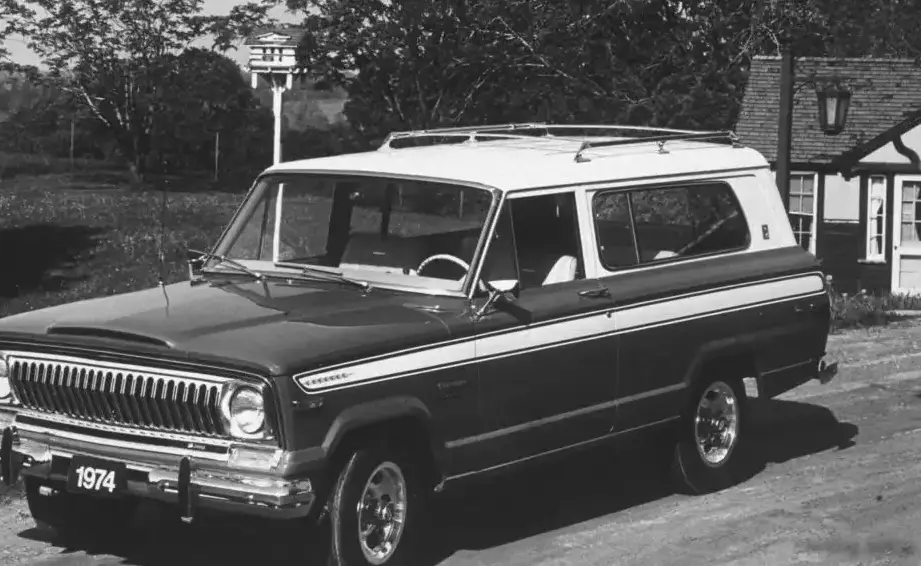
The Jeep Cherokee II (XJ), produced from 1996 to 2000, represents the final years of a highly influential generation of the Cherokee. This five-door SUV, particularly the variant equipped with the 4.0-liter inline-six engine producing 178 horsepower, held a significant position in the North American market as a capable and relatively affordable family vehicle. The XJ Cherokee, known for its unibody construction and solid front and rear axles, had already established a reputation for off-road prowess and durability. This later iteration refined the formula, offering a blend of practicality, comfort, and four-wheel-drive capability. The 4.0L engine paired with an automatic transmission was a popular configuration, appealing to buyers seeking a balance between performance and ease of use.
Technical Specifications
| Brand | Jeep |
| Model | Cherokee |
| Generation | Cherokee II (XJ) 5-door |
| Type (Engine) | 4.0 i (178 Hp) |
| Start of production | 1996 year |
| End of production | 2000 year |
| Powertrain Architecture | Internal Combustion engine |
| Body type | SUV |
| Seats | 5 |
| Doors | 5 |
| Fuel consumption (urban) | 22 l/100 km (10.7 US mpg, 12.8 UK mpg, 4.5 km/l) |
| Fuel consumption (extra urban) | 12 l/100 km (19.6 US mpg, 23.5 UK mpg, 8.3 km/l) |
| Fuel Type | Petrol (Gasoline) |
| Acceleration 0 – 100 km/h | 10.1 sec |
| Acceleration 0 – 62 mph | 10.1 sec |
| Acceleration 0 – 60 mph | 9.6 sec |
| Maximum speed | 180 km/h (111.85 mph) |
| Weight-to-power ratio | 9.2 kg/Hp, 108.9 Hp/tonne |
| Weight-to-torque ratio | 5.4 kg/Nm, 184.1 Nm/tonne |
| Power | 178 Hp @ 4400 rpm |
| Power per litre | 44.9 Hp/l |
| Torque | 301 Nm @ 3000 rpm (222.01 lb.-ft. @ 3000 rpm) |
| Engine layout | Front, Longitudinal |
| Engine Model/Code | ERH |
| Engine displacement | 3964 cm3 (241.9 cu. in.) |
| Number of cylinders | 6 |
| Engine configuration | Inline |
| Cylinder Bore | 98.5 mm (3.88 in.) |
| Piston Stroke | 86.7 mm (3.41 in.) |
| Compression ratio | 8.5:1 |
| Number of valves per cylinder | 2 |
| Fuel injection system | Multi-port manifold injection |
| Engine aspiration | Naturally aspirated engine |
| Engine oil capacity | 5.7 l (6.02 US qt | 5.02 UK qt) |
| Coolant capacity | 11.4 l (12.05 US qt | 10.03 UK qt) |
| Kerb Weight | 1635 kg (3604.56 lbs.) |
| Max. weight | 2170 kg (4784.03 lbs.) |
| Max load | 535 kg (1179.47 lbs.) |
| Trunk (boot) space – minimum | 1011 l (35.7 cu. ft.) |
| Trunk (boot) space – maximum | 2033 l (71.79 cu. ft.) |
| Fuel tank capacity | 76 l (20.08 US gal | 16.72 UK gal) |
| Length | 4240 mm (166.93 in.) |
| Width | 1790 mm (70.47 in.) |
| Height | 1625 mm (63.98 in.) |
| Wheelbase | 2576 mm (101.42 in.) |
| Front track | 1473 mm (57.99 in.) |
| Rear (Back) track | 1473 mm (57.99 in.) |
| Drive wheel | All wheel drive (4×4) |
| Number of gears and type of gearbox | 4 gears, automatic transmission |
| Front suspension | Coil spring |
| Rear suspension | Leaf spring |
| Front brakes | Ventilated discs |
| Rear brakes | Drum |
| Assisting systems | ABS (Anti-lock braking system), Hydraulic Power Steering |
| Tires size | 225/70 R15 T |
INTRODUCTION
The 1996-2000 Jeep Cherokee II 5-door, powered by the 4.0-liter inline-six engine and equipped with an automatic transmission, represented a sweet spot in the Cherokee lineup. Positioned as a mid-range offering, it provided a significant step up in performance from the base 2.5-liter four-cylinder models, while remaining more accessible than the higher-trim level options. Built on the robust XJ platform (1HX0/A3), the Cherokee continued to appeal to buyers needing a versatile SUV capable of both daily commuting and off-road adventures. This generation saw refinements to the interior and exterior styling, along with improvements to safety features, solidifying its position as a popular choice in the competitive SUV market.
Powertrain & Engine Architecture
The heart of this Cherokee variant is the 4.0-liter (3964 cc) inline-six cylinder engine, designated the ERH code. This engine, a mainstay of Jeep vehicles for decades, is known for its durability and relatively simple design. It features a cast iron block and cylinder head, a 8.5:1 compression ratio, and a multi-port fuel injection system. The valvetrain utilizes two valves per cylinder, operated by a single overhead camshaft. The 4.0L engine delivers 178 horsepower at 4400 rpm and 222 lb-ft of torque at 3000 rpm. The automatic transmission used in this model is typically a 42RE four-speed automatic. This transmission is known for its robustness, but can be prone to wear and tear with high mileage. The transmission’s gear ratios are optimized for a balance of acceleration and fuel efficiency, though the latter remains a relative weakness compared to more modern SUVs.
Driving Characteristics
The 4.0L automatic Cherokee offers a comfortable and capable driving experience. While not a performance machine, the engine provides adequate power for everyday driving and towing. Acceleration from 0-60 mph takes around 9.6 seconds, and the top speed is approximately 112 mph. The automatic transmission shifts smoothly, but can feel somewhat sluggish compared to a manual transmission. The Cherokee’s four-wheel-drive system, typically a part-time system with selectable 4-High and 4-Low ranges, provides excellent traction in off-road conditions and inclement weather. The leaf spring rear suspension contributes to a firm ride, particularly when carrying a load, but can also make the ride less refined on rough roads. The steering is hydraulic, providing reasonable feedback, but lacks the precision of more modern steering systems.
Equipment & Trim Levels
The 1996-2000 Cherokee II 4.0L automatic typically came standard with features such as air conditioning, power windows and locks, and an AM/FM stereo. Higher trim levels, such as the Limited, added features like leather upholstery, upgraded sound systems, and alloy wheels. Optional extras included a sunroof, cruise control, and a tow package. Interior upholstery was typically cloth, with the Limited trim offering leather as an upgrade. The dashboard layout is functional and straightforward, with easy-to-read gauges and controls. The interior space is generous for its class, offering comfortable seating for five passengers.
Chassis & Braking
The Cherokee II utilizes a body-on-frame construction, providing a robust and durable chassis. The front suspension consists of coil springs and a stabilizer bar, while the rear suspension employs leaf springs. This setup provides good load-carrying capacity and off-road capability. The braking system features ventilated discs in the front and drum brakes in the rear. Anti-lock brakes (ABS) were standard equipment, enhancing safety in emergency braking situations. The tires are typically 225/70 R15, providing a good balance of on-road comfort and off-road traction.
Market Reception & Comparison
The Cherokee II 4.0L automatic was generally well-received by critics and consumers alike. It was praised for its reliability, off-road capability, and spacious interior. However, its fuel economy was often criticized, averaging around 15 mpg in combined driving. Compared to the base 2.5-liter four-cylinder models, the 4.0L offered a significant performance boost, but at the cost of increased fuel consumption. Compared to the higher-trim level options, the 4.0L automatic provided a good value proposition, offering a balance of features and performance without the higher price tag.
Legacy
The Jeep Cherokee II 4.0L automatic has proven to be a remarkably durable and reliable vehicle. Many examples are still on the road today, a testament to the quality of its construction and the robustness of its powertrain. While maintenance costs can increase with age, parts are readily available and relatively affordable. In the used car market, these Cherokees are popular among enthusiasts and those seeking a capable and affordable SUV. The 4.0L inline-six engine is particularly well-regarded for its longevity and ease of repair, making this variant a desirable choice for those looking for a classic Jeep SUV.