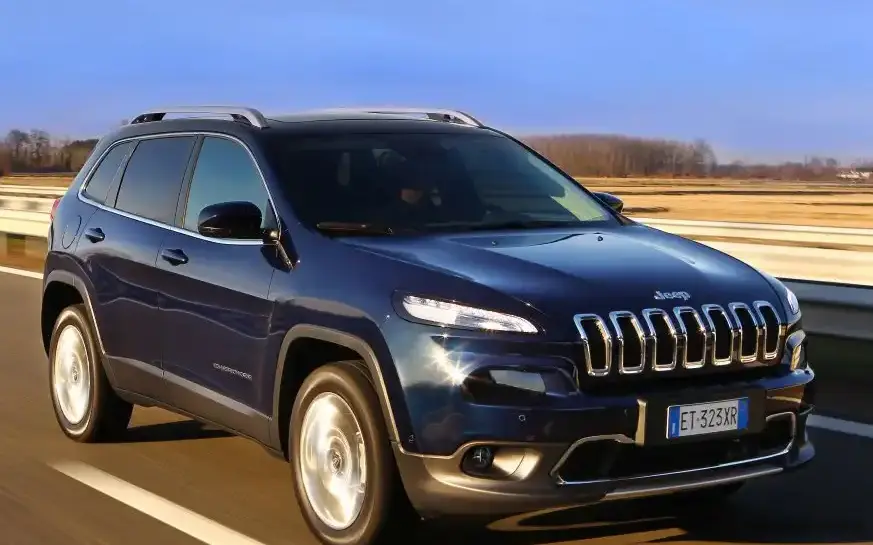
The Jeep Cherokee (KL) 2.0L 4WD Automatic, produced from 2013 to 2017, represented a significant shift for the iconic American brand. This variant was positioned as a fuel-efficient, entry-level option within the broader Cherokee KL lineup, aiming to attract buyers seeking the Cherokee’s capability in a more economical package. It was a key component of Jeep’s strategy to broaden the Cherokee’s appeal beyond traditional off-road enthusiasts, competing with crossovers from brands like Honda, Toyota, and Ford. The KL generation itself was a departure from the previous Liberty model, moving to a more car-like unibody construction and offering a more refined driving experience.
Technical Specifications
| Brand | Jeep |
| Model | Cherokee |
| Generation | Cherokee V (KL) |
| Type (Engine) | 2.0 (170 Hp) 4WD Automatic |
| Start of production | 2013 |
| End of production | 2017 |
| Powertrain Architecture | Internal Combustion engine |
| Body type | SUV |
| Seats | 5 |
| Doors | 5 |
| Fuel consumption (urban) | 7.1 l/100 km (33.1 US mpg) |
| Fuel consumption (extra urban) | 5.1 l/100 km (46.1 US mpg) |
| Fuel consumption (combined) | 5.8 l/100 km (40.6 US mpg) |
| CO2 emissions | 154 g/km |
| Fuel Type | Diesel |
| Acceleration 0 – 100 km/h | 10.3 sec |
| Acceleration 0 – 62 mph | 10.3 sec |
| Acceleration 0 – 60 mph | 9.8 sec |
| Maximum speed | 192 km/h (119.3 mph) |
| Emission standard | Euro 5 |
| Weight-to-power ratio | 11.5 kg/Hp |
| Weight-to-torque ratio | 5.6 kg/Nm |
| Power | 170 Hp @ 4000 rpm |
| Torque | 350 Nm @ 1750 rpm (258.15 lb.-ft. @ 1750 rpm) |
| Engine layout | Front, Longitudinal |
| Engine Model/Code | EBT |
| Engine displacement | 1956 cm3 (119.36 cu. in.) |
| Number of cylinders | 4 |
| Engine configuration | Inline |
| Cylinder Bore | 83 mm (3.27 in.) |
| Piston Stroke | 90.4 mm (3.56 in.) |
| Compression ratio | 16.5:1 |
| Number of valves per cylinder | 4 |
| Fuel injection system | Diesel Commonrail |
| Engine aspiration | Turbocharger, Intercooler |
| Valvetrain | DOHC |
| Engine oil capacity | 4.1 l (4.33 US qt | 3.61 UK qt) |
| Coolant capacity | 6.8 l (7.19 US qt | 5.98 UK qt) |
| Kerb Weight | 1953 kg (4305.63 lbs.) |
| Trunk (boot) space – minimum | 591 l (20.87 cu. ft.) |
| Trunk (boot) space – maximum | 1267 l (44.74 cu. ft.) |
| Fuel tank capacity | 60 l (15.85 US gal | 13.2 UK gal) |
| Permitted trailer load with brakes (12%) | 2475 kg (5456.44 lbs.) |
| Length | 4624 mm (182.05 in.) |
| Width | 1859 mm (73.19 in.) |
| Height | 1670 mm (65.75 in.) |
| Wheelbase | 2700 mm (106.3 in.) |
| Front track | 1586 mm (62.44 in.) |
| Rear track | 1584 mm (62.36 in.) |
| Ride height (ground clearance) | 157-168 mm (6.18 – 6.61 in.) |
| Minimum turning circle | 11.6 m (38.06 ft.) |
| Approach angle | 18.2° |
| Departure angle | 24.0° |
| Drive wheel | All wheel drive (4×4) |
| Number of gears and type of gearbox | 9 gears, automatic transmission |
| Front suspension | Independent type McPherson |
| Rear suspension | Independent multi-link suspension |
| Front brakes | Ventilated discs |
| Rear brakes | Disc |
| Assisting systems | ABS (Anti-lock braking system) |
| Steering type | Steering rack and pinion |
| Tires size | 225/60 R17; 225/55 R18 |
| Wheel rims size | 7J x 17; 7J x 18 |
Powertrain & Engine Architecture
The Cherokee 2.0L 4WD Automatic was powered by the EBT engine, a 1.956-liter inline-four cylinder diesel engine. This engine utilized a common rail direct injection system, delivering fuel at extremely high pressures for improved combustion efficiency and reduced emissions. The engine featured a single turbocharger with an intercooler, boosting power output to 170 horsepower at 4000 rpm and 350 Nm (258 lb-ft) of torque at 1750 rpm. The engine’s double overhead camshaft (DOHC) valvetrain, with four valves per cylinder, further enhanced its breathing and performance. The engine was mounted longitudinally in the chassis. The transmission was a sophisticated 9-speed automatic, a first for Jeep, designed to improve fuel economy and provide smooth shifting. This transmission offered a wide range of gear ratios, optimizing engine performance for both on-road cruising and off-road crawling.
Driving Characteristics
The 2.0L diesel engine, paired with the 9-speed automatic, provided adequate, though not exhilarating, performance. Acceleration from 0-60 mph took around 9.8 seconds. The engine’s strong low-end torque made it well-suited for everyday driving and towing, but it lacked the punch of the available 3.2L V6 engine. The 9-speed transmission, while efficient, was sometimes criticized for its occasional hesitation or hunting for the right gear, particularly during quick acceleration. The 4WD system provided confident traction in various conditions, making the Cherokee a capable all-weather vehicle. Compared to the manual transmission versions, the automatic offered greater convenience, but at the expense of some driver engagement and fuel economy.
Equipment & Trim Levels
The 2.0L 4WD Automatic Cherokee typically came standard with features like air conditioning, power windows and locks, a touchscreen infotainment system, and a rearview camera. Higher trim levels, such as the Limited and Trailhawk, added features like leather upholstery, heated seats, a premium sound system, and advanced safety technologies. Optional extras included a panoramic sunroof, navigation system, and various driver-assistance features. Interior upholstery was typically cloth on base models, with leather available on higher trims. The dashboard layout was modern and functional, with a focus on user-friendliness.
Chassis & Braking
The Cherokee KL utilized a unibody construction, providing a good balance of strength and weight. The front suspension featured independent McPherson struts, while the rear suspension employed an independent multi-link setup. This configuration delivered a comfortable ride and predictable handling. Braking duties were handled by ventilated discs at the front and solid discs at the rear. The anti-lock braking system (ABS) was standard, enhancing safety and control during emergency braking situations. Stabilizer bars were fitted to both the front and rear axles to reduce body roll during cornering.
Market Reception & Comparison
The 2.0L diesel Cherokee was generally well-received by critics as a fuel-efficient and capable crossover. However, some reviewers noted the 9-speed transmission’s occasional quirks and the engine’s lack of outright power compared to the V6 option. Fuel economy was a strong point, with combined figures around 40.6 US mpg. Compared to the V6 models, the 2.0L diesel offered significantly better fuel efficiency but less performance. Reliability was generally good, although some owners reported minor issues with the transmission software. The 2.0L variant appealed to buyers prioritizing fuel economy and practicality over outright performance.
Legacy
The Jeep Cherokee KL 2.0L 4WD Automatic remains a popular choice in the used car market, particularly for those seeking a fuel-efficient and capable crossover. The EBT diesel engine, while not known for being exceptionally powerful, has proven to be relatively reliable with proper maintenance. The 9-speed automatic transmission, after initial software updates, has become more refined and dependable. These Cherokees offer a good value proposition, combining Jeep’s renowned 4×4 capability with reasonable running costs. As with any used vehicle, a thorough inspection and maintenance history review are recommended before purchase.