Technical Specifications
| Brand | Jeep |
| Model | Cherokee |
| Generation | Cherokee V (KL) |
| Type (Engine) | 2.4 MultiAir2 TIGERSHARK (177 Hp) 4WD LOCK Automatic |
| Start of production | 2013 |
| End of production | 2017 |
| Powertrain Architecture | Internal Combustion engine |
| Body type | SUV |
| Seats | 5 |
| Doors | 5 |
| Fuel consumption (economy) – urban | 12 l/100 km (19.6 US mpg, 23.5 UK mpg, 8.3 km/l) |
| Fuel consumption (economy) – extra urban | 6.8 l/100 km (34.6 US mpg, 41.5 UK mpg, 14.7 km/l) |
| Fuel consumption (economy) – combined | 8.8 l/100 km (26.7 US mpg, 32.1 UK mpg, 11.4 km/l) |
| CO2 emissions | 204 g/km |
| Fuel Type | Petrol (Gasoline) |
| Acceleration 0 – 100 km/h | 12.1 sec |
| Acceleration 0 – 62 mph | 12.1 sec |
| Acceleration 0 – 60 mph | 11.5 sec |
| Maximum speed | 175 km/h (108.74 mph) |
| Emission standard | Euro 6 |
| Weight-to-power ratio | 10.7 kg/Hp, 93.5 Hp/tonne |
| Weight-to-torque ratio | 8.3 kg/Nm, 120.9 Nm/tonne |
| Power | 177 Hp @ 6400 rpm |
| Power per litre | 75 Hp/l |
| Torque | 229 Nm @ 3900 rpm (168.9 lb.-ft. @ 3900 rpm) |
| Engine layout | Front, Longitudinal |
| Engine Model/Code | ED6 |
| Engine displacement | 2360 cm3 (144.02 cu. in.) |
| Number of cylinders | 4 |
| Engine configuration | Inline |
| Cylinder Bore | 88 mm (3.46 in.) |
| Piston Stroke | 97 mm (3.82 in.) |
| Compression ratio | 10:1 |
| Number of valves per cylinder | 4 |
| Fuel injection system | Multi-port manifold injection |
| Engine aspiration | Naturally aspirated engine |
| Valvetrain | SOHC |
| Engine oil capacity | 5.2 l (5.49 US qt | 4.58 UK qt) |
| Coolant | 6.8 l (7.19 US qt | 5.98 UK qt) |
| Kerb Weight | 1894-1904 kg (4175.56 – 4197.6 lbs.) |
| Trunk (boot) space – minimum | 591 l (20.87 cu. ft.) |
| Trunk (boot) space – maximum | 1267 l (44.74 cu. ft.) |
| Fuel tank capacity | 60 l (15.85 US gal | 13.2 UK gal) |
| Permitted trailer load with brakes (12%) | 2200 kg (4850.17 lbs.) |
| Length | 4626 mm (182.13 in.) |
| Width | 1904 mm (74.96 in.) |
| Height | 1722 mm (67.8 in.) |
| Wheelbase | 2719 mm (107.05 in.) |
| Front track | 1619 mm (63.74 in.) |
| Rear (Back) track | 1626 mm (64.02 in.) |
| Ride height (ground clearance) | 221 mm (8.7 in.) |
| Minimum turning circle (turning diameter) | 12 m (39.37 ft.) |
| Approach angle | 29.9° |
| Departure angle | 32.1° |
| Drive wheel | All wheel drive (4×4) |
| Number of gears and type of gearbox | 9 gears, automatic transmission |
| Front suspension | Independent type McPherson |
| Rear suspension | Independent multi-link suspension |
| Front brakes | Ventilated discs |
| Rear brakes | Disc |
| Assisting systems | ABS (Anti-lock braking system) |
| Steering type | Steering rack and pinion |
| Tires size | 225/60 R17; 225/55 R18; 245/65 R17 |
| Wheel rims size | 7J x 17; 7J x 18; 7.5J x 17 |
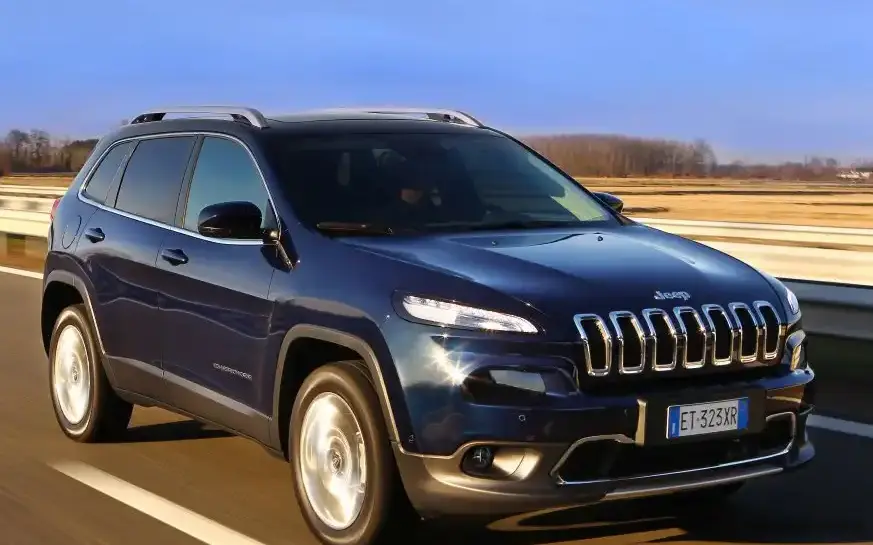
The Jeep Cherokee V (KL) 2.4 MultiAir2 TIGERSHARK, equipped with a 177 horsepower engine and automatic transmission, and featuring 4WD LOCK, was a key offering in the compact SUV segment from 2013 to 2017. This variant represented the first generation of the redesigned KL Cherokee, a redesign that initially proved controversial. It aimed to strike a balance between fuel efficiency and Jeep’s well-known off-road capabilities. Positioned in the mid-range of the Cherokee lineup, it sat between the base 2.4L engine without MultiAir technology and the more powerful 3.2L Pentastar V6. This configuration was primarily targeted towards buyers seeking a comfortable, capable daily driver with the added security of all-wheel drive.
Powertrain & Engine Architecture
The core of this Cherokee variant is the 2.4-liter “Tigershark” inline-four engine, internally designated ED6. This engine incorporates Chrysler’s MultiAir2 technology, a sophisticated fully variable valve lift system. MultiAir2 allows for independent control of both intake and exhaust valve timing and lift, optimizing engine performance and fuel efficiency. The system utilizes electro-hydraulic actuators to dynamically adjust valve behavior based on driving conditions. Fuel delivery is managed by a multi-port fuel injection system. The engine generates 177 horsepower at 6400 rpm and 229 Nm (168.9 lb-ft) of torque at 3900 rpm. A ZF-sourced 9-speed automatic transmission is paired with this engine. This transmission’s wide gear ratio spread contributes to both improved fuel economy and enhanced acceleration. The 4WD LOCK system enhances traction in challenging conditions by locking the front and rear axles, providing a 50/50 power split.
Driving Characteristics
The 177 hp 2.4L MultiAir2 engine, combined with the 9-speed automatic, delivers adequate performance for typical daily driving. Acceleration from 0-60 mph takes approximately 11.5 to 12.1 seconds, which isn’t particularly quick but is sufficient for most commuting and highway merging situations. The 9-speed transmission is programmed to prioritize fuel efficiency, often upshifting to higher gears quickly. This can sometimes result in a slight hesitation during acceleration, particularly when needing to overtake another vehicle. Compared to the 3.2L V6, this variant feels noticeably less powerful, especially when carrying a full load or navigating steep inclines. However, the MultiAir2 system does provide a reasonably responsive throttle feel. The 4WD system provides confident handling in adverse weather conditions and on unpaved surfaces.
Equipment & Trim Levels
The 2.4L MultiAir2 Cherokee typically came standard with features such as air conditioning, power windows and locks, a touchscreen infotainment system with Bluetooth connectivity, and a rearview camera. Higher trim levels, like the Limited, added features like leather upholstery, heated front seats, a power liftgate, and advanced safety technologies like blind-spot monitoring and rear cross-path detection. Optional extras included a panoramic sunroof, a navigation system, and premium audio systems. Interior upholstery was generally cloth on base models, with leather available on higher trims. Dashboard configurations were consistent throughout the range, featuring a user-friendly layout with intuitive controls.
Chassis & Braking
The Cherokee KL utilizes a unibody construction, offering a good balance of strength and weight. The front suspension employs an independent McPherson strut design, while the rear features an independent multi-link setup. This suspension configuration delivers a comfortable ride quality, effectively absorbing bumps and road imperfections. Braking is handled by ventilated discs at the front and solid discs at the rear. An anti-lock braking system (ABS) is standard. The Cherokee’s chassis is tuned to provide a stable and predictable driving experience, with minimal body roll during cornering.
Market Reception & Comparison
The 2.4L MultiAir2 Cherokee received a mixed reception from automotive critics. While its fuel efficiency and comfortable ride were praised, some reviewers found the engine to be underpowered compared to competitors like the Honda CR-V or Toyota RAV4. The 9-speed automatic transmission also drew some criticism for occasional hesitation and jerky shifts, although software updates helped to mitigate these issues. In terms of reliability, the MultiAir2 engine has been known to experience some issues with solenoid failures and oil consumption, necessitating preventative maintenance. Compared to the 3.2L V6 Cherokee, the 2.4L offered better fuel economy but significantly less performance.
Legacy
The Jeep Cherokee KL 2.4L MultiAir2 remains a common vehicle on the used car market. While the MultiAir2 engine requires diligent maintenance to prevent potential issues, it can provide reliable service if properly cared for. The 9-speed transmission, despite initial concerns, has proven to be durable with regular fluid changes. This variant represents a good value for buyers seeking a capable and fuel-efficient compact SUV, particularly those who value all-wheel drive and Jeep’s off-road heritage. However, prospective buyers should be aware of the potential maintenance requirements of the MultiAir2 engine and thoroughly inspect the vehicle before making a purchase.