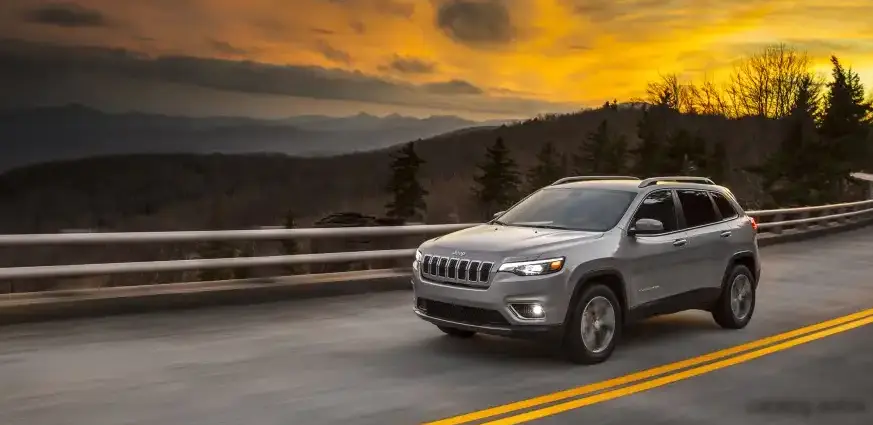
The Jeep Cherokee V (KL, facelift 2018) 2.0-liter (272 hp) 4WD Automatic represents a significant evolution in the Cherokee lineup, introduced in April 2019 and continuing through March 2023. This variant occupied a sweet spot within the fifth-generation KL Cherokee, offering a balance of performance, fuel efficiency, and capability for the North American market. Positioned as a mid-range to upper-mid-range offering, it catered to buyers seeking more power than the base engine but didn’t require the added expense of the Trailhawk or higher trim levels. The facelift brought updated styling, improved interior materials, and enhanced technology, solidifying the Cherokee’s position in the competitive compact SUV segment.
Technical Specifications
| Brand | Jeep |
| Model | Cherokee |
| Generation | Cherokee V (KL, facelift 2018) |
| Type (Engine) | 2.0 (272 Hp) 4WD Automatic |
| Start of production | April, 2019 |
| End of production | March, 2023 |
| Powertrain Architecture | Internal Combustion engine |
| Body type | SUV |
| Seats | 5 |
| Doors | 5 |
| Fuel consumption (urban) | 11.2 l/100 km (21 US mpg, 25.2 UK mpg, 8.9 km/l) |
| Fuel consumption (extra urban) | 8.1 l/100 km (29 US mpg, 34.9 UK mpg, 12.3 km/l) |
| Fuel consumption (combined) | 9.8 l/100 km (24 US mpg, 28.8 UK mpg, 10.2 km/l) |
| Fuel Type | Petrol (Gasoline) |
| Power | 272 Hp @ 5250 rpm |
| Power per litre | 136.4 Hp/l |
| Torque | 400 Nm @ 3000-4500 rpm (295.02 lb.-ft. @ 3000-4500 rpm) |
| Maximum engine speed | 5800 rpm |
| Engine layout | Front, Transverse |
| Engine Model/Code | EC1 |
| Engine displacement | 1994 cm3 (121.68 cu. in.) |
| Number of cylinders | 4 |
| Engine configuration | Inline |
| Cylinder Bore | 84.1 mm (3.31 in.) |
| Piston Stroke | 89.9 mm (3.54 in.) |
| Compression ratio | 10:1 |
| Number of valves per cylinder | 4 |
| Fuel injection system | Direct injection |
| Engine aspiration | Turbocharger, Intercooler |
| Valvetrain | DOHC-VVT |
| Engine oil capacity | 4.7 l (4.97 US qt | 4.14 UK qt) |
| Coolant | 8.6 l (9.09 US qt | 7.57 UK qt) |
| Trunk (boot) space – minimum | 448 l (15.82 cu. ft.) |
| Trunk (boot) space – maximum | 1555 l (54.91 cu. ft.) |
| Fuel tank capacity | 60 l (15.85 US gal | 13.2 UK gal) |
| Permitted trailer load with brakes (12%) | 1814 kg (3999.19 lbs.) |
| Length | 4623 mm (182.01 in.) |
| Width | 1859-1902 mm (73.19 – 74.88 in.) |
| Height | 1681-1722 mm (66.18 – 67.8 in.) |
| Wheelbase | 2708-2720 mm (106.61 – 107.09 in.) |
| Front track | 1593-1615 mm (62.72 – 63.58 in.) |
| Rear (Back) track | 1593-1613 mm (62.72 – 63.5 in.) |
| Minimum turning circle (turning diameter) | 11.5-11.6 m (37.73 – 38.06 ft.) |
| Approach angle | 18.9-29.9° |
| Departure angle | 25.0-32.2° |
| Drivetrain Architecture | The Internal combustion engine (ICE) drives the front wheels permanently, and the rear wheels are driven through an electrically or mechanically operated clutch if necessary. |
| Drive wheel | All wheel drive (4×4) |
| Number of gears and type of gearbox | 9 gears, automatic transmission |
| Front suspension | Independent, type McPherson with coil spring and anti-roll bar |
| Rear suspension | Independent multi-link spring suspension with stabilizer |
| Front brakes | Ventilated discs |
| Rear brakes | Disc |
| Assisting systems | ABS (Anti-lock braking system) |
| Steering type | Steering rack and pinion |
| Power steering | Electric Steering |
| Tires size | 225/65 R17; 245/65 R17; 225/60 R18; 235/50 R19 |
| Wheel rims size | 7J x 17; 7.5J x 17; 7J x 18; 7.5J x 19 |
Powertrain & Engine Architecture
At the heart of the Cherokee 2.0L lies the EC1 engine, a 1.994-liter turbocharged inline-four cylinder gasoline engine. This engine is part of the Global Medium Engine (GME) family developed by FCA (now Stellantis). It utilizes direct fuel injection and a twin-scroll turbocharger, contributing to its responsive power delivery and improved efficiency. The engine employs a Double Overhead Camshaft (DOHC) valvetrain with Variable Valve Timing (VVT) on both intake and exhaust valves, optimizing performance across the rev range. Paired with this engine is a ZF-sourced 9-speed automatic transmission. This transmission is known for its wide gear ratio spread, aiding both fuel economy and acceleration. The 9-speed’s programming is tailored to provide smooth shifts and efficient operation, though some early iterations of this transmission were subject to software updates to address occasional harshness.
Driving Characteristics
The 272-horsepower and 295 lb-ft of torque provided by the 2.0-liter engine delivers a noticeable step up in performance compared to the base 2.4-liter engine. Acceleration is brisk, and the turbocharger provides ample power for highway merging and overtaking. The 9-speed automatic transmission, while generally smooth, can sometimes feel hesitant during quick downshifts. Compared to the 3.2-liter V6 option, the 2.0L offers slightly less overall power, but its lighter weight contributes to a more agile feel. The 2.0L automatic Cherokee provides a comfortable and capable driving experience, well-suited for daily commuting and longer road trips. The 4WD system provides added traction in inclement weather conditions, enhancing stability and control.
Equipment & Trim Levels
The 2.0L 4WD Automatic was typically offered in Latitude, Limited, and North editions. Standard features generally included air conditioning, a touchscreen infotainment system with Apple CarPlay and Android Auto compatibility, keyless entry, and a suite of safety features like blind-spot monitoring and rear cross-traffic alert. Higher trim levels, such as the Limited and North, added features like leather upholstery, heated front seats, a power liftgate, and a premium sound system. Optional extras included a panoramic sunroof, navigation system, and advanced driver-assistance systems like adaptive cruise control and lane-keeping assist.
Chassis & Braking
The Cherokee utilizes a unibody construction with independent suspension on all four wheels. The front suspension employs a McPherson strut design, while the rear features a multi-link setup. This configuration provides a comfortable ride and good handling characteristics. Braking duties are handled by ventilated discs at the front and solid discs at the rear. The standard anti-lock braking system (ABS) enhances safety by preventing wheel lockup during hard braking. Steering is rack-and-pinion with electric power assist, providing precise and responsive steering feel.
Market Reception & Comparison
The 2.0-liter turbocharged engine was generally well-received by automotive critics, praised for its strong performance and improved fuel economy compared to the V6. However, some reviewers noted the occasional hesitation of the 9-speed automatic transmission. Compared to competitors like the Honda CR-V and Toyota RAV4, the Cherokee 2.0L offered a more powerful engine option, but its fuel economy was slightly lower. Reliability reports indicated that the 2.0L engine itself was generally reliable, but the 9-speed transmission experienced some issues in early production years, requiring software updates to address.
Legacy
The Jeep Cherokee KL, particularly the 2.0-liter variant, represents a significant step forward for the Cherokee nameplate. The introduction of the turbocharged engine and 9-speed automatic transmission broadened the Cherokee’s appeal, attracting buyers seeking a more modern and efficient SUV. While the 9-speed transmission had some initial teething problems, these were largely addressed through software updates. On the used car market, the 2019-2023 Cherokee 2.0L 4WD Automatic holds its value reasonably well, offering a compelling combination of performance, features, and capability. Its continued presence in the used market demonstrates its enduring appeal to buyers seeking a versatile and capable compact SUV.