
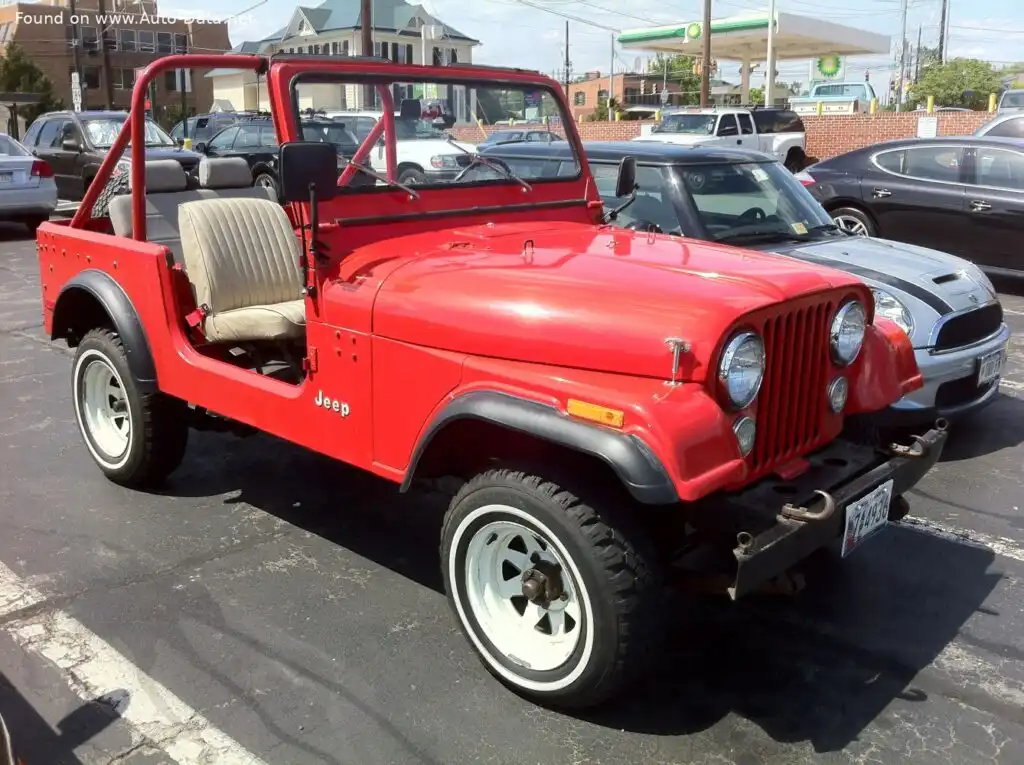
The Jeep CJ-7 2.5, produced from 1980 to 1983, represented a significant evolution in the iconic CJ (Civilian Jeep) lineage. Positioned as a more comfortable and refined offering compared to its predecessors, the CJ-7 aimed to broaden the Jeep’s appeal beyond purely utilitarian buyers. This particular variant, equipped with the 2.5-liter inline-four engine producing 82 horsepower, served as the entry-level engine option in the CJ-7 range, offering a balance of affordability and capability. It was a key model during the transition period of the CJ line, bridging the gap between the rugged, spartan CJ-5 and the more modern Wrangler (YJ) that would follow.
Technical Specifications
| Brand | Jeep |
| Model | CJ |
| Generation | CJ-7 |
| Type (Engine) | 2.5 (82 Hp) |
| Start of production | 1980 |
| End of production | 1983 |
| Powertrain Architecture | Internal Combustion engine |
| Body type | Off-road vehicle |
| Seats | 4 |
| Doors | 2 |
| Fuel Type | Petrol (Gasoline) |
| Power | 82 Hp @ 4000 rpm |
| Power per litre | 33.1 Hp/l |
| Torque | 169 Nm @ 2600 rpm |
| Torque (lb.-ft.) | 124.65 lb.-ft. @ 2600 rpm |
| Engine layout | Front, Longitudinal |
| Engine displacement | 2474 cm3 |
| Engine displacement (cu. in.) | 150.97 cu. in. |
| Number of cylinders | 4 |
| Engine configuration | Inline |
| Cylinder Bore | 101.6 mm (4 in.) |
| Piston Stroke | 76.2 mm (3 in.) |
| Compression ratio | 8.2:1 |
| Number of valves per cylinder | 2 |
| Fuel injection system | Carburettor |
| Engine aspiration | Naturally aspirated engine |
| Valvetrain | OHV |
| Coolant Capacity | 7.5 l (7.93 US qt | 6.6 UK qt) |
| Max. weight | 1882 kg (4149.1 lbs.) |
| Trunk (boot) space – minimum | 385 l (13.6 cu. ft.) |
| Fuel tank capacity | 57 l (15.06 US gal | 12.54 UK gal) |
| Length | 3891 mm (153.19 in.) |
| Width | 1521 mm (59.88 in.) |
| Height | 1755 mm (69.09 in.) |
| Wheelbase | 2372 mm (93.39 in.) |
| Front track | 1417 mm (55.79 in.) |
| Rear (Back) track | 1400 mm (55.12 in.) |
| Front overhang | 597 mm (23.5 in.) |
| Rear overhang | 922 mm (36.3 in.) |
| Ride height (ground clearance) | 193 mm (7.6 in.) |
| Minimum turning circle (turning diameter) | 10.9 m (35.76 ft.) |
| Drivetrain Architecture | The Internal combustion engine (ICE) drives the rear wheels permanently, and the front wheels are driven through an electrically or mechanically operated clutch if necessary. |
| Drive wheel | All wheel drive (4×4) |
| Number of gears and type of gearbox | 4 gears, manual transmission |
| Front suspension | Leaf spring |
| Rear suspension | Leaf spring |
| Front brakes | Disc |
| Rear brakes | Drum |
| Steering type | Cone worm with recirculation balls |
| Tires size | 225/75 R15 |
| Wheel rims size | 7J x 15 |
Powertrain & Engine Architecture
The heart of the CJ-7 2.5 was the AMC 2.5-liter (151 cubic inch) inline-four engine. This engine, designated as the 4-258, was a robust and relatively simple design, utilizing a cast iron block and cylinder head. It featured a single overhead valve (OHV) valvetrain and was fed by a two-barrel carburetor. While not known for its high performance, the 2.5-liter engine was valued for its durability and low-end torque. The 82 horsepower output was achieved at 4000 rpm, while peak torque of 169 Nm (124.65 lb-ft) arrived at 2600 rpm. The engine’s longitudinal front-engine layout was typical for the time, and it was paired with a standard four-speed manual transmission. An optional three-speed automatic transmission was also available, though it further reduced the vehicle’s already modest acceleration.
Driving Characteristics
The CJ-7 2.5 with the manual transmission offered a reasonably engaging driving experience, particularly in off-road situations. The low-end torque of the 2.5-liter engine provided adequate power for navigating trails and obstacles. However, on paved roads, acceleration was slow, and highway cruising required frequent downshifts. The automatic transmission version significantly hampered performance, making the vehicle feel sluggish and unresponsive. The four-speed manual offered better control and allowed the driver to keep the engine in its optimal power band. The CJ-7’s short wheelbase contributed to a somewhat bumpy ride, but also enhanced its maneuverability in tight spaces.
Equipment & Trim Levels
The CJ-7 2.5 typically came with a fairly basic level of equipment. Standard features included high-back bucket seats, a roll bar, and basic instrumentation. Interior upholstery was typically vinyl or a durable cloth. Optional extras included features like power steering, power brakes, a winch, upgraded suspension components, and various trim packages. The CJ-7 offered a range of customization options, allowing buyers to tailor the vehicle to their specific needs and preferences. The base model was fairly spartan, but could be upgraded with a variety of accessories.
Chassis & Braking
The CJ-7 utilized a traditional body-on-frame construction, providing a robust and durable chassis. Suspension consisted of leaf springs at both the front and rear, offering a simple and effective solution for off-road capability. The front brakes were disc brakes, while the rear brakes were drum brakes. This configuration was common for vehicles of this era and weight class. Steering was accomplished via a cone worm and recirculating ball system. The CJ-7’s relatively high ground clearance (193 mm / 7.6 inches) and short wheelbase contributed to its excellent off-road prowess.
Market Reception & Comparison
The CJ-7 2.5 was generally well-received as an affordable and capable off-road vehicle. Critics acknowledged its ruggedness and simplicity, but also noted its lack of refinement and relatively slow performance. Compared to the more powerful CJ-7 variants, such as those equipped with the 304 cubic inch V8 engine, the 2.5-liter model was significantly less potent. However, it offered better fuel economy and lower maintenance costs. Compared to the later Wrangler models, the CJ-7 2.5 felt more basic and less comfortable, but it retained a classic, utilitarian charm. The 2.5L engine was often favored by those who prioritized reliability and affordability over outright performance.
Legacy
The Jeep CJ-7 2.5 has become a popular choice among classic Jeep enthusiasts. The 2.5-liter engine, while not a powerhouse, is known for its durability and relative ease of maintenance. Parts availability remains good, making it a relatively affordable vehicle to restore and maintain. Today, well-maintained CJ-7 2.5 models command a respectable price in the used car market, particularly those with original features and low mileage. The CJ-7, in all its variants, remains a beloved icon of American automotive history, and the 2.5-liter version represents an accessible entry point into the world of classic Jeep ownership.
