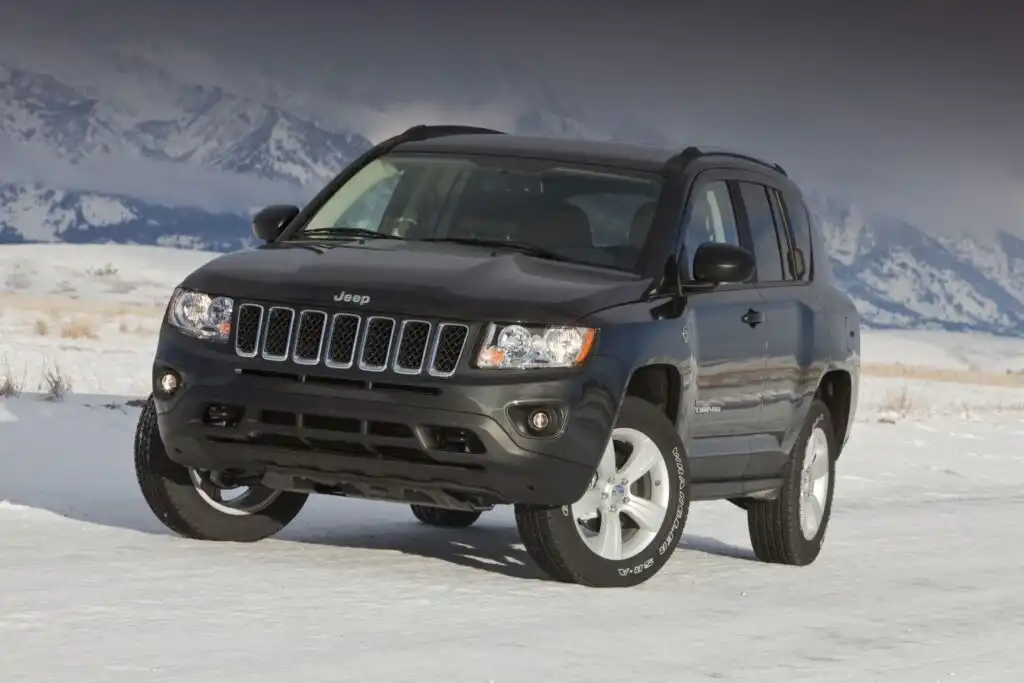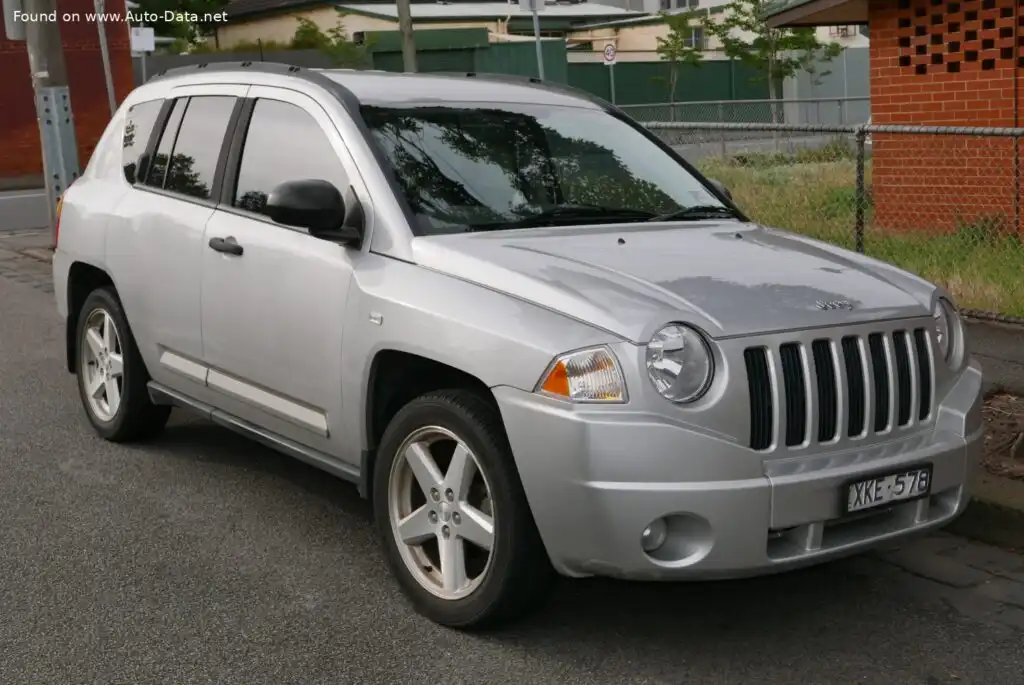
The Jeep Compass (MK) 2.0 (158 hp) CVT2 was a front-wheel drive crossover SUV produced by Jeep from 2006 to 2010. It represented Jeep’s entry into the compact crossover market, aiming to provide a more fuel-efficient and affordable alternative to the brand’s traditional, body-on-frame SUVs. This particular variant, equipped with the 2.0-liter engine and a continuously variable transmission (CVT2), was positioned as a mid-range offering within the Compass lineup, slotting between the base 2.4-liter engine and the more powerful 2.8-liter V6 options. The MK Compass was built on the shared 2HX platform, also used by the Dodge Caliber.
Technical Specifications
| Brand | Jeep |
| Model | Compass |
| Generation | Compass I (MK) |
| Type (Engine) | 2.0 (158 Hp) CVT2 |
| Start of production | August, 2006 |
| End of production | 2010 |
| Powertrain Architecture | Internal Combustion engine |
| Body type | SUV, Crossover |
| Seats | 5 |
| Doors | 5 |
| Fuel consumption (economy) – urban (EPA) | 10.2 l/100 km (23.1 US mpg) |
| Fuel consumption (economy) – extra urban (EPA) | 8.7 l/100 km (27 US mpg) |
| Fuel Type | Petrol (Gasoline) |
| Weight-to-power ratio | 8.9 kg/Hp |
| Weight-to-torque ratio | 7.4 kg/Nm |
| Power | 158 Hp @ 6400 rpm |
| Power per litre | 79.1 Hp/l |
| Torque | 191 Nm @ 5000 rpm (140.87 lb.-ft. @ 5000 rpm) |
| Maximum engine speed | 6750 rpm |
| Engine layout | Front, Transverse |
| Engine Model/Code | World / ECN |
| Engine displacement | 1998 cm3 (121.93 cu. in.) |
| Number of cylinders | 4 |
| Engine configuration | Inline |
| Cylinder Bore | 86 mm (3.39 in.) |
| Piston Stroke | 86 mm (3.39 in.) |
| Compression ratio | 10.5:1 |
| Number of valves per cylinder | 4 |
| Fuel injection system | Multi-port manifold injection |
| Engine aspiration | Naturally aspirated engine |
| Valvetrain | DOHC, Dual VVT |
| Engine oil capacity | 4.26 l (4.5 US qt | 3.75 UK qt) |
| Coolant | 6.8 l (7.19 US qt | 5.98 UK qt) |
| Kerb Weight | 1404 kg (3095.29 lbs.) |
| Trunk (boot) space – minimum | 643 l (22.71 cu. ft.) |
| Trunk (boot) space – maximum | 1719 l (60.71 cu. ft.) |
| Fuel tank capacity | 51.5 l (13.6 US gal | 11.33 UK gal) |
| Length | 4405 mm (173.43 in.) |
| Width | 1761 mm (69.33 in.) |
| Height | 1632 mm (64.25 in.) |
| Wheelbase | 2635 mm (103.74 in.) |
| Front track | 1520 mm (59.84 in.) |
| Rear (Back) track | 1520 mm (59.84 in.) |
| Front overhang | 877 mm (34.53 in.) |
| Rear overhang | 893 mm (35.16 in.) |
| Ride height (ground clearance) | 207-214 mm (8.15 – 8.43 in.) |
| Minimum turning circle (turning diameter) | 10.8 m (35.43 ft.) |
| Approach angle | 20.1-20.6° |
| Departure angle | 31.4-32.2° |
| Ramp-over (brakeover) angle | 20.3-21° |
| Drivetrain Architecture | The Internal combustion engine (ICE) drives the front wheels of the vehicle. |
| Drive wheel | Front wheel drive |
| Number of gears and type of gearbox | automatic transmission CVT2 |
| Front suspension | Independent, type McPherson with coil spring and anti-roll bar |
| Rear suspension | Independent multi-link spring suspension with stabilizer |
| Front brakes | Ventilated discs, 294×26 mm |
| Rear brakes | Drum, 229×35 mm |
| Assisting systems | ABS (Anti-lock braking system) |
| Steering type | Steering rack and pinion |
| Power steering | Hydraulic Steering |
| Tires size | 215/60 R17; 215/55 R18 |
| Wheel rims size | 6.5J x 17; 7J x 18 |
Powertrain & Engine Architecture
The 2.0-liter inline-four engine, designated as the “World” engine by Chrysler (ECN being a specific variant code), was a key component of the Compass’s appeal. This engine featured a cast iron block and an aluminum cylinder head, incorporating dual overhead camshafts (DOHC) and variable valve timing (VVT) on both intake and exhaust valves. The multi-port fuel injection system delivered fuel directly to the intake ports, optimizing combustion efficiency. The engine produced 158 horsepower at 6400 rpm and 191 Nm (140.87 lb-ft) of torque at 5000 rpm. The CVT2 transmission, a second-generation continuously variable transmission developed by Jatco, was paired exclusively with this engine. Unlike traditional automatic transmissions with fixed gear ratios, the CVT2 utilized a belt and pulley system to provide a virtually infinite number of gear ratios, optimizing engine efficiency and smoothness.
Driving Characteristics
The 2.0-liter Compass with the CVT2 offered a comfortable, if not particularly sporty, driving experience. The CVT transmission prioritized fuel economy over rapid acceleration. While the engine provided adequate power for everyday driving, it lacked the punch of the optional 2.8-liter V6. The CVT’s “stepped” programming attempted to mimic the feel of a traditional automatic transmission, but it could sometimes feel sluggish during quick acceleration. The CVT’s gear ratios were optimized for fuel efficiency, resulting in a more relaxed driving experience at highway speeds. Compared to the manual transmission versions of the 2.0-liter engine, the CVT offered smoother operation but sacrificed some responsiveness.
Equipment & Trim Levels
The 2.0-liter CVT2 Compass typically came standard with features such as air conditioning, power windows and locks, a CD player with auxiliary input, and anti-lock brakes (ABS). Higher trim levels, such as the Limited, added features like alloy wheels, upgraded interior upholstery, a premium sound system, and available options like a sunroof and leather seats. The interior design was functional but somewhat basic, reflecting the Compass’s position as an entry-level crossover. The dashboard layout was straightforward, with easy-to-use controls.
Chassis & Braking
The Compass utilized an independent McPherson strut suspension in the front and an independent multi-link suspension in the rear. This suspension setup provided a reasonably comfortable ride, although it wasn’t particularly refined. The front brakes were ventilated discs, while the rear brakes were drum brakes. The use of drum brakes in the rear was a cost-saving measure, and it did impact braking performance compared to models equipped with four-wheel disc brakes. A stabilizer bar was included on both the front and rear axles to reduce body roll during cornering.
Market Reception & Comparison
The Jeep Compass 2.0L CVT2 received mixed reviews from automotive critics. While the fuel economy was praised, the engine’s performance and the CVT transmission’s responsiveness were often criticized. Compared to competitors like the Honda CR-V and Toyota RAV4, the Compass offered a lower price point but lacked the refinement and driving dynamics of those established models. The 2.4-liter engine offered a slightly more engaging driving experience, while the 2.8-liter V6 provided significantly more power. However, the 2.0-liter CVT2 appealed to buyers prioritizing fuel efficiency and affordability.
Legacy
The 2.0-liter engine and CVT2 transmission combination in the first-generation Jeep Compass proved to be reasonably reliable, although the CVT transmission did require regular fluid changes to prevent premature wear. In the used car market, these models are often found at lower price points, making them an attractive option for budget-conscious buyers. However, potential buyers should be aware of the CVT transmission’s maintenance requirements and the engine’s relatively modest power output. The Compass, despite its initial lukewarm reception, played a role in expanding Jeep’s lineup and attracting a new segment of customers to the brand.