Technical Specifications
| Brand | Jeep |
| Model | Compass |
| Generation | Compass I (MK) |
| Type (Engine) | 2.4 (170 Hp) CVT 4×4 |
| Start of production | 2006 |
| End of production | 2010 |
| Powertrain Architecture | Internal Combustion engine |
| Body type | SUV, Crossover |
| Seats | 5 |
| Doors | 4 |
| Fuel consumption (urban) | 11.5 l/100 km (20.5 US mpg) |
| Fuel consumption (extra urban) | 8.3 l/100 km (28.3 US mpg) |
| Fuel consumption (combined) | 9.5 l/100 km (24.8 US mpg) |
| Fuel Type | Petrol (Gasoline) |
| Acceleration 0 – 100 km/h | 11.5 sec |
| Acceleration 0 – 62 mph | 11.5 sec |
| Acceleration 0 – 60 mph | 10.9 sec |
| Maximum speed | 185 km/h (114.95 mph) |
| Emission standard | Euro 4 |
| Weight-to-power ratio | 9.8 kg/Hp |
| Weight-to-torque ratio | 7.5 kg/Nm |
| Power | 170 Hp @ 6000 rpm |
| Torque | 220 Nm @ 4500 rpm (162.26 lb.-ft. @ 4500 rpm) |
| Engine layout | Front, Transverse |
| Engine Model/Code | ED3 |
| Engine displacement | 2360 cm3 (144.02 cu. in.) |
| Number of cylinders | 4 |
| Engine configuration | Inline |
| Cylinder Bore | 88 mm (3.46 in.) |
| Piston Stroke | 97 mm (3.82 in.) |
| Compression ratio | 11:1 |
| Number of valves per cylinder | 4 |
| Fuel injection system | Multi-port manifold injection |
| Engine aspiration | Naturally aspirated engine |
| Engine oil capacity | 4.26 l (4.5 US qt | 3.75 UK qt) |
| Coolant capacity | 6.8 l (7.19 US qt | 5.98 UK qt) |
| Kerb Weight | 1660 kg (3659.67 lbs.) |
| Max. weight | 1980 kg (4365.15 lbs.) |
| Max load | 320 kg (705.48 lbs.) |
| Trunk (boot) space – minimum | 334 l (11.8 cu. ft.) |
| Trunk (boot) space – maximum | 1277 l (45.1 cu. ft.) |
| Fuel tank capacity | 51 l (13.47 US gal | 11.22 UK gal) |
| Max. roof load | 68 kg (149.91 lbs.) |
| Length | 4405 mm (173.43 in.) |
| Width | 1810 mm (71.26 in.) |
| Height | 1630 mm (64.17 in.) |
| Wheelbase | 2635 mm (103.74 in.) |
| Front track | 1520 mm (59.84 in.) |
| Rear (Back) track | 1520 mm (59.84 in.) |
| Drive wheel | All wheel drive (4×4) |
| Number of gears and type of gearbox | automatic transmission CVT |
| Front suspension | Independent, type McPherson with coil spring and anti-roll bar |
| Rear suspension | Independent coil spring |
| Front brakes | Ventilated discs |
| Rear brakes | Disc |
| Assisting systems | ABS (Anti-lock braking system) |
| Steering type | Steering rack and pinion |
| Power steering | Hydraulic Steering |
| Tires size | 215/60 R17 |
| Wheel rims size | 6.5 J x 17 |
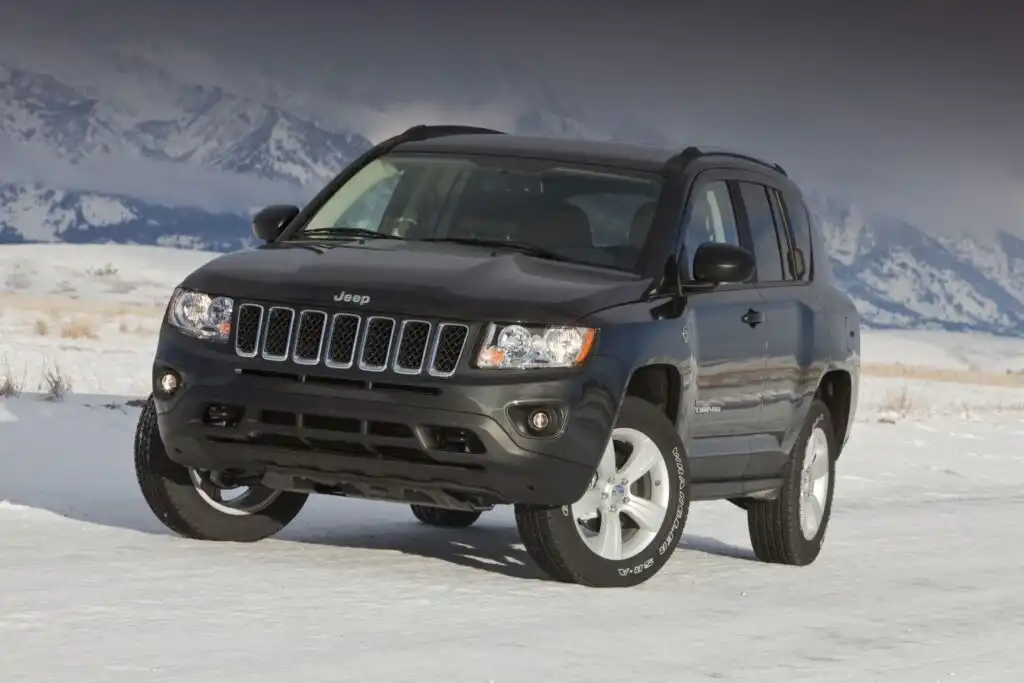
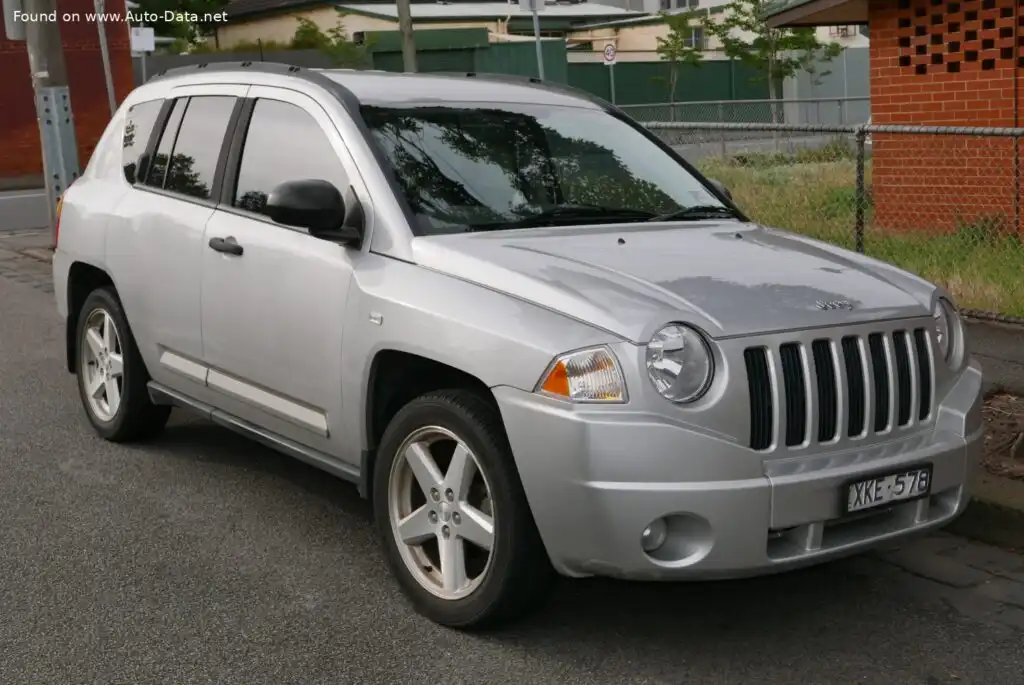
The Jeep Compass MK, introduced in 2006, marked a significant shift for the Jeep brand, venturing into the increasingly popular compact crossover SUV segment. Designed to broaden Jeep’s appeal beyond its traditional, more rugged customer base, the Compass aimed to deliver the brand’s renowned four-wheel-drive capability in a more fuel-efficient and city-friendly package. The 2.4-liter engine paired with a continuously variable transmission (CVT) and a four-wheel-drive system was a common configuration, striking a balance between performance, fuel economy, and price. Built on the 2HX platform, shared with the Dodge Caliber, the Compass represented Jeep’s attempt to gain a foothold in a competitive market.
Powertrain & Engine Architecture
The 2.4-liter engine, designated the ED3, was the primary powerplant for this Compass variant. This inline-four cylinder engine featured a single overhead camshaft (SOHC) design with four valves per cylinder. It employed multi-port fuel injection to deliver fuel to the cylinders, and was designed for smooth operation rather than outright performance. The engine produced 170 horsepower at 6000 rpm and 220 Nm (162 lb-ft) of torque at 4500 rpm. The engine was mated to a CVT transmission, a relatively new technology at the time, designed to provide seamless gear changes and optimize fuel efficiency. Unlike traditional automatic transmissions with fixed gear ratios, the CVT continuously adjusted the gear ratio to keep the engine operating in its most efficient range. The 4×4 system was an active system, automatically engaging all-wheel drive when wheel slippage was detected, enhancing traction in various driving conditions.
Driving Characteristics
On the road, the Jeep Compass 2.4L with the CVT and 4×4 system offered adequate performance for everyday driving. Acceleration from 0 to 60 mph took approximately 10.9 seconds. The CVT transmission, while providing smooth operation, could sometimes exhibit a “rubber band” effect, where engine speed would increase without a corresponding increase in vehicle speed. This sensation was more noticeable during aggressive acceleration. Compared to the available five-speed manual transmission or the more powerful 2.0-liter engine option, the 2.4L CVT felt less responsive. However, the CVT’s efficiency contributed to improved fuel economy. The 4×4 system provided added confidence in slippery conditions, making the Compass capable of handling light off-road trails and inclement weather. The steering was light and easy to use, making it well-suited for navigating city streets.
Equipment & Trim Levels
The Compass 2.4L CVT 4×4 typically came equipped with standard features such as air conditioning, power windows and door locks, a CD player with an auxiliary input jack, and anti-lock brakes (ABS). Higher trim levels, like the Limited, added features such as alloy wheels, upgraded interior trim materials, a premium sound system, and a power sunroof. Interior upholstery was generally cloth, with leather options available on the higher trim levels. Optional extras included a navigation system, heated front seats, and a rear cargo organizer. The dashboard design was functional but relatively basic, reflecting the Compass’s position as an entry-level SUV.
Chassis & Braking
The Jeep Compass utilized an independent suspension system, featuring a McPherson strut setup at the front and an independent coil spring setup at the rear. This suspension configuration aimed to provide a comfortable ride quality. The front brakes were ventilated discs, offering improved cooling and stopping power, while the rear brakes were solid discs. ABS was standard equipment, enhancing braking control during emergency stops. The Compass’s chassis was designed to balance ride comfort with handling stability. The addition of the 4×4 system increased the vehicle’s weight, but also contributed to improved stability and traction, particularly on loose or slippery surfaces.
Market Reception & Comparison
The Jeep Compass 2.4L CVT 4×4 received a mixed reception from automotive critics. While its off-road capability and fuel efficiency were acknowledged, it was often criticized for its unrefined interior and somewhat lackluster performance. Compared to competitors like the Honda CR-V and Toyota RAV4, the Compass offered a more rugged aesthetic and a more capable 4×4 system, but it lacked the refinement and driving dynamics of its Japanese rivals. Fuel economy was comparable to other compact SUVs of the time, averaging around 25 miles per gallon in combined driving. Reliability was generally considered average, with some reports of issues related to the CVT transmission.
Legacy
The first-generation Jeep Compass, including the 2.4L CVT 4×4 variant, played a role in Jeep’s expansion into the compact SUV segment. While it didn’t achieve the same level of success as some of its competitors, it helped broaden the brand’s appeal and attract a new customer base. The CVT transmission, despite initial concerns, proved to be reasonably reliable in many cases. Today, used examples of the Compass 2.4L CVT 4×4 are relatively affordable and can be a viable option for buyers seeking a capable and fuel-efficient SUV with Jeep’s distinctive styling. However, prospective buyers should be aware of the potential for CVT transmission issues and ensure the vehicle has been well-maintained throughout its life.