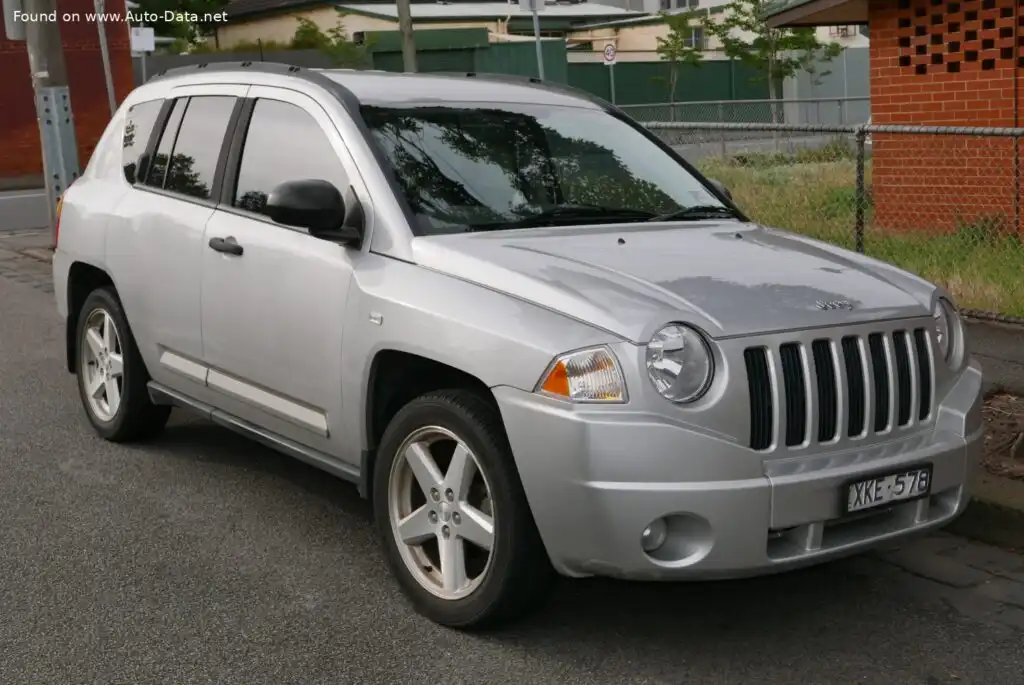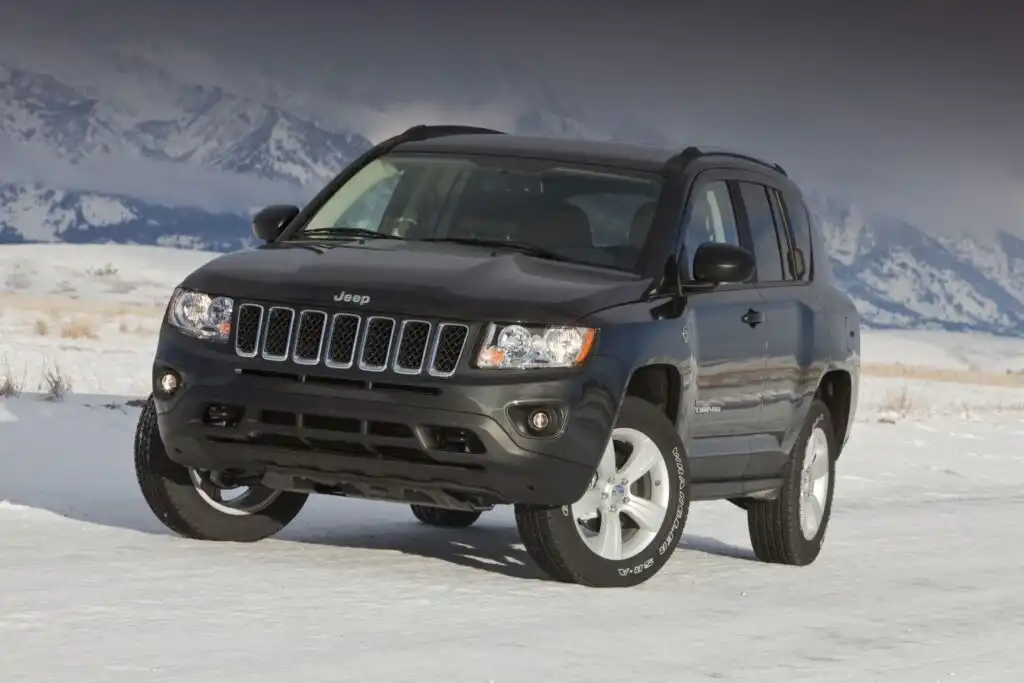
The Jeep Compass I (MK), specifically the facelifted version produced from 2011 to 2013, represented Jeep’s entry into the increasingly popular compact crossover SUV segment. This iteration of the Compass, built on the 2HX platform shared with the Dodge Caliber, aimed to offer a more refined and capable alternative to traditional small SUVs. The 2.4-liter (170 hp) 4×4 variant occupied a mid-range position within the Compass lineup, offering a balance between performance, fuel efficiency, and all-weather capability. It served as a step up from the base 2.0-liter engine, appealing to buyers seeking more power and the added security of four-wheel drive.
Technical Specifications
| Brand | Jeep |
| Model | Compass |
| Generation | Compass I (MK, facelift 2011) |
| Type (Engine) | 2.4 (170 Hp) 4×4 |
| Start of production | 2011 |
| End of production | 2013 |
| Powertrain Architecture | Internal Combustion engine |
| Body type | SUV, Crossover |
| Seats | 5 |
| Doors | 4 |
| Fuel consumption (urban) | 10.9 l/100 km (21.6 US mpg) |
| Fuel consumption (extra urban) | 6.4 l/100 km (36.8 US mpg) |
| Fuel consumption (combined) | 8.1 l/100 km (29 US mpg) |
| CO2 emissions | 187 g/km |
| Fuel Type | Petrol (Gasoline) |
| Acceleration 0 – 100 km/h | 10.7 sec |
| Acceleration 0 – 62 mph | 10.7 sec |
| Acceleration 0 – 60 mph | 10.2 sec |
| Maximum speed | 180 km/h (111.85 mph) |
| Emission standard | Euro 5 |
| Weight-to-power ratio | 8.6 kg/Hp |
| Weight-to-torque ratio | 6.6 kg/Nm |
| Power | 170 Hp @ 6000 rpm |
| Torque | 220 Nm @ 4500 rpm (162.26 lb.-ft. @ 4500 rpm) |
| Engine layout | Front, Transverse |
| Engine Model/Code | World / ED3 |
| Engine displacement | 2359 cm3 (143.96 cu. in.) |
| Number of cylinders | 4 |
| Engine configuration | Inline |
| Cylinder Bore | 88 mm (3.46 in.) |
| Piston Stroke | 97 mm (3.82 in.) |
| Compression ratio | 10.5:1 |
| Number of valves per cylinder | 4 |
| Fuel injection system | Multi-port manifold injection |
| Engine aspiration | Naturally aspirated engine |
| Valvetrain | DOHC, Dual VVT |
| Engine oil capacity | 4.26 l (4.5 US qt | 3.75 UK qt) |
| Coolant capacity | 6.8 l (7.19 US qt | 5.98 UK qt) |
| Kerb Weight | 1460-1575 kg (3218.75 – 3472.28 lbs.) |
| Max. weight | 1980 kg (4365.15 lbs.) |
| Max load | 405-520 kg (892.87 – 1146.4 lbs.) |
| Trunk (boot) space – minimum | 458 l (16.17 cu. ft.) |
| Trunk (boot) space – maximum | 1269 l (44.81 cu. ft.) |
| Fuel tank capacity | 51 l (13.47 US gal | 11.22 UK gal) |
| Max. roof load | 68 kg (149.91 lbs.) |
| Permitted trailer load with brakes (12%) | 1500 kg (3306.93 lbs.) |
| Permitted trailer load without brakes | 450 kg (992.08 lbs.) |
| Length | 4448 mm (175.12 in.) |
| Width | 1812 mm (71.34 in.) |
| Height | 1718 mm (67.64 in.) |
| Wheelbase | 2635 mm (103.74 in.) |
| Front track | 1520 mm (59.84 in.) |
| Rear track | 1520 mm (59.84 in.) |
| Front overhang | 916 mm (36.06 in.) |
| Rear overhang | 897 mm (35.31 in.) |
| Ride height (ground clearance) | 205 mm (8.07 in.) |
| Minimum turning circle | 11.3 m (37.07 ft.) |
| Approach angle | 20° |
| Departure angle | 32° |
| Ramp-over angle | 20° |
| Drivetrain Architecture | All wheel drive (4×4). ICE drives front wheels, rear wheels engaged via clutch. |
| Number of gears | 5 |
| Type of gearbox | Manual transmission |
| Front suspension | Independent, McPherson with coil spring and anti-roll bar |
| Rear suspension | Independent multi-link spring suspension with stabilizer |
| Front brakes | Ventilated discs |
| Rear brakes | Disc |
| Assisting systems | ABS (Anti-lock braking system) |
| Steering type | Steering rack and pinion |
| Power steering | Hydraulic |
| Tires size | 215/60 R17 |
| Wheel rims size | 6.5J x 17 |
Powertrain & Engine Architecture
The 2011-2013 Jeep Compass 2.4 4×4 was powered by the Chrysler World Engine, specifically the ED3 variant. This 2.4-liter inline-four cylinder engine produced 170 horsepower at 6000 rpm and 220 Nm (162 lb-ft) of torque at 4500 rpm. The engine featured a cast iron block with an aluminum cylinder head, dual overhead camshafts (DOHC), and variable valve timing (VVT) on both intake and exhaust valves. This configuration aimed to optimize both power and fuel efficiency. Fuel delivery was handled by a multi-port fuel injection system. The engine was transversely mounted in the front of the vehicle. The 4×4 system utilized a fully automatic four-wheel-drive system, engaging the rear wheels when traction was lost. The transmission was a 5-speed manual, providing direct control over gear selection.
Driving Characteristics
The 2.4-liter engine and 5-speed manual transmission combination in the Compass offered a reasonably responsive driving experience, though it wasn’t particularly sporty. Acceleration from 0-60 mph took around 10.2 seconds. The engine provided adequate power for everyday driving situations, including highway merging and passing. The manual transmission allowed for greater driver engagement compared to the available continuously variable transmission (CVT). However, the gear ratios were tuned more for fuel economy than outright performance. Compared to the base 2.0-liter engine, the 2.4-liter offered a noticeable improvement in acceleration and overall drivability. It didn’t match the performance of larger SUVs, but it provided a comfortable and capable driving experience for its class.
Equipment & Trim Levels
The 2.4-liter 4×4 Compass typically came equipped with features such as air conditioning, power windows and locks, a basic audio system with CD player, and cloth upholstery. Higher trim levels, such as the Limited, added features like alloy wheels, upgraded audio systems, a sunroof, and leather upholstery. Optional extras included a navigation system, remote start, and a premium sound system. Safety features included ABS, front airbags, and side curtain airbags.
Chassis & Braking
The Compass featured an independent suspension system, with a McPherson strut setup at the front and a multi-link setup at the rear. This provided a relatively comfortable ride, although it wasn’t as refined as some of its competitors. The 4×4 system added to the vehicle’s stability and handling, particularly in adverse weather conditions. The braking system consisted of ventilated discs at the front and solid discs at the rear. ABS was standard, providing enhanced braking control.
Market Reception & Comparison
The 2011-2013 Jeep Compass 2.4 4×4 received mixed reviews. Critics praised its available four-wheel-drive system and relatively spacious interior, but criticized its unrefined ride and interior materials. Fuel economy was considered average for its class, with combined figures around 29 US mpg. Compared to other compact crossovers, such as the Honda CR-V and Toyota RAV4, the Compass offered a more affordable price point but lacked the same level of refinement and fuel efficiency. The 2.4-liter engine was generally considered a good compromise between power and fuel economy, but some reviewers found it to be noisy under hard acceleration.
Legacy
The Jeep Compass I, including the 2.4-liter 4×4 variant, has become a relatively affordable option in the used car market. The World Engine is generally considered reliable, although regular maintenance is crucial. Common issues include oil leaks and occasional sensor failures. The 4×4 system is generally robust, but it’s important to check for proper operation during a pre-purchase inspection. While not a class leader, the 2011-2013 Compass 2.4 4×4 offers a capable and affordable entry point into the compact crossover SUV segment, particularly for buyers seeking all-weather capability.