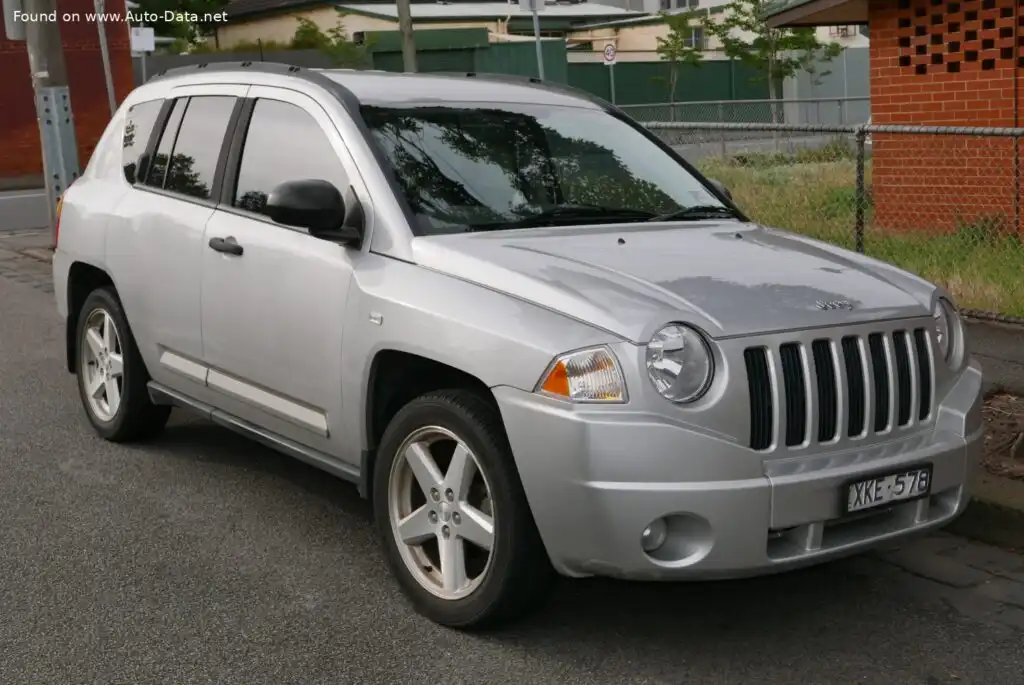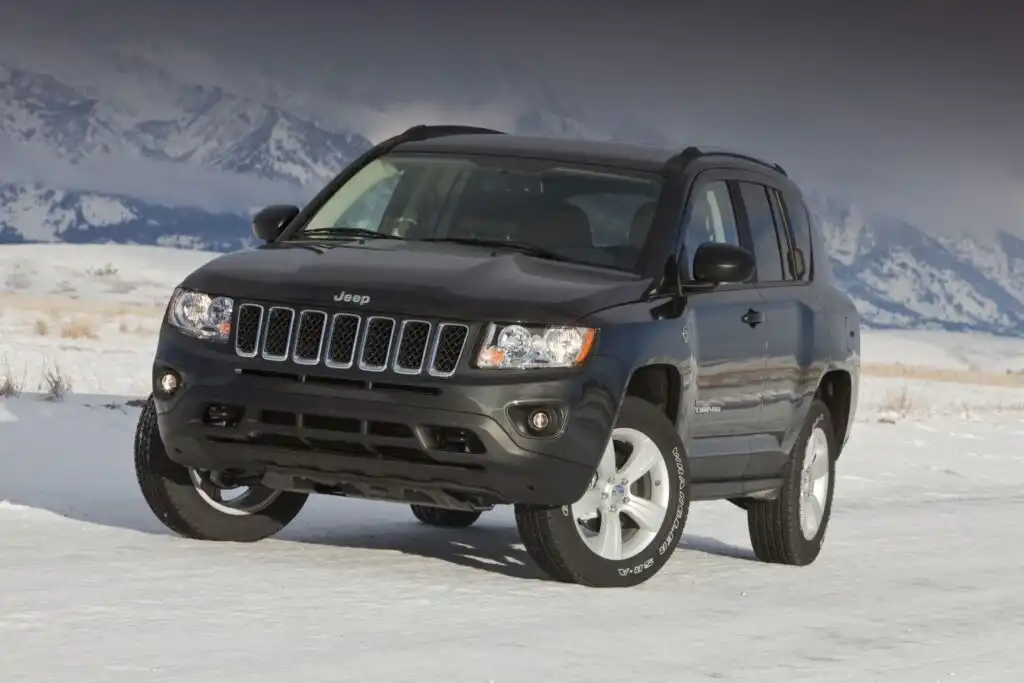
The Jeep Compass I (MK), specifically the facelifted version produced from 2011 to 2013, represented Jeep’s entry into the increasingly popular compact crossover SUV segment. This iteration of the Compass, built on the 2HX platform shared with the Dodge Caliber, aimed to offer a more refined and capable alternative to traditional small SUVs. The 2.4-liter (170 hp) 4×4 CVT variant occupied a mid-range position within the Compass lineup, offering a balance between performance, fuel efficiency, and all-weather capability. It served as a step up from the base 2.0-liter engine, while remaining more accessible than the more rugged Trailhawk models.
Technical Specifications
| Brand | Jeep |
| Model | Compass |
| Generation | Compass I (MK, facelift 2011) |
| Type (Engine) | 2.4 (170 Hp) 4×4 CVT |
| Start of production | 2011 |
| End of production | 2013 |
| Powertrain Architecture | Internal Combustion engine |
| Body type | SUV, Crossover |
| Seats | 5 |
| Doors | 5 |
| Fuel consumption (urban) | 11.3 l/100 km (20.8 US mpg, 25 UK mpg, 8.8 km/l) |
| Fuel consumption (extra urban) | 7 l/100 km (33.6 US mpg, 40.4 UK mpg, 14.3 km/l) |
| Fuel consumption (combined) | 8.6 l/100 km (27.4 US mpg, 32.8 UK mpg, 11.6 km/l) |
| CO2 emissions | 199 g/km |
| Fuel Type | Petrol (Gasoline) |
| Acceleration 0 – 100 km/h | 10.7 sec |
| Acceleration 0 – 62 mph | 10.7 sec |
| Acceleration 0 – 60 mph | 10.2 sec |
| Maximum speed | 180 km/h (111.85 mph) |
| Emission standard | Euro 5 |
| Weight-to-power ratio | 9 kg/Hp, 111.1 Hp/tonne |
| Weight-to-torque ratio | 7 kg/Nm, 143.8 Nm/tonne |
| Power | 170 Hp @ 6000 rpm |
| Power per litre | 72.1 Hp/l |
| Torque | 220 Nm @ 4500 rpm (162.26 lb.-ft. @ 4500 rpm) |
| Engine layout | Front, Transverse |
| Engine Model/Code | World / ED3 |
| Engine displacement | 2359 cm3 (143.96 cu. in.) |
| Number of cylinders | 4 |
| Engine configuration | Inline |
| Cylinder Bore | 88 mm (3.46 in.) |
| Piston Stroke | 97 mm (3.82 in.) |
| Compression ratio | 10.5:1 |
| Number of valves per cylinder | 4 |
| Fuel injection system | Multi-port manifold injection |
| Engine aspiration | Naturally aspirated engine |
| Valvetrain | DOHC, Dual VVT |
| Engine oil capacity | 4.26 l (4.5 US qt | 3.75 UK qt) |
| Coolant | 6.8 l (7.19 US qt | 5.98 UK qt) |
| Kerb Weight | 1530-1586 kg (3373.07 – 3496.53 lbs.) |
| Max. weight | 1980 kg (4365.15 lbs.) |
| Max load | 394-450 kg (868.62 – 992.08 lbs.) |
| Trunk (boot) space – minimum | 458 l (16.17 cu. ft.) |
| Trunk (boot) space – maximum | 1269 l (44.81 cu. ft.) |
| Fuel tank capacity | 51 l (13.47 US gal | 11.22 UK gal) |
| Permitted trailer load with brakes (12%) | 1500 kg (3306.93 lbs.) |
| Permitted trailer load without brakes | 450 kg (992.08 lbs.) |
| Length | 4448 mm (175.12 in.) |
| Width | 1812 mm (71.34 in.) |
| Height | 1718 mm (67.64 in.) |
| Wheelbase | 2635 mm (103.74 in.) |
| Front track | 1520 mm (59.84 in.) |
| Rear (Back) track | 1520 mm (59.84 in.) |
| Front overhang | 916 mm (36.06 in.) |
| Rear overhang | 897 mm (35.31 in.) |
| Ride height (ground clearance) | 205 mm (8.07 in.) |
| Minimum turning circle (turning diameter) | 11.3 m (37.07 ft.) |
| Approach angle | 20° |
| Departure angle | 32° |
| Ramp-over (brakeover) angle | 20° |
| Drivetrain Architecture | The Internal combustion engine (ICE) drives the front wheels permanently, and the rear wheels are driven through an electrically or mechanically operated clutch if necessary. |
| Drive wheel | All wheel drive (4×4) |
| Number of gears and type of gearbox | automatic transmission CVT |
| Front suspension | Independent, type McPherson with coil spring and anti-roll bar |
| Rear suspension | Independent multi-link spring suspension with stabilizer |
| Front brakes | Ventilated discs |
| Rear brakes | Disc |
| Assisting systems | ABS (Anti-lock braking system) |
| Steering type | Steering rack and pinion |
| Power steering | Hydraulic Steering |
| Tires size | 215/55 R18 |
| Wheel rims size | 7J x 18 |
INTRODUCTION
The 2011-2013 Jeep Compass 2.4 4×4 CVT represented a significant refresh of the original Compass launched in 2007. The facelift addressed many criticisms leveled at the initial model, including interior quality and exterior styling. This version aimed to broaden the Compass’s appeal by offering a more comfortable and refined driving experience, while retaining Jeep’s core competency of off-road capability, albeit in a more limited form than dedicated off-roaders. The 2.4-liter engine paired with a continuously variable transmission (CVT) and four-wheel drive was positioned as a practical choice for buyers seeking all-weather traction and reasonable fuel economy.
Powertrain & Engine Architecture
At the heart of the Compass 2.4 4×4 CVT lies the World Engine family’s 2.4-liter inline-four cylinder gasoline engine, internally designated as the ED3. This engine, developed in collaboration with Hyundai, featured a cast iron block and aluminum cylinder head. It employed multi-port fuel injection and a dual overhead camshaft (DOHC) valvetrain with variable valve timing (VVT) on both intake and exhaust camshafts. This configuration helped optimize engine performance and efficiency across a wider range of engine speeds. The engine produced 170 horsepower at 6000 rpm and 220 Nm (162 lb-ft) of torque at 4500 rpm. The CVT transmission, while offering smooth and stepless gear changes, was a point of contention for some drivers, as it lacked the direct feel of a traditional automatic transmission. The 4×4 system was an on-demand system, primarily driving the front wheels and engaging the rear wheels when wheel slip was detected.
Driving Characteristics
The 2.4-liter engine and CVT combination in the Compass delivered adequate, but not exhilarating, performance. Acceleration from 0-60 mph took around 10.2 seconds, making it competitive with other compact crossovers of the time. The CVT transmission prioritized fuel efficiency over outright acceleration, resulting in a somewhat “rubber band” feel during hard acceleration. The continuously variable ratios meant the engine often held at a constant rpm during acceleration, which some drivers found unnatural. The four-wheel drive system provided enhanced traction in slippery conditions, but the Compass was not designed for serious off-roading. The suspension tuning prioritized comfort over sporty handling, resulting in a relatively soft and compliant ride.
Equipment & Trim Levels
The 2.4 4×4 CVT trim typically included standard features such as air conditioning, power windows and locks, a basic audio system with CD player and auxiliary input, and cloth upholstery. Higher trim levels, such as the Limited, added features like leather upholstery, heated front seats, a premium audio system, and alloy wheels. Optional extras included a sunroof, navigation system, and remote start. Safety features such as anti-lock brakes (ABS) and electronic stability control were standard.
Chassis & Braking
The Compass utilized an independent McPherson strut suspension in the front and an independent multi-link suspension in the rear. This setup provided a reasonable balance between ride comfort and handling. Front brakes were ventilated discs, while rear brakes were solid discs. The hydraulic power steering provided adequate assistance, but lacked the feel of more modern electric power steering systems. The 215/55 R18 tires offered a good compromise between comfort and grip.
Market Reception & Comparison
The 2011-2013 Jeep Compass received mixed reviews. Critics praised the improved interior quality and styling compared to the original model, but the CVT transmission and somewhat lackluster performance were common criticisms. Compared to other compact crossovers like the Honda CR-V and Toyota RAV4, the Compass offered a more affordable price point and Jeep’s brand image of ruggedness. However, it generally lagged behind these competitors in terms of refinement, fuel economy, and overall driving experience. The 2.4-liter engine offered a better balance of power and fuel economy than the base 2.0-liter engine, but the manual transmission versions of the 2.4 offered a more engaging driving experience.
Legacy
The Jeep Compass I (MK) ultimately proved to be a transitional model for the brand. While it didn’t achieve the same sales success as some of its competitors, it laid the groundwork for the significantly improved second-generation Compass launched in 2017. The 2.4-liter engine and CVT powertrain, while not known for exceptional reliability, generally proved to be durable with proper maintenance. Today, used examples of the 2011-2013 Compass 2.4 4×4 CVT are relatively affordable and can represent a good value for buyers seeking a practical and capable compact crossover, particularly in regions with inclement weather. However, potential buyers should be aware of the CVT transmission’s potential for issues and ensure it has been properly maintained.