Technical Specifications
| Brand | Jeep |
| Model | Compass |
| Generation | Compass II (MP) |
| Type (Engine) | 1.4 MultiAir (140 Hp) |
| Start of production | July, 2017 |
| End of production | July, 2020 |
| Powertrain Architecture | Internal Combustion engine |
| Body type | SUV, Crossover |
| Seats | 5 |
| Doors | 5 |
| Fuel consumption (urban) | 7.8-8.7 l/100 km (30.2 – 27 US mpg) |
| Fuel consumption (extra urban) | 5.2-5.7 l/100 km (45.2 – 41.3 US mpg) |
| Fuel consumption (combined) | 6.2-6.8 l/100 km (37.9 – 34.6 US mpg) |
| CO2 emissions | 143-155 g/km |
| Fuel Type | Petrol (Gasoline) |
| Acceleration 0 – 100 km/h | 9.9 sec |
| Acceleration 0 – 62 mph | 9.9 sec |
| Acceleration 0 – 60 mph | 9.4 sec |
| Maximum speed | 192 km/h (119.3 mph) |
| Emission standard | Euro 6 |
| Weight-to-power ratio | 10.2 kg/Hp |
| Weight-to-torque ratio | 6.2 kg/Nm |
| Power | 140 Hp @ 5000 rpm |
| Torque | 230 Nm @ 1750 rpm (169.64 lb.-ft. @ 1750 rpm) |
| Engine layout | Front, Transverse |
| Engine Model/Code | EAQ |
| Engine displacement | 1368 cm3 (83.48 cu. in.) |
| Number of cylinders | 4 |
| Engine configuration | Inline |
| Cylinder Bore | 72 mm (2.83 in.) |
| Piston Stroke | 84 mm (3.31 in.) |
| Compression ratio | 10:1 |
| Number of valves per cylinder | 4 |
| Fuel injection system | Multi-port manifold injection |
| Engine aspiration | Turbocharger, Intercooler |
| Valvetrain | SOHC |
| Engine oil capacity | 3.8 l (4.02 US qt | 3.34 UK qt) |
| Coolant capacity | 5.2 l (5.49 US qt | 4.58 UK qt) |
| Kerb Weight | 1430-1536 kg (3152.61 – 3386.3 lbs.) |
| Max. weight | 1916 kg (4224.06 lbs.) |
| Max load | 380-486 kg (837.76 – 1071.45 lbs.) |
| Trunk (boot) space – minimum | 438 l (15.47 cu. ft.) |
| Trunk (boot) space – maximum | 1251 l (44.18 cu. ft.) |
| Fuel tank capacity | 60 l (15.85 US gal | 13.2 UK gal) |
| Max. roof load | 68 kg (149.91 lbs.) |
| Permitted trailer load (braked) | 1000 kg (2204.62 lbs.) |
| Permitted trailer load (unbraked) | 500 kg (1102.31 lbs.) |
| Permitted towbar download | 50 kg (110.23 lbs.) |
| Length | 4394 mm (172.99 in.) |
| Width | 1819 mm (71.61 in.) |
| Height | 1629 mm (64.13 in.) |
| Wheelbase | 2636 mm (103.78 in.) |
| Front track | 1547 mm (60.91 in.) |
| Rear track | 1547 mm (60.91 in.) |
| Ride height (ground clearance) | 198 mm (7.8 in.) |
| Minimum turning circle | 11.07 m (36.32 ft.) |
| Drivetrain Architecture | Front wheel drive |
| Number of gears | 6 |
| Gearbox type | Manual transmission |
| Front suspension | Independent, McPherson with coil spring and anti-roll bar |
| Rear suspension | Independent coil spring, Transverse stabilizer |
| Front brakes | Ventilated discs |
| Rear brakes | Disc |
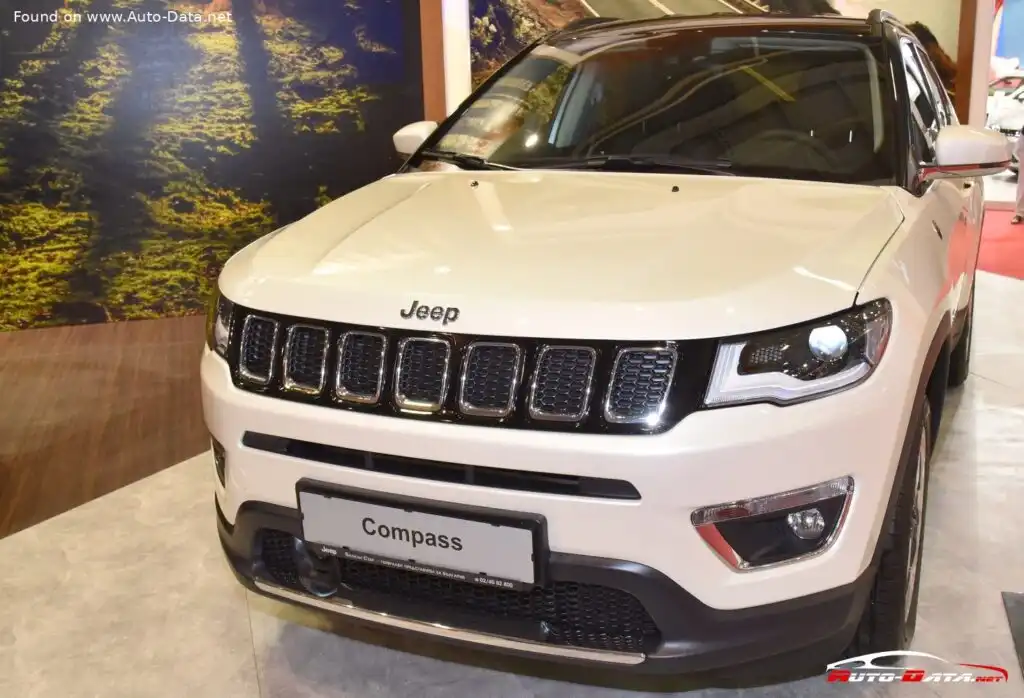
The Jeep Compass II (MP) 1.4 MultiAir, produced from July 2017 to July 2020, was a significant variant in the second generation of the Compass lineup. Positioned as a mainstream offering, it aimed to strike a balance between affordability and the modern features expected in the compact SUV/Crossover segment. This model was particularly important for Jeep’s efforts to expand its appeal in European and Latin American markets, where smaller displacement engines were favored. Built on the 5HX platform, shared with the Fiat 500X, the second-generation Compass represented a substantial improvement over its predecessor in terms of refinement and overall driving experience.
Powertrain & Engine Architecture
The 1.4-liter MultiAir turbocharged inline-four cylinder engine, internally designated as the EAQ, powers this Compass variant. This engine is distinguished by its MultiAir technology, a fully variable valve actuation system. Unlike traditional camshafts, MultiAir utilizes hydraulic actuators to control valve opening and closing, enabling precise control over intake valve timing and lift. This innovative system enhances fuel efficiency, reduces emissions, and boosts torque output. A single-scroll turbocharger with an intercooler further enhances performance, delivering 140 horsepower at 5000 rpm and 230 Nm (169.64 lb-ft) of torque at 1750 rpm. The engine employs multi-point fuel injection for precise fuel delivery. The standard transmission for this trim was a 6-speed manual gearbox, channeling power to the front wheels. While automatic transmissions were available on other Compass models, they weren’t commonly paired with the 1.4 MultiAir engine in most markets.
Driving Characteristics
The combination of the 1.4 MultiAir engine and the 6-speed manual transmission provided adequate performance for daily driving needs. Acceleration from 0 to 60 mph took around 9.4 seconds, with a top speed of approximately 119.3 mph. The turbocharger provided a noticeable power boost during acceleration, although the engine could feel somewhat strained at higher speeds or when carrying a full load. The manual transmission offered precise and engaging shifts, and the gear ratios were well-matched for both city and highway driving. Compared to the larger 2.4-liter engine option available in some markets, the 1.4 MultiAir offered better fuel economy but at the expense of outright power. It also delivered a more connected and enjoyable driving experience compared to the available automatic transmissions.
Equipment & Trim Levels
The 1.4 MultiAir Compass typically came with a solid set of standard features. These included air conditioning, power windows and locks, a touchscreen infotainment system with Bluetooth connectivity, and essential safety features like ABS and airbags. Higher trim levels added features such as alloy wheels, a rearview camera, parking sensors, and upgraded interior materials. The standard interior upholstery was cloth, with optional leather available on higher trims. The dashboard layout was functional and modern, prioritizing ease of use. Optional extras included a panoramic sunroof, a navigation system, and advanced driver-assistance systems.
Chassis & Braking
The Compass II (MP) featured an independent suspension system on all four wheels. The front suspension utilized a McPherson strut design with a coil spring and anti-roll bar, while the rear suspension employed an independent coil spring setup with a transverse stabilizer. This suspension configuration provided a comfortable ride quality, though it wasn’t particularly focused on sporty handling. The braking system consisted of ventilated discs on the front wheels and solid discs on the rear. ABS (Anti-lock Braking System) was standard equipment. The steering was electrically assisted, offering light and precise steering feel.
Market Reception & Comparison
The Jeep Compass II (MP) 1.4 MultiAir was generally well-received by automotive critics as a capable and affordable compact SUV. The MultiAir engine was praised for its fuel efficiency and responsive nature, although some reviewers noted that it could feel underpowered in certain situations. Compared to other trims within the Compass lineup, the 1.4 MultiAir offered a more economical option for buyers prioritizing fuel efficiency over raw performance. It competed with popular compact SUVs like the Honda CR-V, Toyota RAV4, and Nissan Rogue, offering a unique combination of Jeep’s off-road heritage and modern features.
Legacy
The 1.4 MultiAir engine, while innovative, has been known to exhibit some reliability concerns, particularly related to the MultiAir system itself. Common issues include solenoid failures and oil leaks. However, with diligent maintenance and regular oil changes, the engine can prove relatively reliable. In the current used car market, the Compass II (MP) 1.4 MultiAir represents a relatively affordable entry point into Jeep ownership. Its fuel efficiency and reasonable running costs make it an appealing option for budget-conscious buyers. However, prospective buyers should be aware of the potential reliability issues associated with the MultiAir system and factor those considerations into their purchasing decision.