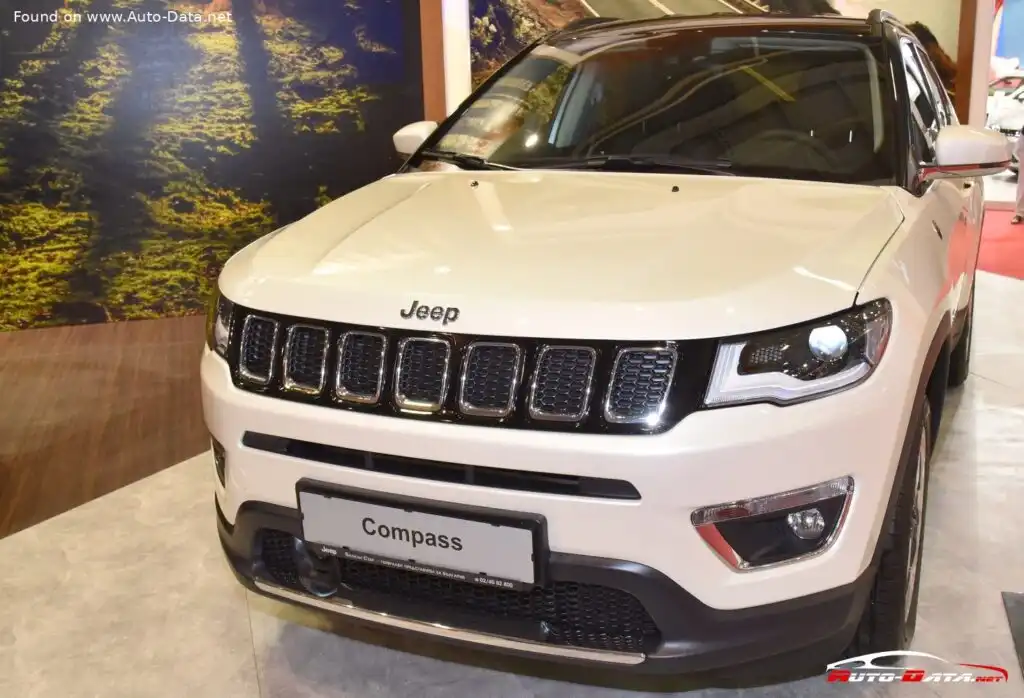
The Jeep Compass II (MP) 1.6 Multijet 120 horsepower variant was a key offering in the European and international markets between July 2017 and August 2018. Positioned as an entry-level diesel option within the broader Compass II (MP) range, it aimed to provide a balance of fuel efficiency and practicality for budget-conscious buyers. This model represented Jeep’s attempt to broaden the appeal of the Compass in regions where diesel engines were favored, and where smaller displacement engines were preferred due to taxation and fuel costs. It was built on the 551 platform, also known as the Small Wide architecture, shared with other Stellantis (then Fiat Chrysler Automobiles) vehicles.
Technical Specifications
| Brand | Jeep |
| Model | Compass |
| Generation | Compass II (MP) |
| Type (Engine) | 1.6 Multijet (120 Hp) |
| Start of production | July, 2017 |
| End of production | August, 2018 |
| Powertrain Architecture | Internal Combustion engine |
| Body type | SUV, Crossover |
| Seats | 5 |
| Doors | 5 |
| Fuel consumption (urban) | 5.2 l/100 km (45.2 US mpg, 54.3 UK mpg, 19.2 km/l) |
| Fuel consumption (extra urban) | 4 l/100 km (58.8 US mpg, 70.6 UK mpg, 25 km/l) |
| Fuel consumption (combined) | 4.4 l/100 km (53.5 US mpg, 64.2 UK mpg, 22.7 km/l) |
| CO2 emissions | 117 g/km |
| Fuel Type | Diesel |
| Acceleration 0 – 100 km/h | 11 sec |
| Acceleration 0 – 62 mph | 11 sec |
| Acceleration 0 – 60 mph | 10.5 sec |
| Maximum speed | 185 km/h (114.95 mph) |
| Emission standard | Euro 6 |
| Weight-to-power ratio | 11.9 kg/Hp, 83.9 Hp/tonne |
| Weight-to-torque ratio | 4.5 kg/Nm, 223.8 Nm/tonne |
| Power | 120 Hp @ 3750 rpm |
| Power per litre | 75.1 Hp/l |
| Torque | 320 Nm @ 1750 rpm (236.02 lb.-ft. @ 1750 rpm) |
| Engine layout | Front, Transverse |
| Engine Model/Code | EJJ |
| Engine displacement | 1598 cm3 (97.52 cu. in.) |
| Number of cylinders | 4 |
| Engine configuration | Inline |
| Cylinder Bore | 79.5 mm (3.13 in.) |
| Piston Stroke | 80.5 mm (3.17 in.) |
| Compression ratio | 16.5:1 |
| Number of valves per cylinder | 4 |
| Fuel injection system | Diesel Commonrail |
| Engine aspiration | Turbocharger, Intercooler |
| Valvetrain | DOHC |
| Engine oil capacity | 4.8 l (5.07 US qt | 4.22 UK qt) |
| Coolant capacity | 6.1 l (6.45 US qt | 5.37 UK qt) |
| Kerb Weight | 1430-1608 kg (3152.61 – 3545.03 lbs.) |
| Max. weight | 1996 kg (4400.43 lbs.) |
| Max load | 388-566 kg (855.39 – 1247.82 lbs.) |
| Trunk (boot) space – minimum | 438 l (15.47 cu. ft.) |
| Trunk (boot) space – maximum | 1251 l (44.18 cu. ft.) |
| Fuel tank capacity | 60 l (15.85 US gal | 13.2 UK gal) |
| Max. roof load | 68 kg (149.91 lbs.) |
| Permitted trailer load with brakes (12%) | 1000 kg (2204.62 lbs.) |
| Permitted trailer load without brakes | 500 kg (1102.31 lbs.) |
| Permitted towbar download | 50 kg (110.23 lbs.) |
| Length | 4394 mm (172.99 in.) |
| Width | 1819 mm (71.61 in.) |
| Height | 1635 mm (64.37 in.) |
| Wheelbase | 2636 mm (103.78 in.) |
| Front track | 1547 mm (60.91 in.) |
| Rear track | 1547 mm (60.91 in.) |
| Ride height (ground clearance) | 198 mm (7.8 in.) |
| Minimum turning circle | 11.07 m (36.32 ft.) |
| Approach angle | 16.3° |
| Departure angle | 31.4° |
| Ramp-over angle | 21.8° |
| Wading depth | 406 mm (15.98 in.) |
| Drivetrain Architecture | Front wheel drive |
| Number of gears and type of gearbox | 6 gears, manual transmission |
| Front suspension | Independent, type McPherson with coil spring and anti-roll bar |
| Rear suspension | Independent coil spring, Transverse stabilizer |
| Front brakes | Ventilated discs |
| Rear brakes | Disc |
| Assisting systems | ABS (Anti-lock braking system) |
| Steering type | Steering rack and pinion |
| Power steering | Electric Steering |
| Tires size | 215/65 R16; 225/60 R17; 225/55 R18; 235/45 R19 |
| Wheel rims size | 6.5J x 16; 7J x 17; 7J x 18; 7.5J x 19 |
Powertrain & Engine Architecture
The heart of this Compass variant was the 1.6-liter Multijet diesel engine, specifically the EJJ code. This engine was a member of the Fiat/Stellantis family of small displacement diesel engines, known for their efficiency and relatively low emissions. It featured a common rail direct injection system, delivering fuel at extremely high pressures for optimized combustion. The engine employed a turbocharger with an intercooler to boost power output and improve torque across a wider rev range. The valvetrain was a Double Overhead Camshaft (DOHC) design with four valves per cylinder, enhancing breathing and contributing to the engine’s power delivery. The 120 horsepower output was achieved at 3750 rpm, while the peak torque of 320 Nm (236 lb-ft) was available from as low as 1750 rpm. This low-end torque was a key characteristic of the engine, making it suitable for everyday driving and towing. The engine was paired with a 6-speed manual transmission, sending power to the front wheels.
Driving Characteristics
The 1.6 Multijet 120 hp Compass offered a comfortable, if not particularly exhilarating, driving experience. Acceleration from 0 to 60 mph took around 10.5 seconds, and top speed was limited to 185 km/h (115 mph). The engine’s strength lay in its mid-range torque, providing adequate power for overtaking and climbing hills. However, it did require downshifting to maintain momentum in certain situations. Compared to higher-output versions of the Compass, such as those equipped with the 2.4-liter gasoline engine, this variant felt noticeably slower. The manual transmission was well-matched to the engine, offering smooth gear changes and a reasonable shift pattern. The front-wheel-drive configuration provided predictable handling, but lacked the all-weather capability of the four-wheel-drive models.
Equipment & Trim Levels
The 1.6 Multijet 120 hp Compass typically came with a standard equipment list that included air conditioning, power windows, power mirrors, a basic audio system with USB connectivity, and steel wheels with wheel covers. Higher trim levels added features such as alloy wheels, a touchscreen infotainment system, rear parking sensors, cruise control, and automatic climate control. Interior upholstery was typically cloth, with options for leather seats on higher trims. Safety features included ABS, electronic stability control, and multiple airbags.
Chassis & Braking
The Compass II (MP) featured an independent suspension setup at all four wheels. The front suspension utilized a McPherson strut design with coil springs and an anti-roll bar, while the rear suspension employed an independent coil spring setup with a transverse stabilizer. This suspension configuration provided a comfortable ride quality, although it wasn’t particularly sporty. The braking system consisted of ventilated discs at the front and solid discs at the rear. ABS (Anti-lock Braking System) was standard, providing enhanced braking performance in emergency situations.
Market Reception & Comparison
The 1.6 Multijet 120 hp Compass was generally well-received by critics as a practical and fuel-efficient option. It offered a good balance of performance and economy, making it an attractive choice for buyers who prioritized fuel costs over outright speed. However, some reviewers noted that the engine could feel strained when fully loaded or driving uphill. Compared to the gasoline-powered Compass models, the diesel variant offered significantly better fuel economy, but came with a higher purchase price. The 1.6 Multijet was also more refined and quieter than the gasoline engines.
Legacy
The 1.6 Multijet engine proved to be a relatively reliable powertrain, although like all diesel engines, it required regular maintenance, including oil changes and filter replacements. The diesel particulate filter (DPF) could be a potential issue if the vehicle was primarily used for short trips, as it required periodic regeneration. In the used car market, the 1.6 Multijet Compass II (MP) represents a good value proposition for buyers seeking a fuel-efficient and practical SUV. Its relatively low running costs and decent reliability make it a sensible choice for everyday commuting and family transportation. However, potential buyers should be aware of the potential DPF issues and ensure that the vehicle has been properly maintained.