
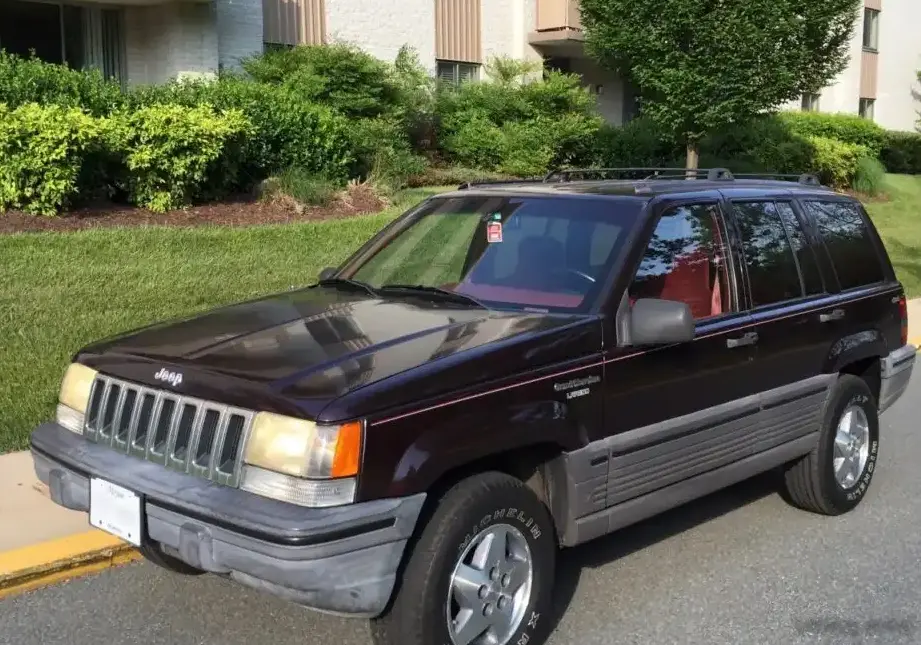
The Jeep Grand Cherokee ZJ, produced from 1993 to 1998, represented a significant step forward for the Jeep brand, moving it into the burgeoning mid-size SUV market. The 4.0i variant, equipped with the 4.0-liter inline-six engine producing 177 horsepower and paired with a four-speed automatic transmission, was a mainstay of the ZJ lineup from 1996 to 1997. This configuration aimed to provide a balance of capability, comfort, and affordability, appealing to a broad range of buyers seeking a versatile family vehicle with genuine off-road credentials. It occupied a middle ground in the ZJ range, positioned above the base 4.0-liter manual transmission models and below the more powerful and expensive 5.2-liter V8 versions.
Technical Specifications
| Brand | Jeep |
| Model | Grand Cherokee |
| Generation | Grand Cherokee I (ZJ) |
| Type (Engine) | 4.0i (177 Hp) 4×4 Automatic |
| Start of production | 1996 |
| End of production | 1997 |
| Powertrain Architecture | Internal Combustion engine |
| Body type | SUV |
| Seats | 5 |
| Doors | 5 |
| Fuel Type | Petrol (Gasoline) |
| Acceleration 0 – 100 km/h | 10.3 sec |
| Acceleration 0 – 62 mph | 10.3 sec |
| Acceleration 0 – 60 mph | 9.8 sec |
| Maximum speed | 180 km/h (111.85 mph) |
| Weight-to-power ratio | 10 kg/Hp, 99.7 Hp/tonne |
| Weight-to-torque ratio | 5.9 kg/Nm, 169.6 Nm/tonne |
| Power | 177 Hp @ 4600 rpm |
| Power per litre | 44.7 Hp/l |
| Torque | 301 Nm @ 2400 rpm (222.01 lb.-ft. @ 2400 rpm) |
| Engine layout | Front, Longitudinal |
| Engine Model/Code | ERH |
| Engine displacement | 3956 cm3 (241.41 cu. in.) |
| Number of cylinders | 6 |
| Engine configuration | Inline |
| Cylinder Bore | 98.4 mm (3.87 in.) |
| Piston Stroke | 86.7 mm (3.41 in.) |
| Compression ratio | 8.75:1 |
| Number of valves per cylinder | 2 |
| Fuel injection system | Multi-port manifold injection |
| Engine aspiration | Naturally aspirated engine |
| Valvetrain | OHV |
| Engine oil capacity | 5.7 l (6.02 US qt | 5.02 UK qt) |
| Coolant | 11.4 l (12.05 US qt | 10.03 UK qt) |
| Kerb Weight | 1775 kg (3913.21 lbs.) |
| Max. weight | 2360 kg (5202.91 lbs.) |
| Max load | 585 kg (1289.7 lbs.) |
| Trunk (boot) space – minimum | 1136 l (40.12 cu. ft.) |
| Trunk (boot) space – maximum | 2254 l (79.6 cu. ft.) |
| Fuel tank capacity | 87 l (22.98 US gal | 19.14 UK gal) |
| Permitted trailer load with brakes (12%) | 3500 kg (7716.18 lbs.) |
| Permitted trailer load without brakes | 750 kg (1653.47 lbs.) |
| Length | 4500 mm (177.17 in.) |
| Width | 1800 mm (70.87 in.) |
| Height | 1690 mm (66.54 in.) |
| Wheelbase | 2690 mm (105.91 in.) |
| Front track | 1473 mm (57.99 in.) |
| Rear (Back) track | 1473 mm (57.99 in.) |
| Ride height (ground clearance) | 193 mm (7.6 in.) |
| Drag coefficient (Cd) | 0.44 |
| Minimum turning circle (turning diameter) | 11.43 m (37.5 ft.) |
| Approach angle | 36.8° |
| Departure angle | 29.6° |
| Ramp-over (brakeover) angle | 17° |
| Drive wheel | All wheel drive (4×4) |
| Number of gears and type of gearbox | 4 gears, automatic transmission |
| Front brakes | Ventilated discs |
| Rear brakes | Ventilated discs |
| Assisting systems | ABS (Anti-lock braking system) |
| Steering type | Steering rack and pinion |
| Power steering | Hydraulic Steering |
| Tires size | 225/75 R15 |
| Wheel rims size | 15 |
Powertrain & Engine Architecture
The heart of the 4.0i Grand Cherokee was the 4.0-liter (3956 cc) inline-six cylinder engine, designated the ERH code. This engine, a descendant of the AMC 242 cubic inch inline-six, was known for its durability and relatively smooth operation. It featured a cast iron block and aluminum cylinder head, utilizing a multi-port fuel injection system for precise fuel delivery. The overhead valve (OHV) valvetrain, while somewhat dated compared to overhead cam designs, contributed to the engine’s simplicity and reliability. The 8.75:1 compression ratio was a compromise between performance and the ability to run on readily available fuel grades. The four-speed automatic transmission (typically the 42RE) was chosen for its ease of use and suitability for both on-road cruising and moderate off-road work. While not a particularly sophisticated transmission, it was robust and generally dependable.
Driving Characteristics
The 177 horsepower and 222 lb-ft of torque provided by the 4.0i powertrain resulted in adequate, but not exhilarating, performance. Acceleration from 0-60 mph took around 9.8 seconds, making it competitive with other mid-size SUVs of the era. The automatic transmission, while smooth, had relatively wide gear ratios, which could sometimes feel sluggish during quick acceleration. The engine delivered its peak torque at 2400 rpm, providing reasonable pulling power for towing and navigating challenging terrain. Compared to the 5.2-liter V8, the 4.0i felt noticeably less powerful, especially when fully loaded or climbing steep hills. However, the 4.0i offered better fuel economy and a lighter front end, which improved handling and steering feel.
Equipment & Trim Levels
The 4.0i Grand Cherokee typically came standard with features such as air conditioning, power windows and locks, and an AM/FM stereo. Higher trim levels, like the Laredo and Limited, added features such as leather upholstery, upgraded sound systems, alloy wheels, and a sunroof. Optional extras included a tow package, heavy-duty suspension, and various interior convenience items. The interior design was functional and comfortable, with a focus on durability rather than luxury. The dashboard layout was straightforward, with easy-to-read gauges and well-placed controls.
Chassis & Braking
The ZJ Grand Cherokee utilized a body-on-frame construction, providing a robust and durable platform. The suspension consisted of a traditional setup with coil springs and shock absorbers. The front suspension featured an independent double-wishbone design, while the rear suspension used a solid axle with coil springs. Brakes were ventilated discs on all four wheels, providing adequate stopping power for the vehicle’s weight. An Anti-lock Braking System (ABS) was standard equipment, enhancing safety and control during emergency braking situations. The 4×4 system was part-time, allowing the driver to switch between two-wheel drive and four-wheel drive as needed.
Market Reception & Comparison
The 4.0i Grand Cherokee was generally well-received by critics and consumers alike. It was praised for its comfortable ride, spacious interior, and genuine off-road capability. However, some reviewers noted its relatively slow acceleration and dated interior design. Compared to the V8-powered models, the 4.0i offered better fuel economy, achieving around 16-18 mpg in city driving and 20-22 mpg on the highway. The 4.0i also tended to be more reliable than the V8, as it had fewer potential points of failure. It was a popular choice for buyers who prioritized practicality and affordability over outright performance.
Legacy
The 4.0-liter inline-six engine and 42RE automatic transmission combination proved to be remarkably durable and reliable. Many 4.0i Grand Cherokees have surpassed 200,000 miles with proper maintenance. Today, these vehicles are sought after by enthusiasts and those looking for a capable and affordable SUV. While not as collectible as the V8 models, the 4.0i Grand Cherokee remains a popular choice in the used car market, offering a blend of classic Jeep capability and everyday practicality. Parts availability is generally good, and the relatively simple mechanical design makes it a relatively easy vehicle to maintain and repair.
