
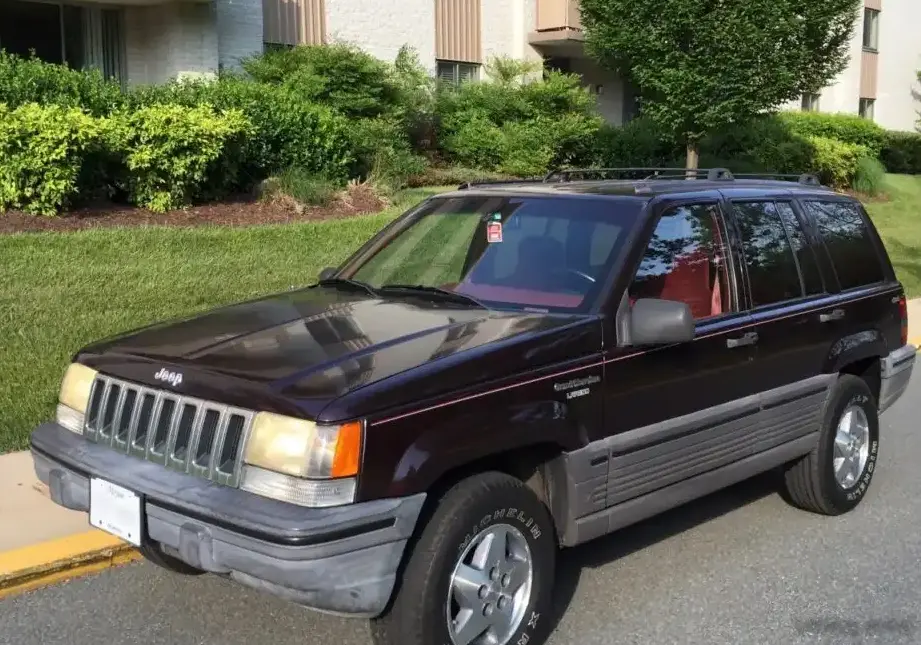
The Jeep Grand Cherokee (ZJ) 4.0i, equipped with a 4.0-liter inline-six engine producing 180 horsepower and paired with a four-speed automatic transmission, was a significant offering in the first generation of the Grand Cherokee line, produced primarily for the 1995 model year. Positioned as a mid-range option within the ZJ lineup, it aimed to balance capability with a more accessible price point than the higher-performance trims. The ZJ series, launched in 1993, represented a substantial leap forward for Jeep, moving away from the more utilitarian Cherokee (XJ) and offering a more refined and luxurious SUV experience. This particular variant played a key role in establishing the Grand Cherokee as a competitor in the burgeoning SUV market, particularly appealing to buyers seeking a capable vehicle for both on and off-road use.
Technical Specifications
| Brand | Jeep |
| Model | Grand Cherokee |
| Generation | Grand Cherokee I (ZJ) |
| Type (Engine) | 4.0i (180 Hp) 4×4 Automatic |
| Start of production | 1995 |
| End of production | 1995 |
| Powertrain Architecture | Internal Combustion engine |
| Body type | SUV |
| Seats | 5 |
| Doors | 5 |
| Fuel consumption (combined) | 14 l/100 km |
| Fuel consumption (US mpg) | 16.8 US mpg |
| Fuel consumption (UK mpg) | 20.2 UK mpg |
| Fuel consumption (km/l) | 7.1 km/l |
| Fuel Type | Petrol (Gasoline) |
| Acceleration 0 – 100 km/h | 11.3 sec |
| Acceleration 0 – 62 mph | 11.3 sec |
| Acceleration 0 – 60 mph | 10.7 sec |
| Maximum speed | 180 km/h (111.85 mph) |
| Weight-to-power ratio | 9.6 kg/Hp |
| Hp/tonne | 103.7 Hp/tonne |
| Weight-to-torque ratio | 6.1 kg/Nm |
| Nm/tonne | 164.3 Nm/tonne |
| Power | 180 Hp @ 4700 rpm |
| Power per litre | 45.5 Hp/l |
| Torque | 285 Nm @ 3950 rpm (210.21 lb.-ft. @ 3950 rpm) |
| Engine layout | Front, Longitudinal |
| Engine Model/Code | ERH |
| Engine displacement | 3956 cm3 (241.41 cu. in.) |
| Number of cylinders | 6 |
| Engine configuration | Inline |
| Cylinder Bore | 98.4 mm (3.87 in.) |
| Piston Stroke | 86.7 mm (3.41 in.) |
| Compression ratio | 8.75:1 |
| Number of valves per cylinder | 2 |
| Fuel injection system | Multi-port manifold injection |
| Engine aspiration | Naturally aspirated engine |
| Valvetrain | OHV |
| Engine oil capacity | 5.7 l (6.02 US qt | 5.02 UK qt) |
| Coolant capacity | 11.4 l (12.05 US qt | 10.03 UK qt) |
| Kerb Weight | 1735 kg (3825.02 lbs.) |
| Max. weight | 2400 kg (5291.09 lbs.) |
| Max load | 665 kg (1466.07 lbs.) |
| Trunk (boot) space – minimum | 1136 l (40.12 cu. ft.) |
| Trunk (boot) space – maximum | 2254 l (79.6 cu. ft.) |
| Fuel tank capacity | 87 l (22.98 US gal | 19.14 UK gal) |
| Length | 4489 mm (176.73 in.) |
| Width | 1800 mm (70.87 in.) |
| Height | 1719 mm (67.68 in.) |
| Wheelbase | 2690 mm (105.91 in.) |
| Front track | 1473 mm (57.99 in.) |
| Rear (Back) track | 1473 mm (57.99 in.) |
| Ride height (ground clearance) | 202 mm (7.95 in.) |
| Drag coefficient (Cd) | 0.45 |
| Minimum turning circle | 11.7 m (38.39 ft.) |
| Drive wheel | All wheel drive (4×4) |
| Number of gears | 4 |
| Gearbox type | automatic transmission |
| Front suspension | Coil spring |
| Rear suspension | Coil spring |
| Front brakes | Ventilated discs |
| Rear brakes | Disc |
| Assisting systems | ABS (Anti-lock braking system) |
| Steering type | Steering rack and pinion |
| Power steering | Hydraulic Steering |
| Tires size | 225/70 R15 |
| Wheel rims size | 15 |
Powertrain & Engine Architecture
The heart of the ZJ 4.0i is the 4.0-liter (3956 cc) inline-six cylinder engine, designated the ERH code. This engine, a mainstay of Jeep vehicles for decades, is known for its durability and relatively simple design. It utilizes a cast iron block and aluminum cylinder head, featuring a single overhead valve (OHV) valvetrain with two valves per cylinder. Fuel delivery is managed by a multi-port fuel injection system, providing a balance between efficiency and performance. The 4.0L engine’s design prioritized low-end torque, making it well-suited for off-road driving and towing. The four-speed automatic transmission (typically the 42RE) was chosen for its robustness and ease of use. While not offering the most advanced gear ratios, it provided smooth shifts and adequate performance for the vehicle’s intended purpose. The transmission was electronically controlled, enhancing shift quality and adapting to driving conditions.
Driving Characteristics
The 180 horsepower and 285 lb-ft of torque delivered by the 4.0i powertrain resulted in a driving experience focused on usability rather than outright speed. Acceleration from 0-60 mph took around 10.7 seconds, which was adequate for the time but not particularly quick compared to some competitors. The automatic transmission, while smooth, could feel somewhat sluggish during quick acceleration, as it prioritized fuel economy and comfort over aggressive shifting. The engine’s strength lay in its low-end torque, providing ample power for climbing hills and navigating challenging terrain. The 4×4 system, typically a part-time system with selectable 4-High and 4-Low ranges, enhanced the vehicle’s off-road capabilities significantly. Compared to the higher-output 4.7L V8, the 4.0i offered a more economical driving experience, but at the expense of overall power and towing capacity. Compared to the manual transmission versions of the 4.0i, the automatic traded some responsiveness for convenience.
Equipment & Trim Levels
The 4.0i trim typically included features such as air conditioning, power windows and locks, and an AM/FM stereo. Upholstery was generally cloth, although leather was available as an option. Higher trim levels within the 4.0i range could add features like a power sunroof, upgraded sound systems, and alloy wheels. The base model was fairly spartan, focusing on essential features, while the Laredo and Limited trims offered increasing levels of luxury and convenience. Optional extras included a tow package, heavy-duty suspension, and various interior upgrades.
Chassis & Braking
The ZJ Grand Cherokee utilized a body-on-frame construction, providing a robust and durable platform. The suspension consisted of coil springs at all four corners, offering a comfortable ride both on and off-road. Front brakes were ventilated discs, providing adequate stopping power, while rear brakes were typically solid discs. An Anti-lock Braking System (ABS) was standard, enhancing safety. The chassis was designed to handle the demands of off-road driving, with a relatively high ground clearance of 7.95 inches. Stabilizer bars were included to reduce body roll during cornering.
Market Reception & Comparison
The Jeep Grand Cherokee ZJ 4.0i was generally well-received by critics and consumers alike. It was praised for its comfortable ride, spacious interior, and capable 4×4 system. However, some reviewers noted the engine’s lack of outright power compared to V8-powered competitors. Fuel economy was considered average for the class, around 16.8 mpg combined. Compared to the 4.7L V8, the 4.0i offered better fuel economy and lower maintenance costs, making it a popular choice for buyers who prioritized practicality over performance. The 4.0i also proved to be more reliable than some of the more complex V8 engines.
Legacy
The 4.0-liter inline-six engine in the ZJ Grand Cherokee has earned a reputation for exceptional durability and longevity. Many examples are still on the road today, often with high mileage. The powertrain is relatively simple to maintain, and parts are readily available. In the used car market, the ZJ 4.0i remains a popular choice for those seeking a capable and affordable SUV. Its robust construction and reliable engine make it a good value for the money, particularly for those who plan to use it for off-road adventures or light towing. While not the fastest or most luxurious SUV of its era, the ZJ 4.0i represents a significant milestone in Jeep’s history, establishing the Grand Cherokee as a leading contender in the SUV segment.
