
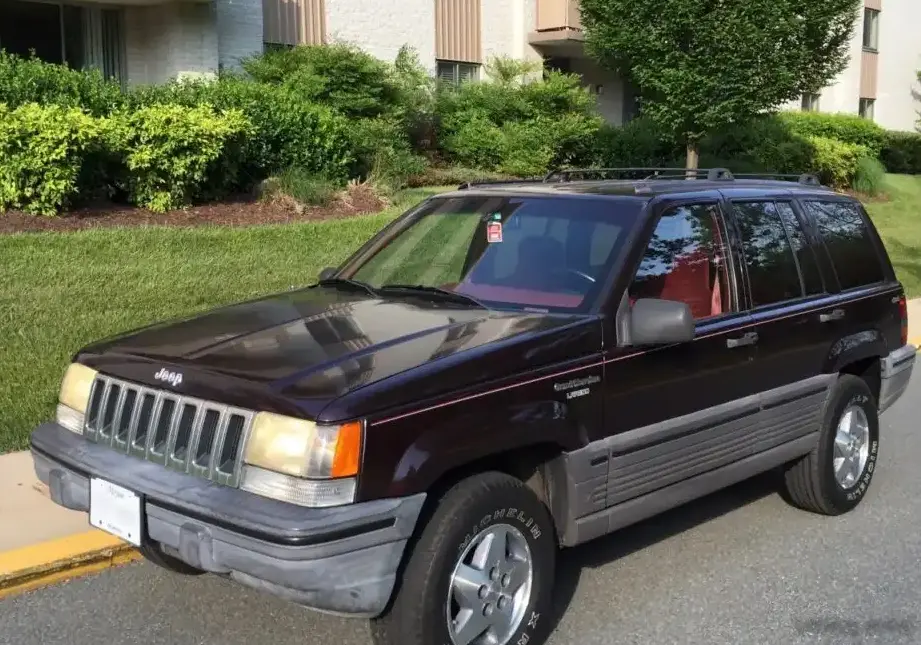
The Jeep Grand Cherokee (ZJ) 4.0i, produced from 1993 to 1994, represented a significant step forward for the American automaker, offering a blend of on-road comfort and genuine off-road capability in a newly refined package. This variant, equipped with the 4.0-liter inline-six engine and a four-speed automatic transmission, occupied a crucial middle ground in the ZJ lineup, appealing to buyers seeking a balance between performance, fuel economy, and ease of use. It was positioned above the base 2.5L models and below the more powerful and expensive 5.2L V8 versions. The ZJ generation, internally designated as the 1993-1998 model years, was a complete redesign of the previous Cherokee (XJ) model, offering increased size, improved refinement, and a more luxurious interior.
Technical Specifications
| Brand | Jeep |
| Model | Grand Cherokee |
| Generation | Grand Cherokee I (ZJ) |
| Type (Engine) | 4.0i (184 Hp) 4×4 Automatic |
| Start of production | 1993 |
| End of production | 1994 |
| Powertrain Architecture | Internal Combustion engine |
| Body type | SUV |
| Seats | 5 |
| Doors | 5 |
| Fuel consumption (combined) | 15 l/100 km |
| Fuel consumption (US mpg) | 15.7 US mpg |
| Fuel consumption (UK mpg) | 18.8 UK mpg |
| Fuel consumption (km/l) | 6.7 km/l |
| Fuel Type | Petrol (Gasoline) |
| Acceleration 0 – 100 km/h | 10.3 sec |
| Acceleration 0 – 62 mph | 10.3 sec |
| Acceleration 0 – 60 mph | 9.8 sec |
| Maximum speed | 180 km/h (111.85 mph) |
| Weight-to-power ratio | 9.1 kg/Hp |
| Hp/tonne | 109.5 Hp/tonne |
| Weight-to-torque ratio | 5.8 kg/Nm |
| Nm/tonne | 172.6 Nm/tonne |
| Power | 184 Hp @ 4700 rpm |
| Power per litre | 46.5 Hp/l |
| Torque | 290 Nm @ 3950 rpm (213.89 lb.-ft. @ 3950 rpm) |
| Engine layout | Front, Longitudinal |
| Engine Model/Code | ERH |
| Engine displacement | 3956 cm3 (241.41 cu. in.) |
| Number of cylinders | 6 |
| Engine configuration | Inline |
| Cylinder Bore | 98.4 mm (3.87 in.) |
| Piston Stroke | 86.7 mm (3.41 in.) |
| Compression ratio | 8.8:1 |
| Number of valves per cylinder | 2 |
| Fuel injection system | Multi-port manifold injection |
| Engine aspiration | Naturally aspirated |
| Valvetrain | OHV |
| Engine oil capacity | 5.7 l (6.02 US qt | 5.02 UK qt) |
| Coolant capacity | 11.4 l (12.05 US qt | 10.03 UK qt) |
| Kerb Weight | 1680 kg (3703.77 lbs.) |
| Max. weight | 2400 kg (5291.09 lbs.) |
| Max load | 720 kg (1587.33 lbs.) |
| Trunk (boot) space – minimum | 1136 l (40.12 cu. ft.) |
| Trunk (boot) space – maximum | 2254 l (79.6 cu. ft.) |
| Fuel tank capacity | 87 l (22.98 US gal | 19.14 UK gal) |
| Length | 4489 mm (176.73 in.) |
| Width | 1790 mm (70.47 in.) |
| Height | 1708 mm (67.24 in.) |
| Wheelbase | 2690 mm (105.91 in.) |
| Front track | 1473 mm (57.99 in.) |
| Rear track | 1473 mm (57.99 in.) |
| Ride height (ground clearance) | 202 mm (7.95 in.) |
| Drag coefficient (Cd) | 0.45 |
| Minimum turning circle | 11.7 m (38.39 ft.) |
| Drive wheel | All wheel drive (4×4) |
| Number of gears | 4 |
| Gearbox type | automatic transmission |
| Front suspension | Coil spring |
| Rear suspension | Coil spring |
| Front brakes | Ventilated discs |
| Rear brakes | Disc |
| Assisting systems | ABS (Anti-lock braking system) |
| Steering type | Steering rack and pinion |
| Power steering | Hydraulic |
| Tires size | 225/70 R15 |
| Wheel rims size | 15 |
Powertrain & Engine Architecture
The heart of the ZJ 4.0i is the 4.0-liter (3956 cc) inline-six cylinder engine, designated as the ERH code. This engine, a descendant of the AMC 242 cubic inch inline-six, was known for its durability and relatively smooth operation. It featured a cast iron block and cylinder head, with a two-valve-per-cylinder OHV (Overhead Valve) configuration. Fuel delivery was managed by a multi-port fuel injection system, providing improved efficiency and throttle response compared to earlier carbureted designs. The 4.0L engine produced 184 horsepower at 4700 rpm and 290 Nm (213.89 lb-ft) of torque at 3950 rpm. The engine’s longitudinal mounting and the use of a four-speed automatic transmission (typically the Chrysler 42RE) allowed for a robust driveline capable of handling both on-road and off-road conditions. The 42RE transmission was a workhorse unit, known for its reliability, but it lacked the sophistication of more modern automatic transmissions.
Driving Characteristics
The 4.0i automatic Grand Cherokee offered a comfortable and capable driving experience. While not a performance machine, the engine provided adequate power for everyday driving and highway cruising. Acceleration from 0-60 mph took around 9.8 seconds, which was respectable for an SUV of its size and era. The automatic transmission, while smooth, had relatively wide gear ratios, which could sometimes feel sluggish during quick acceleration. The 4×4 system, typically a part-time system with a 2WD/4WD High/4WD Low selector, provided excellent traction in various conditions. The ZJ’s independent front suspension and coil-spring rear suspension delivered a reasonably comfortable ride, although it could feel somewhat body-roll during cornering. Compared to the V8 models, the 4.0i offered better fuel economy, but at the expense of outright power and towing capacity.
Equipment & Trim Levels
The 4.0i Grand Cherokee typically came standard with features such as air conditioning, power windows and locks, and an AM/FM stereo. Higher trim levels, such as the Limited, added features like leather upholstery, upgraded sound systems, and alloy wheels. Optional extras included a sunroof, premium audio systems, and a heavy-duty towing package. Interior upholstery was typically cloth, with the Limited trim offering leather as an option. The dashboard layout was straightforward and functional, with easy-to-read gauges and well-placed controls.
Chassis & Braking
The ZJ Grand Cherokee utilized a body-on-frame construction, providing a robust and durable chassis. The front suspension featured independent coil springs, while the rear suspension employed a coil-spring solid axle design. Braking duties were handled by ventilated discs at the front and solid discs at the rear. An Anti-lock Braking System (ABS) was standard equipment, enhancing safety and control during emergency braking situations. The steering system was a hydraulic power-assisted rack and pinion setup, providing responsive and precise steering feel.
Market Reception & Comparison
The Jeep Grand Cherokee ZJ 4.0i was well-received by critics and consumers alike. It was praised for its comfortable ride, spacious interior, and capable off-road performance. The 4.0-liter engine was considered a good balance between power and fuel economy, making it a popular choice for buyers who didn’t need the extra power of the V8 models. Compared to the 2.5L base model, the 4.0i offered a significant performance upgrade. Compared to the 5.2L V8, it provided better fuel economy and a lower purchase price. However, the V8 offered superior towing capacity and acceleration.
Legacy
The Jeep Grand Cherokee ZJ 4.0i remains a popular choice among enthusiasts and collectors today. The 4.0-liter inline-six engine is known for its longevity and relatively simple maintenance requirements. While age and mileage can take their toll, these engines are generally reliable and can provide many years of service with proper care. The ZJ generation Grand Cherokee is considered a classic SUV, representing a pivotal moment in Jeep’s history. The 4.0i variant, in particular, is valued for its balance of performance, fuel economy, and affordability, making it a desirable option in the used car market.
