
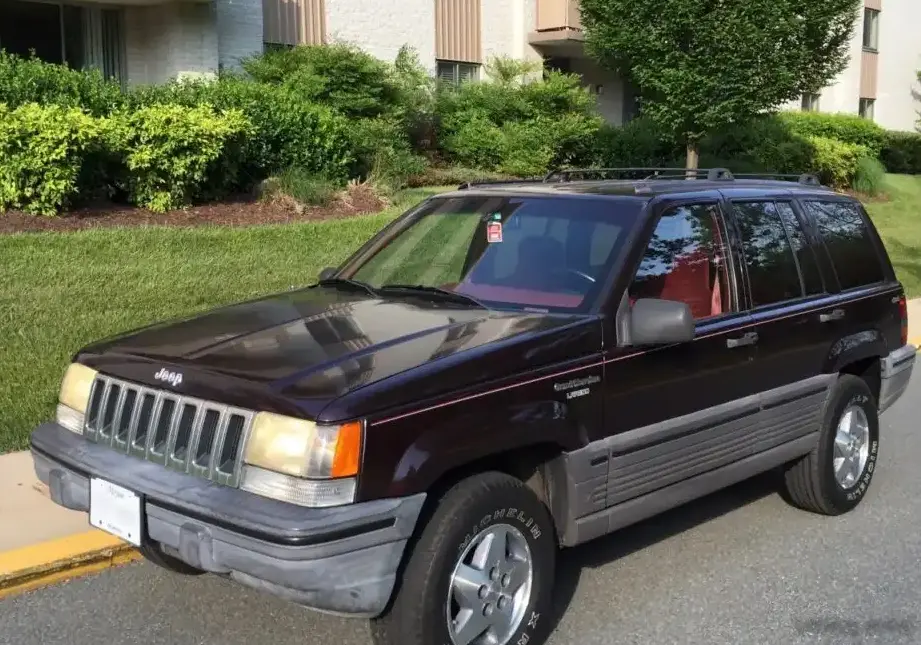
The Jeep Grand Cherokee (ZJ) 4.0i Automatic, produced from 1994 to 1995, represented a significant step forward for the Jeep brand, blending traditional off-road capability with a more refined and comfortable driving experience. This variant, powered by the 4.0-liter inline-six engine paired with a four-speed automatic transmission, occupied a middle ground in the ZJ lineup, offering a balance between performance, fuel economy, and affordability. It was positioned above the base 4.0-liter manual transmission models and below the more powerful and expensive 5.2-liter V8 versions. The ZJ generation, launched in 1993, was a crucial model for Jeep, replacing the aging Cherokee and Wagoneer, and establishing the Grand Cherokee as a premium SUV contender in the North American market.
Technical Specifications
| Brand | Jeep |
| Model | Grand Cherokee |
| Generation | Grand Cherokee I (ZJ) |
| Type (Engine) | 4.0i (188 Hp) Automatic |
| Start of production | 1994 |
| End of production | 1995 |
| Powertrain Architecture | Internal Combustion engine |
| Body type | SUV |
| Seats | 5 |
| Doors | 5 |
| Fuel consumption (urban) | 15.7 l/100 km (15 US mpg, 18 UK mpg, 6.4 km/l) |
| Fuel consumption (extra urban) | 11.2 l/100 km (21 US mpg, 25.2 UK mpg, 8.9 km/l) |
| Fuel consumption (combined) | 13.1 l/100 km (18 US mpg, 21.6 UK mpg, 7.6 km/l) |
| Fuel Type | Petrol (Gasoline) |
| Weight-to-power ratio | 8.6 kg/Hp, 116 Hp/tonne |
| Weight-to-torque ratio | 5.4 kg/Nm, 184 Nm/tonne |
| Power | 188 Hp @ 4600 rpm |
| Power per litre | 47.5 Hp/l |
| Torque | 298 Nm @ 2400 rpm (219.79 lb.-ft. @ 2400 rpm) |
| Engine layout | Front, Longitudinal |
| Engine Model/Code | ERH |
| Engine displacement | 3956 cm3 (241.41 cu. in.) |
| Number of cylinders | 6 |
| Engine configuration | Inline |
| Cylinder Bore | 98.4 mm (3.87 in.) |
| Piston Stroke | 86.7 mm (3.41 in.) |
| Compression ratio | 8.8:1 |
| Number of valves per cylinder | 2 |
| Fuel injection system | Multi-port manifold injection |
| Engine aspiration | Naturally aspirated engine |
| Valvetrain | OHV |
| Engine oil capacity | 5.7 l (6.02 US qt | 5.02 UK qt) |
| Coolant | 11.4 l (12.05 US qt | 10.03 UK qt) |
| Kerb Weight | 1620 kg (3571.49 lbs.) |
| Fuel tank capacity | 87 l (22.98 US gal | 19.14 UK gal) |
| Length | 4489 mm (176.73 in.) |
| Width | 1758 mm (69.21 in.) |
| Height | 1648 mm (64.88 in.) |
| Wheelbase | 2690 mm (105.91 in.) |
| Front track | 1473 mm (57.99 in.) |
| Rear track | 1473 mm (57.99 in.) |
| Ride height (ground clearance) | 208 mm (8.19 in.) |
| Drag coefficient (Cd) | 0.45 |
| Minimum turning circle | 11.0 m (36.09 ft.) |
| Drivetrain Architecture | Rear wheel drive |
| Number of gears | 4 |
| Gearbox type | Automatic transmission |
| Front brakes | Ventilated discs |
| Rear brakes | Ventilated discs |
| Assisting systems | ABS (Anti-lock braking system) |
| Steering type | Steering rack and pinion |
| Power steering | Hydraulic Steering |
| Tires size | 215/75 R15 |
| Wheel rims size | 15 |
Powertrain & Engine Architecture
The heart of the Grand Cherokee 4.0i Automatic is the 4.0-liter (3956 cc) inline-six cylinder engine, designated the ERH code. This engine, a descendant of the AMC 242 cubic inch inline-six, was known for its durability and relatively smooth operation. It featured a cast iron block and aluminum cylinder head, utilizing a multi-port fuel injection system for precise fuel delivery. The overhead valve (OHV) valvetrain, while somewhat dated compared to overhead cam designs, contributed to the engine’s simplicity and reliability. The 8.8:1 compression ratio was a compromise between performance and the ability to run on readily available gasoline grades. The four-speed automatic transmission, a Chrysler-built 42RE unit, was chosen for its ease of use and suitability for both on-road cruising and moderate off-road conditions. While not as quick-shifting as more modern automatics, the 42RE provided smooth and predictable gear changes.
Driving Characteristics
The 188 horsepower and 298 lb-ft of torque produced by the 4.0-liter engine, when coupled with the automatic transmission, resulted in adequate, but not exhilarating, performance. Acceleration from 0 to 60 mph typically took around 9-10 seconds. The automatic transmission’s gear ratios were optimized for everyday driving, prioritizing fuel economy and smooth cruising over outright speed. Compared to the 5.2-liter V8 models, the 4.0i Automatic felt noticeably less powerful, particularly when towing or climbing steep hills. However, the inline-six offered a more responsive feel than the 4.0-liter manual transmission versions, thanks to the automatic’s torque multiplication. The rear-wheel-drive configuration provided a traditional SUV driving experience, with a focus on stability and predictable handling.
Equipment & Trim Levels
The Grand Cherokee 4.0i Automatic typically came standard with features such as air conditioning, power windows and locks, and an AM/FM stereo. Upholstery was usually cloth, although leather was available as an option. Base models featured a relatively simple interior, while higher trim levels, such as the Laredo and Limited, offered upgrades like upgraded sound systems, woodgrain interior trim, and power-adjustable seats. Optional extras included a sunroof, upgraded wheels, and a heavy-duty towing package. The 4.0i Automatic was often chosen by buyers who wanted a comfortable and well-equipped SUV without the added cost of the V8 engine.
Chassis & Braking
The ZJ Grand Cherokee utilized a body-on-frame construction, providing a robust and durable platform for both on-road and off-road use. The suspension consisted of a traditional coil spring setup with a solid rear axle. The 4.0i Automatic models typically featured rear ventilated disc brakes, a step up from the drum brakes found on some base models. An anti-lock braking system (ABS) was standard, enhancing safety and control during emergency braking situations. The steering system was a hydraulic power rack-and-pinion setup, providing responsive and precise steering feel. Stabilizer bars were fitted to both the front and rear axles to reduce body roll during cornering.
Market Reception & Comparison
The Grand Cherokee 4.0i Automatic was generally well-received by automotive critics as a capable and comfortable SUV. While the V8 models garnered more attention for their performance, the 4.0i Automatic was praised for its fuel efficiency and affordability. Fuel economy figures averaged around 18 mpg combined, making it a more economical choice than the V8-powered versions. Reliability was generally good, although some owners reported issues with the automatic transmission over the long term. Compared to competitors like the Ford Explorer and Chevrolet Blazer, the Grand Cherokee offered a more refined interior and a more sophisticated suspension system.
Legacy
The Jeep Grand Cherokee ZJ 4.0i Automatic has become a popular choice among classic SUV enthusiasts. The 4.0-liter inline-six engine is known for its longevity and relatively simple maintenance requirements. While finding well-maintained examples can be challenging, these vehicles offer a unique blend of classic Jeep capability and modern comfort. The 42RE automatic transmission, while durable, may require occasional servicing or rebuilding depending on its usage history. Today, the ZJ Grand Cherokee remains a testament to Jeep’s commitment to building rugged and reliable SUVs, and the 4.0i Automatic variant continues to be appreciated for its balance of performance, economy, and practicality.
