
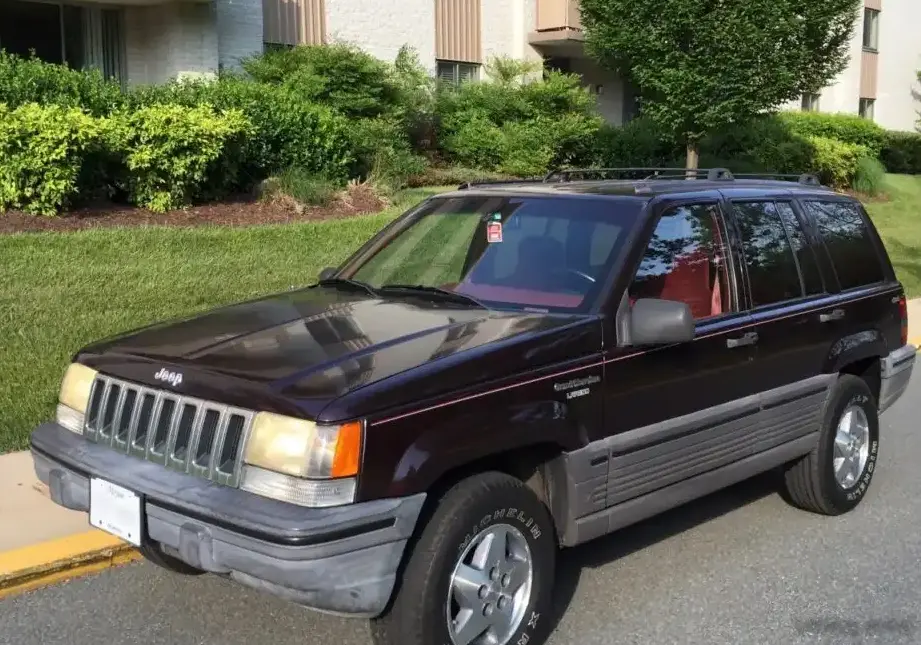
The Jeep Grand Cherokee (ZJ), produced from 1991 to 1999, represented a significant step forward for the American automaker, offering a blend of on-road comfort and respectable off-road capability in a newly refined package. The 4.0i variant, equipped with a 4.0-liter inline-six engine producing 190 horsepower and paired with a four-speed automatic transmission, occupied a crucial middle ground in the ZJ lineup. It aimed to provide a balance between affordability, fuel efficiency (relative to the V8 options), and adequate performance for everyday driving and light-duty towing. This model served as a popular choice for families and individuals seeking a versatile SUV without the higher price tag or fuel consumption of the larger engine options.
Technical Specifications
| Brand | Jeep |
| Model | Grand Cherokee |
| Generation | Grand Cherokee I (ZJ) |
| Type (Engine) | 4.0i (190 Hp) Automatic |
| Start of production | 1991 |
| End of production | 1999 |
| Powertrain Architecture | Internal Combustion engine |
| Body type | SUV |
| Seats | 5 |
| Doors | 5 |
| Fuel consumption (combined) | 13.9 l/100 km (16.9 US mpg, 20.3 UK mpg, 7.2 km/l) |
| Fuel Type | Petrol (Gasoline) |
| Weight-to-power ratio | 8.4 kg/Hp, 118.6 Hp/tonne |
| Weight-to-torque ratio | 5.3 kg/Nm, 190.4 Nm/tonne |
| Power | 190 Hp @ 4750 rpm |
| Power per litre | 48 Hp/l |
| Torque | 305 Nm @ 4000 rpm (224.96 lb.-ft. @ 4000 rpm) |
| Engine layout | Front, Longitudinal |
| Engine Model/Code | ERH |
| Engine displacement | 3960 cm3 (241.65 cu. in.) |
| Number of cylinders | 6 |
| Engine configuration | Inline |
| Cylinder Bore | 98.5 mm (3.88 in.) |
| Piston Stroke | 86.7 mm (3.41 in.) |
| Compression ratio | 8.8:1 |
| Number of valves per cylinder | 2 |
| Fuel injection system | Multi-port manifold injection |
| Engine aspiration | Naturally aspirated engine |
| Engine oil capacity | 5.7 l (6.02 US qt | 5.02 UK qt) |
| Coolant capacity | 11.4 l (12.05 US qt | 10.03 UK qt) |
| Kerb Weight | 1602 kg (3531.81 lbs.) |
| Trunk (boot) space – minimum | 732 l (25.85 cu. ft.) |
| Trunk (boot) space – maximum | 1483 l (52.37 cu. ft.) |
| Fuel tank capacity | 87 l (22.98 US gal | 19.14 UK gal) |
| Length | 4548 mm (179.06 in.) |
| Width | 1800 mm (70.87 in.) |
| Height | 1647 mm (64.84 in.) |
| Wheelbase | 2690 mm (105.91 in.) |
| Front track | 1473 mm (57.99 in.) |
| Rear track | 1473 mm (57.99 in.) |
| Drivetrain Architecture | Rear wheel drive |
| Number of gears and type of gearbox | 4 gears, automatic transmission |
| Front suspension | Coil spring |
| Rear suspension | Coil spring |
| Front brakes | Ventilated discs |
| Rear brakes | Drum |
| Assisting systems | ABS (Anti-lock braking system), Hydraulic Power Steering |
| Tires size | 225/75 R15 S |
Powertrain & Engine Architecture
The heart of the Grand Cherokee 4.0i was the 4.0-liter (3960 cc) AMC inline-six engine, designated the ERH code. This engine, a descendant of designs dating back to the 1960s, was known for its durability and relatively smooth operation. It featured a cast iron block and cylinder head, a two-valve-per-cylinder configuration, and a multi-port fuel injection system. The fuel injection system, while not cutting-edge for the time, provided adequate fuel delivery for the engine’s output. The 4.0L engine produced 190 horsepower at 4750 rpm and 225 lb-ft of torque at 4000 rpm. The engine’s longevity was a key selling point, and it was often praised for its ability to withstand high mileage with proper maintenance. The four-speed automatic transmission (typically the 42RE or 45RFE, depending on the year) was chosen for its ease of use and suitability for the target demographic. While not offering the quickest acceleration, the transmission provided smooth shifts and adequate gear ratios for highway cruising and moderate towing.
Driving Characteristics
The 4.0i Grand Cherokee offered a comfortable, if not particularly sporty, driving experience. Acceleration was adequate for merging onto highways and passing slower vehicles, but it wasn’t a performance-oriented SUV. The automatic transmission, while smooth, could sometimes feel sluggish, especially when downshifting. The gear ratios were optimized for fuel economy and cruising, rather than rapid acceleration. Compared to the V8-powered Grand Cherokees, the 4.0i felt noticeably less powerful, especially when fully loaded or towing. However, the inline-six offered a more refined and quieter driving experience than the V8s, and its lighter weight contributed to slightly better handling. The rear-wheel-drive configuration provided a more traditional SUV feel, and while it didn’t offer the all-weather capability of the four-wheel-drive models, it was sufficient for most driving conditions.
Equipment & Trim Levels
The 4.0i Grand Cherokee typically came standard with features such as air conditioning, power windows and locks, and an AM/FM stereo. Higher trim levels, such as the Laredo and Limited, added features like upgraded upholstery (cloth or leather), a premium sound system, alloy wheels, and a sunroof. Optional extras included a tow package, a heavy-duty cooling system, and various interior convenience features. The interior design was functional and relatively spacious, with comfortable seating for five passengers. The dashboard layout was straightforward and easy to use, with clearly labeled controls.
Chassis & Braking
The ZJ Grand Cherokee utilized a body-on-frame construction, providing a robust and durable chassis. The front suspension featured coil springs and a stabilizer bar, while the rear suspension also used coil springs. The braking system consisted of ventilated discs on the front wheels and drum brakes on the rear wheels. Anti-lock brakes (ABS) were available as an option, and later became standard equipment. The steering was hydraulic power steering, providing relatively light and easy steering effort. The suspension was tuned for a balance between ride comfort and handling, offering a reasonably smooth ride on most road surfaces.
Market Reception & Comparison
The Grand Cherokee 4.0i was generally well-received by critics and consumers alike. It was praised for its comfortable ride, spacious interior, and relatively affordable price. However, some critics noted its lack of outright performance compared to the V8 models. Fuel economy was considered acceptable for an SUV of its size, averaging around 16-17 mpg in real-world driving. Compared to the 4.0L manual transmission version, the automatic offered convenience at the cost of some fuel efficiency and responsiveness. The V6 models offered a slightly better fuel economy, but the 4.0L inline-six was considered more durable and reliable.
Legacy
The Jeep Grand Cherokee ZJ 4.0i has proven to be a remarkably durable and reliable vehicle. Many examples are still on the road today, a testament to the quality of its construction and the longevity of the 4.0-liter inline-six engine. In the used car market, these models are often sought after by enthusiasts and those looking for a dependable and affordable SUV. While maintenance costs can increase with age, the 4.0i Grand Cherokee remains a popular choice for those who appreciate its classic design, rugged capability, and enduring reliability. The engine, in particular, is known for its ability to withstand high mileage with proper care, making it a favorite among those seeking a long-lasting vehicle.
