
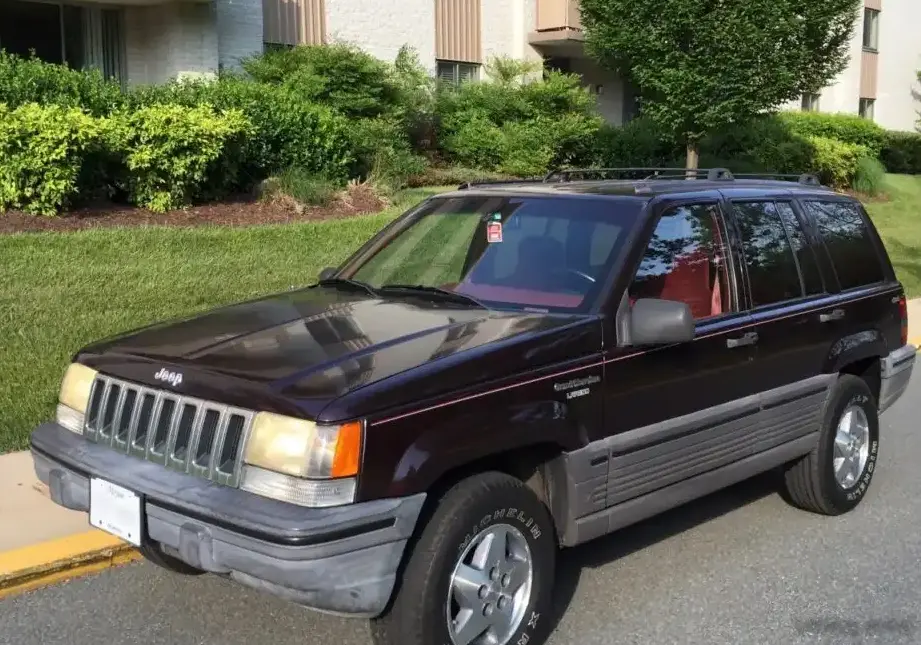
The Jeep Grand Cherokee (ZJ) 5.2i, produced from 1992 to 1993, marked a pivotal moment for the Jeep brand, introducing a more refined and luxurious experience compared to its predecessors. This first-generation Grand Cherokee, internally designated the ZJ, aimed to successfully blend robust off-road capability with on-road comfort. The 5.2i variant, equipped with the 5.2-liter V8 engine and a four-speed automatic transmission, was positioned as a mid-to-upper range offering within the ZJ lineup, appealing to buyers seeking substantial power and a more relaxed driving experience. It played a crucial role in establishing the Grand Cherokee as a serious competitor in the rapidly expanding SUV market.
Technical Specifications
| Brand | Jeep |
| Model | Grand Cherokee |
| Generation | Grand Cherokee I (ZJ) |
| Type (Engine) | 5.2i V8 (223 Hp) 4×4 Automatic |
| Start of production | 1992 |
| End of production | 1993 |
| Powertrain Architecture | Internal Combustion engine |
| Body type | SUV |
| Seats | 5 |
| Doors | 5 |
| Fuel consumption (economy) – urban | 16.8 l/100 km (14 US mpg, 16.8 UK mpg, 6 km/l) |
| Fuel consumption (economy) – extra urban | 13.1 l/100 km (18 US mpg, 21.6 UK mpg, 7.6 km/l) |
| Fuel consumption (economy) – combined | 15.7 l/100 km (15 US mpg, 18 UK mpg, 6.4 km/l) |
| Fuel Type | Petrol (Gasoline) |
| Acceleration 0 – 100 km/h | 9.5 sec |
| Acceleration 0 – 62 mph | 9.5 sec |
| Acceleration 0 – 60 mph | 9 sec |
| Weight-to-power ratio | 8.1 kg/Hp, 123.9 Hp/tonne |
| Weight-to-torque ratio | 4.7 kg/Nm, 214.4 Nm/tonne |
| Power | 223 Hp @ 4750 rpm |
| Power per litre | 42.8 Hp/l |
| Torque | 386 Nm @ 3600 rpm (284.7 lb.-ft. @ 3600 rpm) |
| Engine layout | Front, Longitudinal |
| Engine Model/Code | ELF |
| Engine displacement | 5210 cm3 (317.93 cu. in.) |
| Number of cylinders | 8 |
| Engine configuration | V-engine |
| Cylinder Bore | 99.31 mm (3.91 in.) |
| Piston Stroke | 84.07 mm (3.31 in.) |
| Compression ratio | 9.1:1 |
| Number of valves per cylinder | 2 |
| Fuel injection system | Multi-port manifold injection |
| Engine aspiration | Naturally aspirated engine |
| Engine oil capacity | 4.7 l (4.97 US qt | 4.14 UK qt) |
| Coolant | 14.1 l (14.9 US qt | 12.41 UK qt) |
| Kerb Weight | 1800 kg (3968.32 lbs.) |
| Fuel tank capacity | 87 l (22.98 US gal | 19.14 UK gal) |
| Length | 4489 mm (176.73 in.) |
| Width | 1758 mm (69.21 in.) |
| Height | 1648 mm (64.88 in.) |
| Wheelbase | 2690 mm (105.91 in.) |
| Front track | 1473 mm (57.99 in.) |
| Rear (Back) track | 1473 mm (57.99 in.) |
| Ride height (ground clearance) | 202 mm (7.95 in.) |
| Drag coefficient (Cd) | 0.45 |
| Minimum turning circle (turning diameter) | 11.7 m (38.39 ft.) |
| Drive wheel | All wheel drive (4×4) |
| Number of gears and type of gearbox | 4 gears, automatic transmission |
| Front brakes | Ventilated discs |
| Rear brakes | Ventilated discs |
| Assisting systems | ABS (Anti-lock braking system) |
| Steering type | Steering rack and pinion |
| Power steering | Hydraulic Steering |
| Tires size | 215/75 R15 |
| Wheel rims size | 15 |
Powertrain & Engine Architecture
The Jeep Grand Cherokee 5.2i’s powertrain revolved around the 5.2-liter (318 cubic inch) LA-series V8 engine, internally known as the ELF. This engine was a direct descendant of Chrysler’s well-established small-block V8 family, renowned for its inherent durability and relatively uncomplicated design. It featured a cast iron block, aluminum cylinder heads, and initially utilized a two-barrel carburetor, though later production models transitioned to multi-port fuel injection for improved efficiency and emissions. The engine generated 223 horsepower at 4,750 rpm and a robust 386 lb-ft of torque at 3,600 rpm. The 5.2L engine employed a hydraulic lifter valvetrain, simplifying routine maintenance procedures. The engine was coupled with a Chrysler-built A727 four-speed automatic transmission. This transmission was a heavy-duty unit, engineered to manage the engine’s substantial torque output and the stresses associated with off-road driving. While not particularly fuel-efficient, this combination delivered ample power for towing and tackling difficult terrain.
Driving Characteristics
The 5.2i Grand Cherokee provided a markedly different driving experience compared to the inline-six or smaller V6 options available. The V8 engine delivered strong low-end torque, making it exceptionally well-suited for hauling loads and navigating challenging off-road conditions. Acceleration to 60 mph was achieved in approximately 9 seconds, a respectable figure for an SUV of its size and era. The automatic transmission, while generally smooth in operation, wasn’t particularly quick to downshift, and the gear ratios were optimized for cruising rather than outright performance. Compared to a ZJ equipped with a manual transmission, the automatic version felt somewhat less responsive, but offered a more relaxed and user-friendly driving experience. The vehicle’s considerable weight (around 3,968 lbs) was noticeable, especially during cornering, but the suspension system did a reasonable job of minimizing body roll.
Equipment & Trim Levels
The 5.2i Grand Cherokee typically came standard with features such as air conditioning, power windows and door locks, and a tilt-adjustable steering wheel. The standard interior upholstery was cloth, although leather interiors were offered as an optional upgrade. Higher trim levels, like the Limited, added features like leather seating surfaces, upgraded audio systems, and alloy wheels. A range of optional extras were available, including a sunroof, premium sound systems, and a heavy-duty towing package. The interior design was functional and straightforward, prioritizing durability and ease of use over extravagant luxury.
Chassis & Braking
The ZJ Grand Cherokee utilized a traditional body-on-frame construction, providing a robust and durable chassis. The suspension system consisted of a conventional setup with coil springs and shock absorbers. The front suspension was independent, while the rear suspension employed a solid axle with leaf springs. The braking system featured ventilated discs on all four wheels, and an Anti-lock Braking System (ABS) was included as standard equipment. The braking performance was adequate for the vehicle’s weight, but lacked the sophistication of more contemporary systems. The 5.2i models generally benefited from a slightly more robust suspension setup compared to the base models, designed to handle the increased weight and power.
Market Reception & Comparison
The Grand Cherokee 5.2i was generally well-received by automotive critics, who lauded its powerful engine, comfortable ride quality, and impressive off-road capabilities. However, its fuel economy was a frequent point of criticism. Compared to the inline-six or 4.0L V6 models, the 5.2i offered significantly more power, but at the expense of increased fuel consumption. The 5.2i also carried a higher price tag than the lower-trim models, positioning it as a premium offering for buyers who prioritized performance and towing capacity. Overall reliability was generally good, although the carburetor (on earlier models) occasionally required adjustments to maintain optimal performance.
Legacy
The Jeep Grand Cherokee ZJ 5.2i continues to be a sought-after vehicle among collectors and enthusiasts today. The 5.2L V8 engine is celebrated for its durability and relative simplicity, making it a relatively straightforward engine to maintain and repair. While fuel economy is undeniably poor by modern standards, the 5.2i delivers a unique and engaging driving experience, and serves as a strong connection to Jeep’s rich heritage. Well-preserved examples command a premium in the used car market, and the ZJ Grand Cherokee is widely regarded as a classic American SUV.
