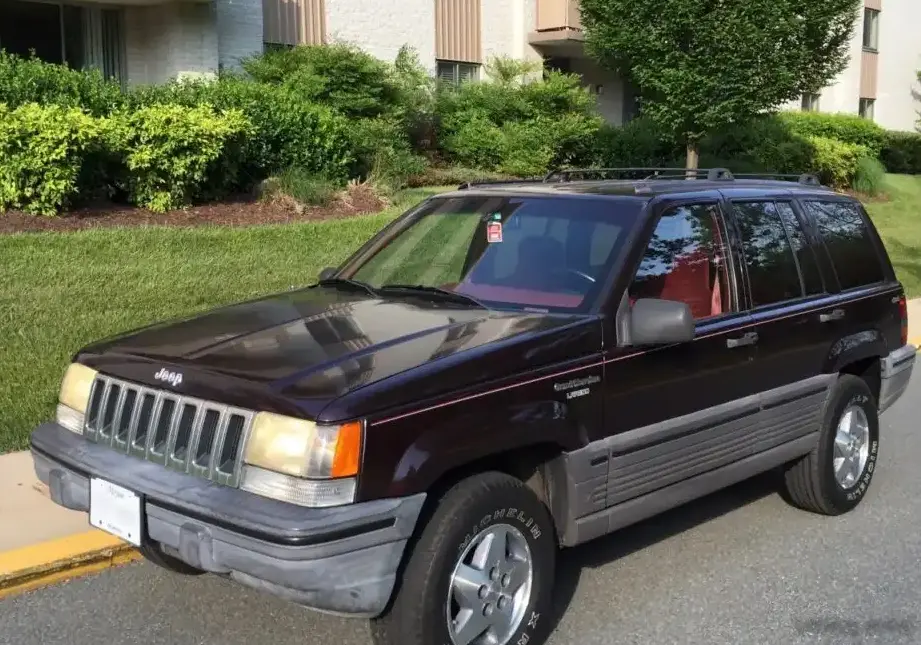
The Jeep Grand Cherokee II (WJ), produced from 1999 to 2004, represented a significant leap forward for the iconic American SUV. The 4.7 HO V8 4×4 Automatic variant, specifically manufactured from 2001 to 2003, occupied a prominent position in the lineup, offering a blend of power, capability, and relative luxury. This model year marked a transition for the WJ, solidifying its reputation as a capable off-roader and comfortable family vehicle. It was built on the WH platform, a substantial redesign from the previous ZJ generation, focusing on improved refinement and on-road manners while retaining Jeep’s legendary four-wheel-drive prowess.
Technical Specifications
| Brand | Jeep |
| Model | Grand Cherokee |
| Generation | Grand Cherokee II (WJ) |
| Type (Engine) | 4.7 HO V8 (258 Hp) 4×4 Automatic |
| Start of production | 2001 year |
| End of production | 2003 year |
| Powertrain Architecture | Internal Combustion engine |
| Body type | SUV |
| Seats | 5 |
| Doors | 5 |
| Fuel consumption (economy) – urban (NEDC) | 22 l/100 km (10.7 US mpg, 12.8 UK mpg, 4.5 km/l) |
| Fuel consumption (economy) – extra urban (NEDC) | 12 l/100 km (19.6 US mpg, 23.5 UK mpg, 8.3 km/l) |
| Fuel consumption (economy) – combined (NEDC) | 15.7 l/100 km (15 US mpg, 18 UK mpg, 6.4 km/l) |
| CO2 emissions (NEDC) | 376 g/km |
| Fuel Type | Petrol (Gasoline) |
| Acceleration 0 – 100 km/h | 8.3 sec |
| Acceleration 0 – 62 mph | 8.3 sec |
| Acceleration 0 – 60 mph | 7.9 sec |
| Maximum speed | 206 km/h (128 mph) |
| Emission standard | Euro 3 |
| Weight-to-power ratio | 7.6 kg/Hp, 131.6 Hp/tonne |
| Weight-to-torque ratio | 4.6 kg/Nm, 216.8 Nm/tonne |
| Power | 258 Hp @ 5200 rpm |
| Power per litre | 54.9 Hp/l |
| Torque | 425 Nm @ 3500 rpm (313.46 lb.-ft. @ 3500 rpm) |
| Engine layout | Front, Longitudinal |
| Engine Model/Code | EVC |
| Engine displacement | 4701 cm3 (286.87 cu. in.) |
| Number of cylinders | 8 |
| Engine configuration | V-engine |
| Cylinder Bore | 93 mm (3.66 in.) |
| Piston Stroke | 86.5 mm (3.41 in.) |
| Compression ratio | 9.7:1 |
| Number of valves per cylinder | 2 |
| Fuel injection system | Multi-port manifold injection |
| Engine aspiration | Naturally aspirated engine |
| Valvetrain | SOHC |
| Engine oil capacity | 5.7 l (6.02 US qt | 5.02 UK qt) |
| Coolant | 13.7 l (14.48 US qt | 12.05 UK qt) |
| Kerb Weight | 1960 kg (4321.06 lbs.) |
| Max. weight | 2495 kg (5500.53 lbs.) |
| Max load | 535 kg (1179.47 lbs.) |
| Trunk (boot) space – minimum | 1110 l (39.2 cu. ft.) |
| Trunk (boot) space – maximum | 2059 l (72.71 cu. ft.) |
| Fuel tank capacity | 78 l (20.61 US gal | 17.16 UK gal) |
| Length | 4613 mm (181.61 in.) |
| Width | 1836 mm (72.28 in.) |
| Height | 1762 mm (69.37 in.) |
| Wheelbase | 2691 mm (105.94 in.) |
| Front track | 1511 mm (59.49 in.) |
| Rear (Back) track | 1511 mm (59.49 in.) |
| Ride height (ground clearance) | 220 mm (8.66 in.) |
| Drag coefficient (Cd) | 0.45 |
| Minimum turning circle (turning diameter) | 11.4 m (37.4 ft.) |
| Approach angle | 36.7° |
| Departure angle | 28.6° |
| Ramp-over (brakeover) angle | 19.2° |
| Drivetrain Architecture | The Internal combustion engine (ICE) drives the rear wheels permanently, and the front wheels are driven through an electrically or mechanically operated clutch if necessary. |
| Drive wheel | All wheel drive (4×4) |
| Number of gears and type of gearbox | 5 gears, automatic transmission |
| Front suspension | Coil spring, Rigid axle suspension, Transverse stabilizer |
| Rear suspension | Rigid axle suspension, Transverse stabilizer, Trailing arm, Coil spring |
| Front brakes | Ventilated discs, 305 mm |
| Rear brakes | Disc, 305 mm |
| Assisting systems | ABS (Anti-lock braking system) |
| Steering type | Cone worm with recirculation balls |
| Power steering | Hydraulic Steering |
| Tires size | 235/65 R17 |
| Wheel rims size | 7.5J x 17 |
Powertrain & Engine Architecture
The heart of the 4.7 HO variant was the EVC engine, a 4.7-liter (286.87 cubic inch) V8. This engine was a significant upgrade over the base 4.7, featuring higher-flow cylinder heads, a more aggressive camshaft profile, and a revised intake manifold. These modifications boosted output to 258 horsepower at 5200 rpm and 313 lb-ft of torque at 3500 rpm. The engine utilized a multi-port fuel injection system, delivering fuel directly to each cylinder for optimized combustion. The valvetrain employed a single overhead camshaft (SOHC) design, balancing simplicity with adequate performance. Paired with this engine was a 5-speed automatic transmission, providing smooth shifts and convenient operation. This transmission was tuned for a balance between fuel efficiency and responsiveness, though it wasn’t as sporty as the available manual transmission.
Driving Characteristics
The 4.7 HO Automatic Grand Cherokee offered a comfortable and capable driving experience. While not a sports car, the V8 provided ample power for everyday driving and confident highway passing. Acceleration from 0-60 mph was achieved in around 7.9 seconds. The automatic transmission, while smooth, could feel somewhat hesitant during quick acceleration compared to the manual transmission option. The 4×4 system, selectable via a rotary dial, provided excellent traction in various conditions, making it a capable off-road vehicle. The ride quality was generally comfortable, though the solid rear axle could transmit some bumps to the cabin.
Equipment & Trim Levels
The 4.7 HO trim typically included features such as air conditioning, power windows and locks, cruise control, and an upgraded audio system. Leather upholstery, heated front seats, and a sunroof were often optional extras. The interior design was functional and relatively upscale for its time, though it lacked the refinement of some European competitors. The Laredo, Limited, and Overland trim levels offered increasing levels of luxury and features, with the 4.7 HO engine available on the Limited and Overland models.
Chassis & Braking
The WJ Grand Cherokee featured a body-on-frame construction, providing a robust and durable platform. The front suspension utilized a coil spring and rigid axle setup with a transverse stabilizer bar, while the rear suspension employed a similar configuration with trailing arms. Braking duties were handled by ventilated discs at the front and solid discs at the rear. Anti-lock brakes (ABS) were standard, enhancing safety and control during emergency braking situations. The relatively heavy weight of the vehicle (approximately 4321 lbs) contributed to its stable handling, but also impacted its fuel economy.
Market Reception & Comparison
The 4.7 HO Grand Cherokee was generally well-received by critics and consumers alike. It was praised for its powerful engine, comfortable ride, and off-road capability. However, its fuel economy was a common criticism, averaging around 15 mpg combined. Compared to the base 4.7-liter engine, the HO version offered a noticeable performance improvement, making it a popular choice for those who wanted more power. Compared to the 4.0-liter inline-six engine, the V8 provided significantly more torque and acceleration, but at the expense of fuel efficiency. The diesel variants, while offering better fuel economy, lacked the V8’s outright power.
Legacy
The 4.7 HO V8 engine proved to be relatively reliable, though regular maintenance is crucial. Common issues include oil leaks, sensor failures, and occasional transmission problems. Today, the 2001-2003 Grand Cherokee 4.7 HO remains a popular choice in the used car market, particularly among those seeking a capable and affordable SUV. Its blend of power, comfort, and off-road capability continues to appeal to a wide range of buyers. While not as fuel-efficient as modern SUVs, its robust construction and readily available parts make it a viable option for those willing to accept its limitations.