Technical Specifications
| Brand | Jeep |
| Model | Grand Cherokee |
| Generation | Grand Cherokee II (WJ, facelift 2003) |
| Type (Engine) | 4.0 (195 Hp) Automatic |
| Start of production | 2003 |
| End of production | 2004 |
| Powertrain Architecture | Internal Combustion engine |
| Body type | SUV |
| Seats | 5 |
| Doors | 5 |
| Fuel consumption (economy) – urban (EPA) | 14.7 l/100 km (16 US mpg, 19.2 UK mpg, 6.8 km/l) |
| Fuel consumption (economy) – extra urban (EPA) | 11.2 l/100 km (21 US mpg, 25.2 UK mpg, 8.9 km/l) |
| Fuel consumption (economy) – combined (EPA) | 13.1 l/100 km (18 US mpg, 21.6 UK mpg, 7.6 km/l) |
| Fuel Type | Petrol (Gasoline) |
| Weight-to-power ratio | 8.8 kg/Hp, 113.6 Hp/tonne |
| Weight-to-torque ratio | 5.5 kg/Nm, 181.8 Nm/tonne |
| Power | 195 Hp @ 4600 rpm |
| Power per litre | 49.3 Hp/l |
| Torque | 312 Nm @ 3000 rpm (230.12 lb.-ft. @ 3000 rpm) |
| Engine layout | Front, Longitudinal |
| Engine Model/Code | ERH |
| Engine displacement | 3956 cm3 (241.41 cu. in.) |
| Number of cylinders | 6 |
| Engine configuration | Inline |
| Cylinder Bore | 98.4 mm (3.87 in.) |
| Piston Stroke | 86.7 mm (3.41 in.) |
| Compression ratio | 8.7:1 |
| Number of valves per cylinder | 2 |
| Fuel injection system | Multi-port manifold injection |
| Engine aspiration | Naturally aspirated engine |
| Valvetrain | OHV |
| Engine oil capacity | 5.7 l (6.02 US qt | 5.02 UK qt) |
| Coolant | 14 l (14.79 US qt | 12.32 UK qt) |
| Kerb Weight | 1716 kg (3783.13 lbs.) |
| Max. weight | 2336 kg (5150 lbs.) |
| Max load | 620 kg (1366.87 lbs.) |
| Trunk (boot) space – minimum | 1104 l (38.99 cu. ft.) |
| Trunk (boot) space – maximum | 2047 l (72.29 cu. ft.) |
| Fuel tank capacity | 78 l (20.61 US gal | 17.16 UK gal) |
| Max. roof load | 68 kg (149.91 lbs.) |
| Permitted trailer load with brakes (12%) | 2268 kg (5000.08 lbs.) |
| Length | 4610 mm (181.5 in.) |
| Width | 1836 mm (72.28 in.) |
| Height | 1786 mm (70.31 in.) |
| Wheelbase | 2690 mm (105.91 in.) |
| Front track | 1511 mm (59.49 in.) |
| Rear (Back) track | 1511 mm (59.49 in.) |
| Front overhang | 815 mm (32.09 in.) |
| Rear overhang | 1105 mm (43.5 in.) |
| Ride height (ground clearance) | 221 mm (8.7 in.) |
| Drag coefficient (Cd) | 0.45 |
| Minimum turning circle (turning diameter) | 11.4 m (37.4 ft.) |
| Approach angle | 36.7° |
| Departure angle | 28.6° |
| Ramp-over (brakeover) angle | 22.6° |
| Drivetrain Architecture | The Internal combustion engine (ICE) drives the rear wheels of the vehicle. |
| Drive wheel | Rear wheel drive |
| Number of gears and type of gearbox | 5 gears, automatic transmission |
| Front suspension | Coil spring, Rigid axle suspension, Transverse stabilizer |
| Rear suspension | Rigid axle suspension, Transverse stabilizer, Trailing arm, Coil spring |
| Front brakes | Ventilated discs, 305 mm |
| Rear brakes | Disc, 305 mm |
| Assisting systems | ABS (Anti-lock braking system) |
| Steering type | Cone worm with recirculation balls |
| Power steering | Hydraulic Steering |
| Tires size | 225/75 R16; 245/70 R16 |
| Wheel rims size | 7J x 16 |
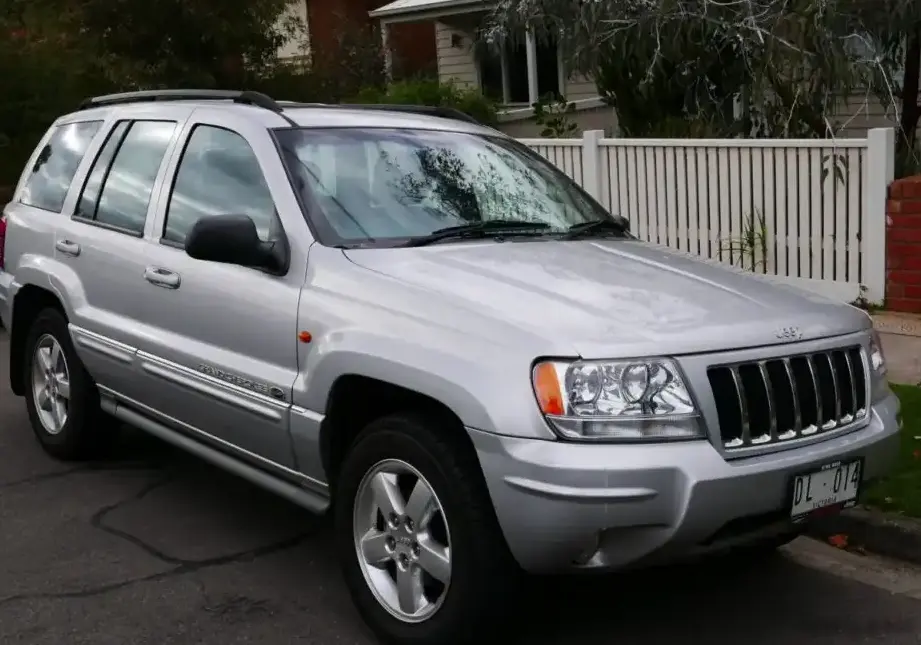
The 2003-2004 Jeep Grand Cherokee II 4.0L Automatic was a popular choice for buyers seeking a capable and comfortable SUV. Built on the WJ platform, this iteration of the Grand Cherokee offered a refined driving experience compared to its predecessor. The 4.0-liter inline-six engine, while not the most powerful option available, provided adequate performance for everyday driving and towing, and was known for its durability. The four-speed automatic transmission offered smooth shifts and contributed to the vehicle’s overall ease of use. This variant served as a sweet spot in the lineup, offering a more affordable entry point than the V8 models while still delivering the core Grand Cherokee experience.
Powertrain & Engine Architecture
The heart of this Grand Cherokee variant is the 4.0-liter (3956 cc) inline-six cylinder engine, designated as the ERH code. This engine is a descendant of the AMC 242 cubic inch inline-six, which Jeep inherited during the Chrysler acquisition. It features a cast iron block and aluminum cylinder head, utilizing a multi-port fuel injection system for precise fuel delivery. The engine employs an overhead valve (OHV) valvetrain with two valves per cylinder. The 4.0L engine is known for its robust construction and relatively simple design, contributing to its longevity. The four-speed 42RE automatic transmission, a Chrysler design, was the standard pairing for this engine. This transmission is electronically controlled and features a torque converter for smooth power transfer. While not known for its cutting-edge efficiency, the 42RE is a durable unit capable of handling the engine’s output.
Driving Characteristics
The 4.0L automatic Grand Cherokee offered a comfortable and predictable driving experience. With 195 horsepower and 230 lb-ft of torque, acceleration was adequate but not particularly brisk. The four-speed automatic transmission, while smooth, had relatively wide gear ratios, which could result in the engine feeling strained during highway passing maneuvers. Compared to the 4.7L V8 models, the 4.0L felt noticeably less powerful, but it also offered better fuel economy. The rear-wheel-drive configuration provided a traditional SUV feel, and the available four-wheel-drive system enhanced traction in inclement weather or off-road conditions. The suspension, tuned for comfort, absorbed bumps well, but the vehicle’s considerable weight (approximately 3783 lbs) was noticeable in corners.
Equipment & Trim Levels
The 4.0L automatic Grand Cherokee typically came standard with features such as air conditioning, power windows and locks, and an AM/FM stereo. Higher trim levels, like the Limited, added features such as leather upholstery, heated seats, a premium sound system, and alloy wheels. Optional extras included a sunroof, navigation system, and upgraded towing packages. Interior upholstery was typically cloth on the base models, with leather available on higher trims. The dashboard layout was functional and straightforward, with easy-to-read gauges and intuitive controls.
Chassis & Braking
The WJ Grand Cherokee utilized a body-on-frame construction, providing a robust and durable chassis. The front suspension consisted of a coil spring and rigid axle setup with a transverse stabilizer bar. The rear suspension also employed a rigid axle configuration with coil springs and a transverse stabilizer bar. Braking duties were handled by ventilated discs at the front and discs at the rear, with ABS (Anti-lock Braking System) standard. The braking system was adequate for the vehicle’s weight, but it lacked the stopping power of more modern SUVs.
Market Reception & Comparison
The 4.0L automatic Grand Cherokee was generally well-received by critics as a practical and capable SUV. It was praised for its comfortable ride, spacious interior, and rugged styling. However, some reviewers noted its relatively slow acceleration and less-than-stellar fuel economy compared to newer, more fuel-efficient SUVs. Compared to the V8-powered Grand Cherokees, the 4.0L offered a more affordable price point and better fuel efficiency, but at the expense of performance. The 4.0L was often seen as a good choice for buyers who prioritized practicality and reliability over outright speed.
Legacy
The 4.0L inline-six engine in the WJ Grand Cherokee has proven to be remarkably durable, with many examples still on the road today. While the four-speed automatic transmission is generally reliable, it can be prone to wear and tear with high mileage. The WJ Grand Cherokee, particularly the 4.0L variant, has gained a reputation as a dependable and affordable used SUV. Its simple design and readily available parts make it relatively easy to maintain and repair. Today, these vehicles are often sought after by enthusiasts looking for a classic American SUV with proven reliability and off-road capability.