Technical Specifications
| Brand | Jeep |
| Model | Grand Cherokee |
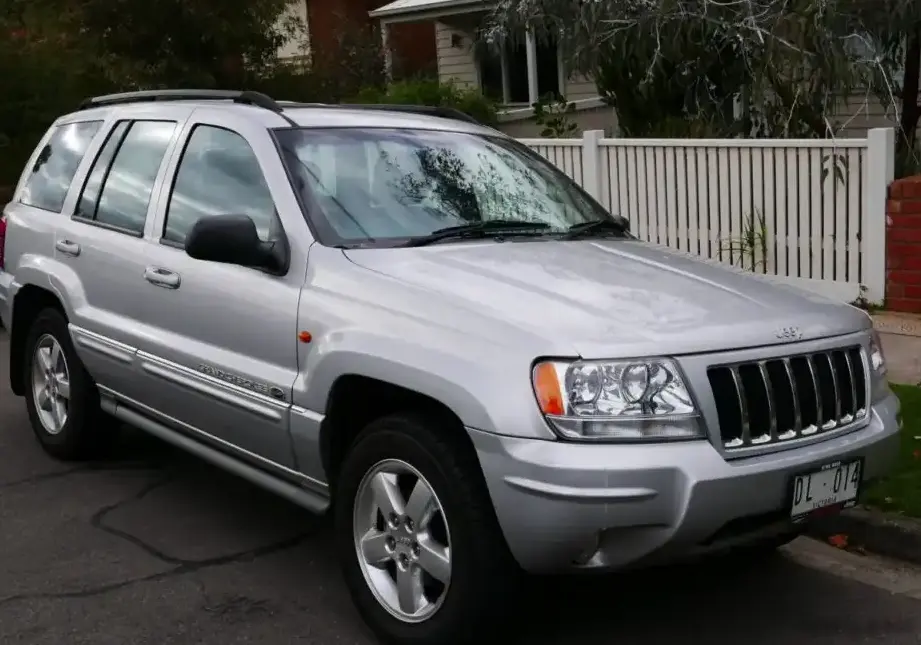
| Generation | Grand Cherokee II (WJ, facelift 2003) |
| Type (Engine) | 4.7 HO V8 (265 Hp) 4×4 Automatic |
| Start of production | 2003 |
| End of production | 2004 |
| Powertrain Architecture | Internal Combustion engine |
| Body type | SUV |
| Seats | 5 |
| Doors | 5 |
| Fuel consumption (economy) – urban (EPA) | 15.7 l/100 km (15 US mpg, 18 UK mpg, 6.4 km/l) |
| Fuel consumption (economy) – extra urban (EPA) | 11.8 l/100 km (19.9 US mpg, 23.9 UK mpg, 8.5 km/l) |
| Fuel consumption (economy) – combined (EPA) | 13.8 l/100 km (17 US mpg, 20.5 UK mpg, 7.2 km/l) |
| Fuel Type | Petrol (Gasoline) |
| Weight-to-power ratio | 7 kg/Hp, 143.2 Hp/tonne |
| Weight-to-torque ratio | 4.2 kg/Nm, 238.2 Nm/tonne |
| Power | 265 Hp @ 5200 rpm |
| Power per litre | 56.4 Hp/l |
| Torque | 441 Nm @ 3600 rpm (325.26 lb.-ft. @ 3600 rpm) |
| Engine layout | Front, Longitudinal |
| Engine Model/Code | EVC |
| Engine displacement | 4701 cm3 (286.87 cu. in.) |
| Number of cylinders | 8 |
| Engine configuration | V-engine |
| Cylinder Bore | 93 mm (3.66 in.) |
| Piston Stroke | 86.5 mm (3.41 in.) |
| Compression ratio | 9.7:1 |
| Number of valves per cylinder | 2 |
| Fuel injection system | Multi-port manifold injection |
| Engine aspiration | Naturally aspirated engine |
| Valvetrain | SOHC |
| Engine oil capacity | 5.7 l (6.02 US qt, 5.02 UK qt) |
| Coolant | 13.7 l (14.48 US qt, 12.05 UK qt) |
| Kerb Weight | 1851 kg (4080.76 lbs.) |
| Max. weight | 2495 kg (5500.53 lbs.) |
| Max load | 644 kg (1419.78 lbs.) |
| Trunk (boot) space – minimum | 1104 l (38.99 cu. ft.) |
| Trunk (boot) space – maximum | 2047 l (72.29 cu. ft.) |
| Fuel tank capacity | 78 l (20.61 US gal, 17.16 UK gal) |
| Permitted trailer load with brakes (12%) | 2948 kg (6499.23 lbs.) |
| Permitted towbar download | 340 kg (749.57 lbs.) |
| Length | 4610 mm (181.5 in.) |
| Width | 1836 mm (72.28 in.) |
| Height | 1786 mm (70.31 in.) |
| Wheelbase | 2690 mm (105.91 in.) |
| Front track | 1511 mm (59.49 in.) |
| Rear (Back) track | 1511 mm (59.49 in.) |
| Front overhang | 815 mm (32.09 in.) |
| Rear overhang | 1105 mm (43.5 in.) |
| Ride height (ground clearance) | 221 mm (8.7 in.) |
| Drag coefficient (Cd) | 0.45 |
| Minimum turning circle (turning diameter) | 11.4 m (37.4 ft.) |
| Approach angle | 36.7° |
| Departure angle | 28.6° |
| Ramp-over (brakeover) angle | 22.6° |
| Drivetrain Architecture | The Internal combustion engine (ICE) drives the rear wheels permanently, and the front wheels are driven through an electrically or mechanically operated clutch if necessary. |
| Drive wheel | All wheel drive (4×4) |
| Number of gears and type of gearbox | 5 gears, automatic transmission |
| Front suspension | Coil spring, Rigid axle suspension, Transverse stabilizer |
| Rear suspension | Rigid axle suspension, Transverse stabilizer, Trailing arm, Coil spring |
| Front brakes | Ventilated discs, 305 mm |
| Rear brakes | Disc, 305 mm |
| Assisting systems | ABS (Anti-lock braking system) |
| Steering type | Cone worm with recirculation balls |
| Power steering | Hydraulic Steering |
| Tires size | 235/65 R17 |
| Wheel rims size | 7.5J x 17 |
The 2003-2004 Jeep Grand Cherokee II 4.7 HO V8 4×4 Automatic represented a sweet spot in the WJ generation’s lineup. Positioned above the base 3.7L V6 models, it offered a significant power upgrade without the added cost and complexity of the higher-output 4.7L or the diesel options. This variant was aimed at buyers who wanted a capable and comfortable SUV for daily driving, towing, and occasional off-road adventures. The “HO” designation signified a higher output version of the 4.7L engine, featuring improved cylinder heads and other enhancements. Built on the 1HX platform, the WJ Grand Cherokee aimed to blend Jeep’s legendary off-road prowess with a more refined and modern driving experience.
Powertrain & Engine Architecture
At the heart of this Grand Cherokee variant lies the 4.7-liter V8 engine, internally designated as the EVC. This engine is a member of the Chrysler/Jeep PowerTech family. The 4.7 HO V8 produced 265 horsepower at 5200 rpm and 325 lb-ft of torque at 3600 rpm. It featured multi-port fuel injection and a single overhead camshaft (SOHC) valvetrain with two valves per cylinder. The engine’s architecture was a 90-degree V-configuration, providing inherent balance and smoothness. The 42RE four-speed automatic transmission was the standard pairing for this engine. This transmission, while robust, was known for its relatively conservative gear ratios, prioritizing fuel economy and smooth shifts over outright acceleration. The transmission featured electronic control for improved shift quality and adaptability.
Driving Characteristics
The 4.7 HO V8 with the 42RE automatic delivered a comfortable and capable driving experience. Acceleration was adequate for most situations, but not particularly brisk. The four-speed automatic, while smooth, lacked the responsiveness of more modern transmissions. The gear ratios were spaced to prioritize fuel efficiency and towing capacity, resulting in a noticeable delay during kickdown for passing maneuvers. The four-wheel-drive system, Quadra-Trac II, provided automatic engagement of the front axle when rear wheel slippage was detected, enhancing traction in inclement weather or off-road conditions. The ride quality was generally comfortable, thanks to the coil-spring suspension and relatively long wheelbase. However, the solid rear axle contributed to some degree of bumpiness on rough roads.
Equipment & Trim Levels
The 4.7 HO V8 4×4 Automatic typically came standard with a respectable array of features. These included air conditioning, power windows and locks, cruise control, an AM/FM stereo with a CD player, and cloth upholstery. Higher trim levels, such as the Limited, added features like leather upholstery, heated front seats, a premium sound system, and automatic climate control. Optional extras included a sunroof, navigation system, and upgraded wheels. The interior design was functional and relatively spacious, offering comfortable seating for five passengers. The rear seats could be folded down to expand cargo capacity.
Chassis & Braking
The Grand Cherokee II utilized a body-on-frame construction, providing a robust and durable chassis. The front suspension consisted of a coil-spring, rigid axle setup with a transverse stabilizer bar. The rear suspension also employed a coil-spring, rigid axle configuration with a trailing arm and transverse stabilizer bar. Braking duties were handled by ventilated discs at the front and solid discs at the rear. Anti-lock brakes (ABS) were standard. The steering system was a recirculating ball type with hydraulic power assist. The tires were typically 235/65R17 size, providing a good balance of on-road comfort and off-road capability.
Market Reception & Comparison
The 4.7 HO V8 4×4 Automatic Grand Cherokee was generally well-received by critics and consumers. It offered a compelling combination of power, capability, and value. Compared to the base 3.7L V6 models, the 4.7 HO provided a noticeable performance boost, making it more suitable for towing and highway driving. However, it wasn’t as fuel-efficient as the V6. Compared to the higher-output 4.7L and diesel options, the 4.7 HO offered a more affordable price point and simpler mechanicals. Reliability was generally good, although some owners reported issues with the automatic transmission and cooling system. Fuel economy averaged around 17 mpg combined, which was typical for a V8-powered SUV of that era.
Legacy
The 2003-2004 Jeep Grand Cherokee II 4.7 HO V8 4×4 Automatic remains a popular choice in the used car market. Its robust construction, capable four-wheel-drive system, and relatively affordable price make it an attractive option for buyers seeking a reliable and versatile SUV. While the 42RE automatic transmission can be a potential maintenance item, it is generally durable if properly maintained. The 4.7 HO V8 engine is also known for its longevity. These Grand Cherokees are often sought after by enthusiasts for their off-road potential and classic American SUV styling. They represent a transitional period in Jeep’s history, bridging the gap between traditional body-on-frame SUVs and more modern, car-based crossovers.