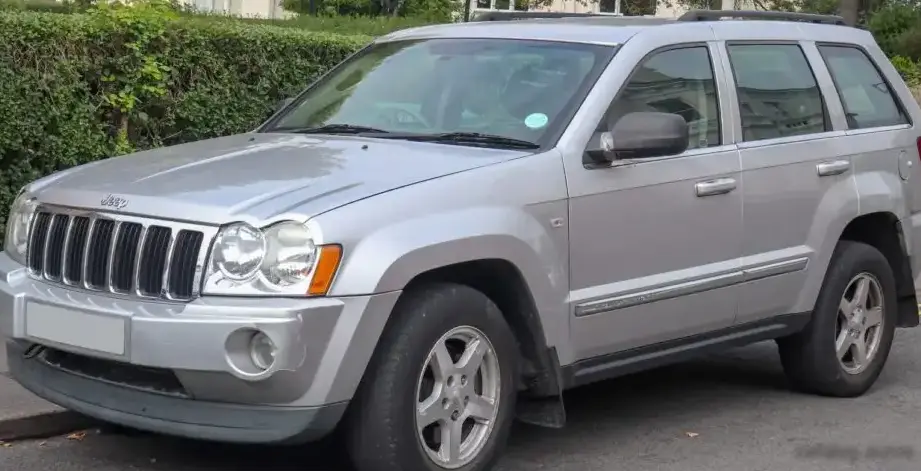
The Jeep Grand Cherokee WK, produced from 2005 to 2010, represented a significant step forward for the iconic American SUV. The 3.0 CRD variant, equipped with a 218 horsepower turbodiesel engine and a five-speed automatic transmission, was primarily aimed at the European market, where diesel engines held a substantial share of the SUV segment. This model offered a blend of Jeep’s renowned off-road capability with improved fuel efficiency and a more refined driving experience compared to its gasoline-powered counterparts. It sat in the mid-range of the WK lineup, offering a balance between performance and economy, positioned below the more powerful V8 models and above the base 3.7L V6.
Technical Specifications
| Brand | Jeep |
| Model | Grand Cherokee |
| Generation | Grand Cherokee III (WK) |
| Type (Engine) | 3.0 CRD (218 Hp) 4×4 Automatic |
| Start of production | 2005 |
| End of production | 2010 |
| Powertrain Architecture | Internal Combustion engine |
| Body type | SUV |
| Seats | 5 |
| Doors | 5 |
| Fuel consumption (urban) | 13.1 l/100 km (18 US mpg, 21.6 UK mpg, 7.6 km/l) |
| Fuel consumption (extra urban) | 8.6 l/100 km (27.4 US mpg, 32.8 UK mpg, 11.6 km/l) |
| Fuel consumption (combined) | 10.2 l/100 km (23.1 US mpg, 27.7 UK mpg, 9.8 km/l) |
| Fuel Type | Diesel |
| Acceleration 0 – 100 km/h | 9 sec |
| Acceleration 0 – 62 mph | 9 sec |
| Acceleration 0 – 60 mph | 8.6 sec |
| Maximum speed | 200 km/h (124.27 mph) |
| Emission standard | Euro 4 |
| Weight-to-power ratio | 9.8 kg/Hp, 102.1 Hp/tonne |
| Weight-to-torque ratio | 4.2 kg/Nm, 238.9 Nm/tonne |
| Power | 218 Hp @ 4000 rpm |
| Power per litre | 73 Hp/l |
| Torque | 510 Nm @ 1600-2400 rpm (376.16 lb.-ft. @ 1600-2400 rpm) |
| Engine layout | Front, Longitudinal |
| Engine Model/Code | EXL |
| Engine displacement | 2987 cm3 (182.28 cu. in.) |
| Number of cylinders | 6 |
| Engine configuration | V-engine |
| Cylinder Bore | 83 mm (3.27 in.) |
| Piston Stroke | 92 mm (3.62 in.) |
| Compression ratio | 17.7:1 |
| Number of valves per cylinder | 4 |
| Fuel injection system | Diesel Commonrail |
| Engine aspiration | Turbocharger, Intercooler |
| Valvetrain | DOHC |
| Engine oil capacity | 9.5 l (10.04 US qt | 8.36 UK qt) |
| Coolant | 13.2 l (13.95 US qt | 11.61 UK qt) |
| Kerb Weight | 2135 kg (4706.87 lbs.) |
| Max. weight | 2750 kg (6062.71 lbs.) |
| Max load | 615 kg (1355.84 lbs.) |
| Trunk (boot) space – minimum | 978 l (34.54 cu. ft.) |
| Trunk (boot) space – maximum | 1909 l (67.42 cu. ft.) |
| Fuel tank capacity | 78 l (20.61 US gal | 17.16 UK gal) |
| Length | 4750 mm (187.01 in.) |
| Width | 1870 mm (73.62 in.) |
| Height | 1740 mm (68.5 in.) |
| Wheelbase | 2781 mm (109.49 in.) |
| Front track | 1575 mm (62.01 in.) |
| Rear (Back) track | 1575 mm (62.01 in.) |
| Drag coefficient (Cd) | 0.41 |
| Minimum turning circle | 11.3 m (37.07 ft.) |
| Drive wheel | All wheel drive (4×4) |
| Number of gears | 5 |
| Gearbox type | automatic transmission |
| Front brakes | Ventilated discs |
| Rear brakes | Ventilated discs |
| Assisting systems | ABS (Anti-lock braking system) |
| Steering type | Steering rack and pinion |
| Tires size | 245/65 R17 |
| Wheel rims size | 17 |
Powertrain & Engine Architecture
The heart of the 3.0 CRD Grand Cherokee is the EXL engine, a 2.987-liter V6 diesel. This engine utilizes a common rail direct injection system, delivering fuel at extremely high pressure for optimized combustion. The EXL engine featured a variable geometry turbocharger (VGT) and an intercooler, enhancing both power and efficiency. The DOHC (Double Overhead Camshaft) valvetrain, with four valves per cylinder, further contributed to the engine’s performance. The five-speed automatic transmission, sourced from Chrysler, was calibrated to suit the diesel engine’s torque characteristics. While not known for lightning-fast shifts, it provided smooth and predictable gear changes, prioritizing comfort and drivability. The transmission was designed to handle the substantial 510 Nm (376 lb-ft) of torque produced by the engine.
Driving Characteristics
The 3.0 CRD Grand Cherokee offered a distinctly different driving experience compared to the V6 gasoline or V8 models. The diesel engine’s abundant low-end torque made it well-suited for towing and off-road driving. Acceleration to 60 mph took around 8.6 seconds, respectable for a vehicle of its size and weight, but noticeably slower than the V8 variants. The automatic transmission, while smooth, could feel somewhat sluggish during quick acceleration. The gear ratios were optimized for fuel economy and relaxed cruising, rather than outright performance. In real-world conditions, the 3.0 CRD provided a comfortable and capable driving experience, particularly on long journeys where its fuel efficiency shone.
Equipment & Trim Levels
The 3.0 CRD trim typically included features such as air conditioning, power windows and locks, a CD player with an auxiliary input, and alloy wheels. Higher trim levels offered upgrades like leather upholstery, heated front seats, a premium sound system, and a sunroof. Optional extras included a navigation system, rear parking sensors, and a tow package. Interior materials were generally of good quality, reflecting the Grand Cherokee’s positioning as a premium SUV. The dashboard layout was functional and user-friendly, with clearly labeled controls.
Chassis & Braking
The WK Grand Cherokee utilized a fully independent suspension system, providing a comfortable ride and good handling characteristics. The front suspension featured upper and lower control arms with coil springs and stabilizer bar, while the rear suspension employed a multi-link design. Braking duties were handled by ventilated discs on all four wheels, providing ample stopping power. An Anti-lock Braking System (ABS) was standard, enhancing safety and control during emergency braking situations. The suspension was tuned to balance on-road comfort with off-road capability, making it a versatile vehicle for a variety of driving conditions.
Market Reception & Comparison
The 3.0 CRD Grand Cherokee was well-received in Europe, where diesel SUVs were popular. Critics praised its fuel efficiency, comfortable ride, and off-road capability. However, some noted that the automatic transmission could feel slow to respond, and the engine was not as refined as some of its European competitors. Compared to the 3.7L V6 gasoline model, the 3.0 CRD offered significantly better fuel economy and more torque, but at a slightly higher purchase price. Against the V8 models, it sacrificed some performance but provided a substantial fuel savings. Reliability was generally good, although some owners reported issues with the diesel particulate filter (DPF) and the fuel injection system.
Legacy
The 3.0 CRD Grand Cherokee WK remains a popular choice in the used car market, particularly for those seeking a capable and fuel-efficient SUV. The EXL diesel engine, while not without its potential issues, is generally considered to be durable and reliable when properly maintained. Regular servicing, including timely DPF regeneration and fuel filter replacements, is crucial for long-term reliability. Today, these vehicles offer a compelling combination of value, capability, and comfort, making them a viable alternative to newer, more expensive SUVs.