Technical Specifications
| Brand | Jeep |
| Model | Grand Cherokee |
| Generation | Grand Cherokee IV (WK2) |
| Type (Engine) | 3.0 CRD (241 Hp) 4×4 Automatic |
| Start of production | 2011 |
| End of production | 2013 |
| Powertrain Architecture | Internal Combustion engine |
| Body type | SUV |
| Seats | 5 |
| Doors | 5 |
| Fuel consumption (urban) | 10.3 l/100 km (22.8 US mpg, 27.4 UK mpg, 9.7 km/l) |
| Fuel consumption (extra urban) | 7.2 l/100 km (32.7 US mpg, 39.2 UK mpg, 13.9 km/l) |
| Fuel consumption (combined) | 8.3 l/100 km (28.3 US mpg, 34 UK mpg, 12 km/l) |
| CO2 emissions | 218 g/km |
| Fuel Type | Diesel |
| Acceleration 0 – 100 km/h | 8.2 sec |
| Acceleration 0 – 62 mph | 8.2 sec |
| Acceleration 0 – 60 mph | 7.8 sec |
| Maximum speed | 202 km/h (125.52 mph) |
| Emission standard | Euro 5 |
| Weight-to-power ratio | 9.4 kg/Hp, 106.1 Hp/tonne |
| Weight-to-torque ratio | 4.1 kg/Nm, 242.1 Nm/tonne |
| Power | 241 Hp @ 3600-4000 rpm |
| Power per litre | 80.7 Hp/l |
| Torque | 550 Nm @ 1800 rpm (405.66 lb.-ft. @ 1800 rpm) |
| Engine layout | Front, Longitudinal |
| Engine Model/Code | EXN |
| Engine displacement | 2987 cm3 (182.28 cu. in.) |
| Number of cylinders | 6 |
| Engine configuration | V-engine |
| Cylinder Bore | 83 mm (3.27 in.) |
| Piston Stroke | 92 mm (3.62 in.) |
| Compression ratio | 18:1 |
| Number of valves per cylinder | 4 |
| Fuel injection system | Diesel Commonrail |
| Engine aspiration | Turbocharger, Intercooler |
| Engine oil capacity | 8.4 l (8.88 US qt | 7.39 UK qt) |
| Coolant | 13.2 l (13.95 US qt | 11.61 UK qt) |
| Kerb Weight | 2272 kg (5008.9 lbs.) |
| Max. weight | 2949 kg (6501.43 lbs.) |
| Max load | 677 kg (1492.53 lbs.) |
| Trunk (boot) space – minimum | 457 l (16.14 cu. ft.) |
| Trunk (boot) space – maximum | 1554 l (54.88 cu. ft.) |
| Fuel tank capacity | 93 l (24.57 US gal | 20.46 UK gal) |
| Permitted trailer load with brakes (12%) | 3500 kg (7716.18 lbs.) |
| Permitted trailer load without brakes | 750 kg (1653.47 lbs.) |
| Length | 4822 mm (189.84 in.) |
| Width | 1943 mm (76.5 in.) |
| Width including mirrors | 2154 mm (84.8 in.) |
| Height | 1781 mm (70.12 in.) |
| Wheelbase | 2915 mm (114.76 in.) |
| Front track | 1628 mm (64.09 in.) |
| Rear (Back) track | 1634 mm (64.33 in.) |
| Ride height (ground clearance) | 218 mm (8.58 in.) |
| Drag coefficient (Cd) | 0.37 |
| Minimum turning circle (turning diameter) | 11.6 m (38.06 ft.) |
| Approach angle | 26° |
| Departure angle | 24° |
| Ramp-over (brakeover) angle | 19° |
| Drive wheel | All wheel drive (4×4) |
| Number of gears and type of gearbox | 5 gears, automatic transmission |
| Front suspension | Double wishbone |
| Rear suspension | Independent multi-link suspension |
| Front brakes | Ventilated discs |
| Rear brakes | Ventilated discs |
| Assisting systems | ABS (Anti-lock braking system) |
| Steering type | Steering rack and pinion |
| Tires size | 265/60 R18 |
| Wheel rims size | 18 |
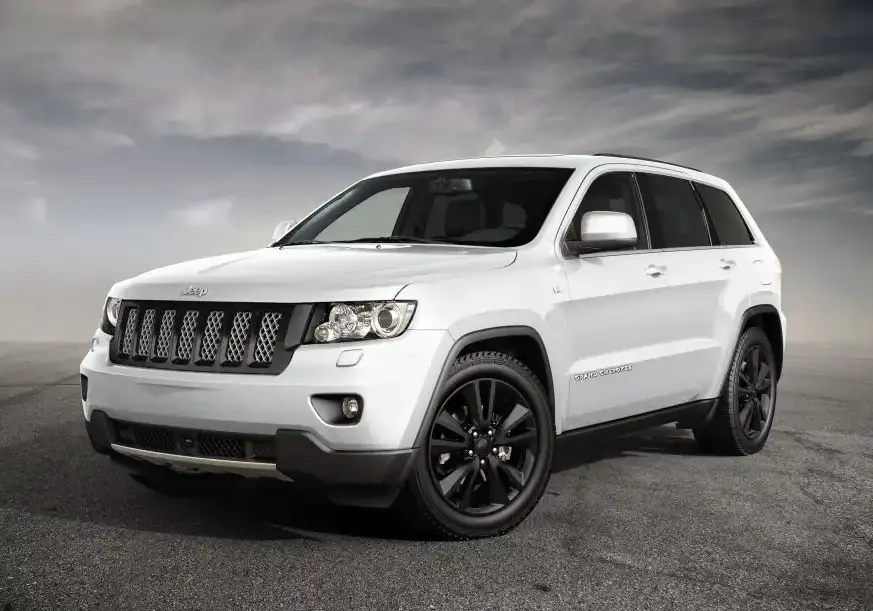
The Jeep Grand Cherokee WK2 3.0 CRD 4×4 Automatic, produced from 2011 to 2013, was a key offering in the fourth generation of Jeep’s flagship SUV, specifically tailored for the European and international markets. It aimed to deliver a blend of luxury, capability, and fuel efficiency, appealing to buyers seeking a diesel-powered alternative to the gasoline engines commonly found in North America. Built on the 1HX0/A3 platform, the WK2 marked a significant improvement in refinement and on-road manners for the Grand Cherokee, while retaining its renowned off-road abilities. The 3.0 CRD variant provided a compelling package for those wanting a capable SUV with reduced running costs.
Powertrain & Engine Architecture
The 3.0 CRD Grand Cherokee is powered by the EXN engine, a 3.0-liter V6 diesel. This engine employs a common rail direct injection system, injecting fuel at extremely high pressure for optimized combustion efficiency. A variable geometry turbocharger (VGT) and intercooler further enhance power and torque. The engine generates 241 horsepower between 3600 and 4000 rpm, and a robust 550 Nm (405.66 lb-ft) of torque at 1800 rpm. The engine is paired with a five-speed automatic transmission, designed to manage the engine’s torque and provide smooth gear changes. While not the most advanced transmission available at the time, it proved to be durable and reliable. The engine is mounted longitudinally within the chassis, contributing to a balanced weight distribution.
Driving Characteristics
The 3.0 CRD Automatic Grand Cherokee offers a comfortable and relaxed driving experience. The diesel engine’s high torque output provides ample power for towing and tackling various terrains. Acceleration to 60 mph is achieved in approximately 7.8 seconds, which is respectable for a full-size SUV. The five-speed automatic transmission delivers smooth, if not particularly rapid, gear changes. Compared to the V6 gasoline models, the 3.0 CRD feels more effortless in everyday driving, especially when carrying a load. Compared to potentially higher-output diesel versions available in some markets, this 241 hp variant strikes a balance between performance and fuel economy, prioritizing refinement and efficiency.
Equipment & Trim Levels
Standard equipment levels for the 3.0 CRD Automatic varied by market, but generally included leather upholstery, dual-zone climate control, a touchscreen infotainment system, and alloy wheels. Optional extras commonly included a premium sound system, navigation, a sunroof, and advanced safety features like adaptive cruise control and blind-spot monitoring. Interior trim levels ranged from cloth to premium leather, with options for wood or metallic accents. The dashboard layout was consistent across the WK2 range, offering a user-friendly design with intuitive controls.
Chassis & Braking
The WK2 Grand Cherokee features a robust chassis with a double wishbone front suspension and an independent multi-link rear suspension. This configuration provides a comfortable ride and good handling. The 3.0 CRD variant typically came equipped with ventilated disc brakes on all four wheels, offering strong stopping power. An Anti-lock Braking System (ABS) was standard for enhanced safety during emergency braking. The suspension was tuned to balance on-road comfort with off-road capability, making it a versatile vehicle. Stabilizer bars were fitted front and rear to minimize body roll during cornering.
Market Reception & Comparison
The Jeep Grand Cherokee 3.0 CRD was generally well-received by automotive critics in Europe and other diesel-focused markets. It was praised for its comfortable ride, refined interior, and fuel efficiency. Compared to the gasoline-powered models, the 3.0 CRD offered significantly better fuel economy, making it a more appealing choice for long-distance travel. Some critics noted that the five-speed automatic transmission felt somewhat dated compared to newer six or eight-speed units found in competing vehicles. In terms of reliability, the 3.0 CRD engine proved to be generally robust, though, like all diesel engines, it required regular maintenance and the use of quality fuel and oil.
Legacy
The Jeep Grand Cherokee WK2 3.0 CRD 4×4 Automatic has become a reliable and capable SUV in the used car market. The 3.0-liter diesel engine, when properly maintained, can provide many years of service. Routine maintenance includes regular oil changes, filter replacements, and periodic inspection of the turbocharger and fuel injection system. Today, these vehicles offer good value for buyers seeking a luxurious and capable SUV with reasonable running costs. The WK2 generation, as a whole, significantly improved the Grand Cherokee’s reputation, and the 3.0 CRD variant remains a popular choice for those prioritizing fuel efficiency and torque.