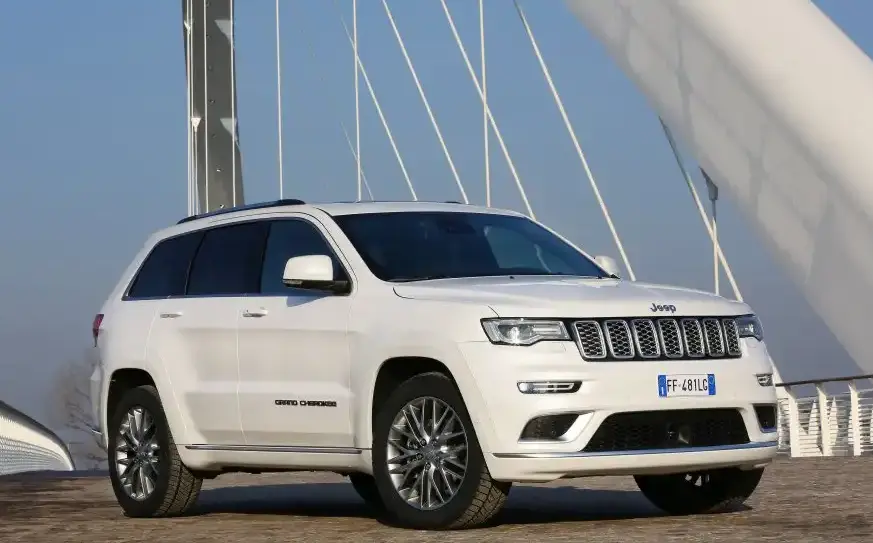
The Jeep Grand Cherokee IV (WK2), specifically the facelifted version produced from 2017 to 2019, offered a 3.0-liter V6 MultiJet diesel engine producing 190 horsepower paired with an eight-speed automatic transmission and a four-wheel-drive system. This configuration represented a mid-range offering within the WK2 lineup, positioned between the base petrol models and the higher-performance trims like the SRT. The facelift brought updated styling, improved technology, and refinements to the powertrain, solidifying the Grand Cherokee’s position as a premium SUV in the European and international markets. This variant aimed to balance fuel efficiency with respectable performance for everyday driving and towing needs.
Technical Specifications
| Brand | Jeep |
| Model | Grand Cherokee |
| Generation | Grand Cherokee IV (WK2, facelift 2017) |
| Type (Engine) | 3.0 V6 MultiJet (190 Hp) 4×4 Automatic |
| Start of production | 2017 |
| End of production | 2019 |
| Powertrain Architecture | Internal Combustion engine |
| Body type | SUV |
| Seats | 5 |
| Doors | 5 |
| Fuel consumption (economy) – urban (NEDC) | 8-9.7 l/100 km (29.4 – 24.2 US mpg, 35.3 – 29.1 UK mpg, 12.5 – 10.3 km/l) |
| Fuel consumption (economy) – extra urban (NEDC) | 6.4-6.9 l/100 km (36.8 – 34.1 US mpg, 44.1 – 40.9 UK mpg, 15.6 – 14.5 km/l) |
| Fuel consumption (economy) – combined (NEDC) | 7-7.9 l/100 km (33.6 – 29.8 US mpg, 40.4 – 35.8 UK mpg, 14.3 – 12.7 km/l) |
| CO2 emissions (NEDC) | 184-208 g/km |
| Fuel Type | Diesel |
| Acceleration 0 – 100 km/h | 10.2 sec |
| Acceleration 0 – 62 mph | 10.2 sec |
| Acceleration 0 – 60 mph | 9.7 sec |
| Maximum speed | 190 km/h (118.06 mph) |
| Emission standard | Euro 6 |
| Weight-to-power ratio | 12.3 kg/Hp, 81.6 Hp/tonne |
| Weight-to-torque ratio | 5.3 kg/Nm, 189 Nm/tonne |
| Power | 190 Hp @ 4000 rpm |
| Power per litre | 63.6 Hp/l |
| Torque | 440 Nm @ 1600-2800 rpm (324.53 lb.-ft. @ 1600-2800 rpm) |
| Maximum engine speed | 4800 rpm |
| Engine layout | Front, Longitudinal |
| Engine Model/Code | EXN |
| Engine displacement | 2987 cm3 (182.28 cu. in.) |
| Number of cylinders | 6 |
| Engine configuration | V-engine |
| Cylinder Bore | 83 mm (3.27 in.) |
| Piston Stroke | 92 mm (3.62 in.) |
| Compression ratio | 16.5:1 |
| Number of valves per cylinder | 4 |
| Fuel injection system | Diesel Commonrail |
| Engine aspiration | Turbocharger, Intercooler |
| Valvetrain | DOHC |
| Engine oil capacity | 7.7 l (8.14 US qt | 6.78 UK qt) |
| Coolant | 11.4 l (12.05 US qt | 10.03 UK qt) |
| Kerb Weight | 2328-2447 kg (5132.36 – 5394.71 lbs.) |
| Max. weight | 2949 kg (6501.43 lbs.) |
| Max load | 502-621 kg (1106.72 – 1369.07 lbs.) |
| Trunk (boot) space – minimum | 800 l (28.25 cu. ft.) |
| Trunk (boot) space – maximum | 1689 l (59.65 cu. ft.) |
| Fuel tank capacity | 93.5 l (24.7 US gal | 20.57 UK gal) |
| Permitted trailer load with brakes (12%) | 3500 kg (7716.18 lbs.) |
| Permitted trailer load without brakes | 750 kg (1653.47 lbs.) |
| Length | 4828 mm (190.08 in.) |
| Width | 1943 mm (76.5 in.) |
| Width including mirrors | 2156 mm (84.88 in.) |
| Height | 1792-1802 mm (70.55 – 70.94 in.) |
| Wheelbase | 2915 mm (114.76 in.) |
| Front track | 1628 mm (64.09 in.) |
| Rear (Back) track | 1634 mm (64.33 in.) |
| Ride height (ground clearance) | 206-270 mm (8.11 – 10.63 in.) |
| Drag coefficient (Cd) | 0.371 |
| Minimum turning circle (turning diameter) | 11.6 m (38.06 ft.) |
| Front suspension | Coil spring, Double wishbone, Transverse stabilizer, Air Suspension – Optional |
| Rear suspension | Independent multi-link spring suspension with stabilizer, Air Suspension – Optional |
| Front brakes | Ventilated discs, 350×32 mm |
| Rear brakes | Ventilated discs, 330×32 mm |
| Drive wheel | All wheel drive (4×4) |
| Number of gears and type of gearbox | 8 gears, automatic transmission |
Powertrain & Engine Architecture
The heart of this Grand Cherokee variant is the 3.0-liter V6 MultiJet diesel engine, designated with the engine code EXN. This engine utilizes a common rail direct injection system, delivering fuel at extremely high pressure for optimized combustion. The engine features a variable geometry turbocharger (VGT) and an intercooler to enhance power and efficiency. The valvetrain employs a Double Overhead Camshaft (DOHC) configuration with four valves per cylinder, contributing to improved breathing and overall performance. The eight-speed automatic transmission, sourced from ZF, is a key component, offering smooth shifts and a wide gear ratio spread to maximize fuel economy and provide adequate acceleration. This transmission is known for its responsiveness and durability.
Driving Characteristics
The 190 horsepower and 440 Nm (324.53 lb-ft) of torque delivered by the 3.0L MultiJet, when coupled with the eight-speed automatic, provided a comfortable and capable driving experience. While not overtly sporty, the Grand Cherokee offered sufficient power for highway cruising, overtaking, and towing. The automatic transmission’s gear ratios were tuned for efficiency, keeping engine speeds relatively low during normal driving conditions. Compared to the higher-output diesel variants (typically around 250 hp), this version felt less urgent in acceleration, but it compensated with improved fuel economy. The automatic transmission, while smooth, could sometimes exhibit a slight hesitation during kickdown maneuvers. The four-wheel-drive system provided excellent traction in various conditions, making it a capable all-weather vehicle.
Equipment & Trim Levels
The 3.0 V6 MultiJet 190 hp Automatic typically came equipped with a respectable level of standard features. These included leather upholstery, dual-zone automatic climate control, a touchscreen infotainment system with navigation, and a rearview camera. Common optional extras included a panoramic sunroof, premium sound system, advanced safety features like adaptive cruise control and blind-spot monitoring, and air suspension for a more comfortable ride. Trim levels varied by market, but generally, this engine configuration was offered in mid-range trims, providing a balance of luxury and value.
Chassis & Braking
The WK2 Grand Cherokee featured an independent front suspension with coil springs and a double wishbone setup, and an independent multi-link rear suspension. Air suspension was available as an option, providing adjustable ride height and improved comfort. Braking duties were handled by ventilated discs on all four wheels, with dimensions of 350x32mm at the front and 330x32mm at the rear. The braking system was equipped with ABS (Anti-lock Braking System) and electronic stability control. Stabilizer bars were fitted front and rear to reduce body roll during cornering.
Market Reception & Comparison
The 190 hp 3.0L MultiJet Grand Cherokee was generally well-received by automotive critics as a practical and efficient SUV. It offered a compelling alternative to petrol-powered models, particularly for drivers who prioritized fuel economy and torque for towing. Compared to the more powerful diesel variants, this version was often praised for its lower running costs and reduced tax implications in some European countries. However, some reviewers noted that the acceleration was not as brisk as that of the higher-output engines. Reliability reports generally indicated good durability for the powertrain, although diesel particulate filter (DPF) maintenance was a consideration for owners who primarily drove short distances.
Legacy
The 3.0L MultiJet engine in the WK2 Grand Cherokee has proven to be a relatively reliable powertrain when properly maintained. The eight-speed automatic transmission has also demonstrated good durability. On the used car market, this variant represents a good value proposition, offering a comfortable and capable SUV at a more affordable price point than the higher-performance trims. Regular servicing, including DPF regeneration and oil changes, is crucial to ensure long-term reliability. The WK2 Grand Cherokee, in general, has established a reputation as a well-built and refined SUV, and the 3.0L MultiJet 190 hp Automatic remains a popular choice for buyers seeking a balance of performance, efficiency, and luxury.