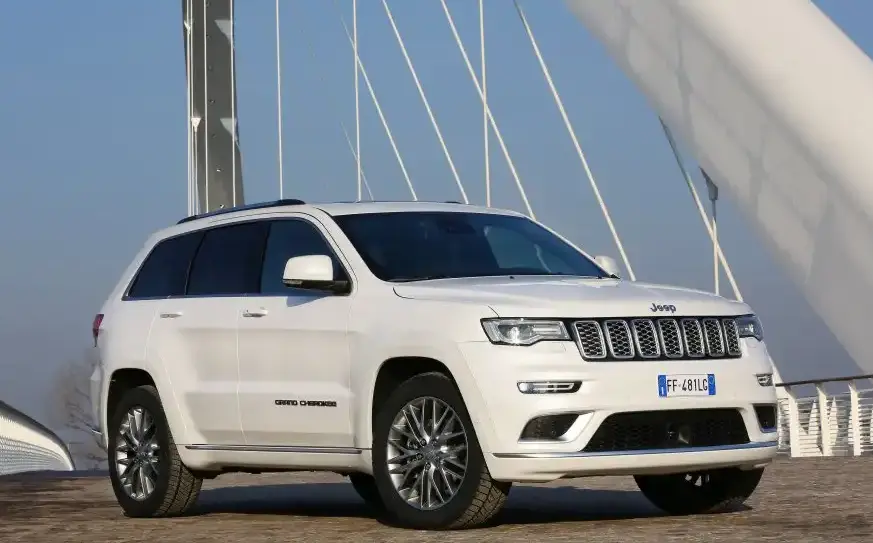
The Jeep Grand Cherokee IV (WK2), particularly the facelifted version introduced in 2017, represented a significant evolution of Jeep’s flagship SUV. Produced from 2017 through 2021, the 3.0 V6 MultiJet (250 Hp) 4×4 Automatic variant occupied a crucial position in the lineup, offering a balance between fuel efficiency, performance, and capability. This model aimed to appeal to buyers seeking a refined and capable SUV without the higher price tag of the more powerful engine options like the 5.7L HEMI V8 or the high-performance Trackhawk. It was built on the 1HX0/A3 platform, shared with the Maserati Levante, and represented a move towards more sophisticated engineering and luxury features for the Grand Cherokee.
Technical Specifications
| Brand | Jeep |
| Model | Grand Cherokee |
| Generation | Grand Cherokee IV (WK2, facelift 2017) |
| Type (Engine) | 3.0 V6 MultiJet (250 Hp) 4×4 Automatic |
| Start of production | 2017 year |
| End of production | 2021 year |
| Powertrain Architecture | Internal Combustion engine |
| Body type | SUV |
| Seats | 5 |
| Doors | 5 |
| Fuel consumption (economy) – urban (NEDC) | 8-9.8 l/100 km (29.4 – 24 US mpg, 35.3 – 28.8 UK mpg, 12.5 – 10.2 km/l) |
| Fuel consumption (economy) – extra urban (NEDC) | 6.4-7 l/100 km (36.8 – 33.6 US mpg, 44.1 – 40.4 UK mpg, 15.6 – 14.3 km/l) |
| Fuel consumption (economy) – combined (NEDC) | 7-8 l/100 km (33.6 – 29.4 US mpg, 40.4 – 35.3 UK mpg, 14.3 – 12.5 km/l) |
| CO2 emissions (NEDC) | 184-212 g/km |
| Fuel Type | Diesel |
| Acceleration 0 – 100 km/h | 8.2 sec |
| Acceleration 0 – 62 mph | 8.2 sec |
| Acceleration 0 – 60 mph | 7.8 sec |
| Maximum speed | 202 km/h (125.52 mph) |
| Emission standard | Euro 6 |
| Weight-to-power ratio | 9.3 kg/Hp, 107.4 Hp/tonne |
| Weight-to-torque ratio | 4.1 kg/Nm, 244.8 Nm/tonne |
| Power | 250 Hp @ 3600 rpm |
| Power per litre | 83.7 Hp/l |
| Torque | 570 Nm @ 2000 rpm (420.41 lb.-ft. @ 2000 rpm) |
| Maximum engine speed | 4800 rpm |
| Engine layout | Front, Longitudinal |
| Engine Model/Code | EXN |
| Engine displacement | 2987 cm3 (182.28 cu. in.) |
| Number of cylinders | 6 |
| Engine configuration | V-engine |
| Cylinder Bore | 83 mm (3.27 in.) |
| Piston Stroke | 92 mm (3.62 in.) |
| Compression ratio | 16.5:1 |
| Number of valves per cylinder | 4 |
| Fuel injection system | Diesel Commonrail |
| Engine aspiration | Turbocharger, Intercooler |
| Valvetrain | DOHC |
| Engine oil capacity | 7.7 l (8.14 US qt | 6.78 UK qt) |
| Coolant | 11.4 l (12.05 US qt | 10.03 UK qt) |
| Kerb Weight | 2328-2498 kg (5132.36 – 5507.15 lbs.) |
| Max. weight | 2949 kg (6501.43 lbs.) |
| Max load | 451-621 kg (994.28 – 1369.07 lbs.) |
| Trunk (boot) space – minimum | 800 l (28.25 cu. ft.) |
| Trunk (boot) space – maximum | 1689 l (59.65 cu. ft.) |
| Fuel tank capacity | 93.5 l (24.7 US gal | 20.57 UK gal) |
| AdBlue tank | 30.3 l (8 US gal | 6.67 UK gal) |
| Permitted trailer load with brakes (12%) | 3500 kg (7716.18 lbs.) |
| Permitted trailer load without brakes | 750 kg (1653.47 lbs.) |
| Length | 4828 mm (190.08 in.) |
| Width | 1943 mm (76.5 in.) |
| Width including mirrors | 2156 mm (84.88 in.) |
| Height | 1792-1802 mm (70.55 – 70.94 in.) |
| Wheelbase | 2915 mm (114.76 in.) |
| Front track | 1628 mm (64.09 in.) |
| Rear (Back) track | 1634 mm (64.33 in.) |
| Ride height (ground clearance) | 206-270 mm (8.11 – 10.63 in.) |
| Drag coefficient (Cd) | 0.371 |
| Minimum turning circle (turning diameter) | 11.6 m (38.06 ft.) |
| Front brakes | Ventilated discs, 350×32 mm |
| Rear brakes | Ventilated discs, 330×22 mm |
| Number of gears and type of gearbox | 8 gears, automatic transmission |
Powertrain & Engine Architecture
The heart of this Grand Cherokee variant is the 3.0-liter V6 MultiJet diesel engine, designated with the engine code EXN. This engine is a common-rail direct injection diesel, utilizing piezoelectric injectors for precise fuel delivery. The engine features a variable geometry turbocharger (VGT) and an intercooler to maximize power and efficiency. The DOHC valvetrain, with four valves per cylinder, contributes to improved breathing and overall performance. The 8-speed automatic transmission, sourced from ZF (8HP70), is a key component, known for its smooth shifting and wide gear ratio spread. This transmission is designed to optimize fuel economy and provide responsive acceleration. The engine produces 250 horsepower at 3600 rpm and a substantial 570 Nm (420 lb-ft) of torque at 2000 rpm, making it well-suited for towing and off-road driving.
Driving Characteristics
The 3.0L V6 MultiJet with the 8-speed automatic delivers a comfortable and capable driving experience. While not as overtly powerful as the HEMI V8, the diesel engine provides ample torque for everyday driving and highway cruising. The automatic transmission is well-programmed, offering smooth gear changes and quick downshifts when needed. Acceleration from 0-60 mph takes around 7.8 seconds, which is respectable for a vehicle of this size and weight. The wide gear ratio spread of the 8-speed transmission helps to keep the engine in its optimal power band, resulting in good responsiveness. Compared to the manual transmission versions, the automatic offers greater convenience, especially in urban traffic. However, some drivers may find the automatic slightly less engaging than the manual.
Equipment & Trim Levels
The 3.0 V6 MultiJet Automatic typically came equipped with a generous array of standard features. These included leather upholstery, dual-zone automatic climate control, a touchscreen infotainment system with navigation, and a rearview camera. Higher trim levels, such as the Limited and Trailhawk, added features like heated and ventilated front seats, a panoramic sunroof, premium audio systems, and advanced safety technologies like adaptive cruise control and blind-spot monitoring. Optional extras included air suspension, which provided a more comfortable ride and increased off-road capability, and a rear-seat entertainment system.
Chassis & Braking
The Grand Cherokee IV features an independent front suspension with a double wishbone setup and a multi-link independent rear suspension. The suspension is tuned to provide a balance between ride comfort and handling. Air suspension was available as an option, offering adjustable ride height and improved off-road performance. Braking duties are handled by ventilated discs on all four wheels, providing ample stopping power. The braking system is equipped with ABS (Anti-lock Braking System) and electronic stability control. Stabilizer bars are fitted to both the front and rear axles to reduce body roll during cornering.
Market Reception & Comparison
The 3.0 V6 MultiJet Automatic Grand Cherokee was generally well-received by automotive critics. It was praised for its fuel efficiency, comfortable ride, and capable performance. Compared to the 5.7L HEMI V8, the diesel offered significantly better fuel economy, making it a more practical choice for drivers who prioritize efficiency. However, the HEMI V8 provided more raw power and a more traditional V8 sound. The diesel also offered a quieter and more refined driving experience than the HEMI. Reliability has been generally good, although some owners have reported issues with the diesel particulate filter (DPF) and the AdBlue system.
Legacy
The 3.0 V6 MultiJet engine has proven to be a relatively durable and reliable powertrain when properly maintained. In the used car market, these Grand Cherokees represent a good value proposition, offering a blend of luxury, capability, and fuel efficiency. However, potential buyers should be aware of the potential for DPF and AdBlue system issues and ensure that the vehicle has been regularly serviced. The 2017-2021 facelifted models, with their updated styling and improved features, are particularly desirable. The combination of the diesel engine and the 8-speed automatic transmission continues to be a popular choice among Grand Cherokee owners seeking a refined and capable SUV.