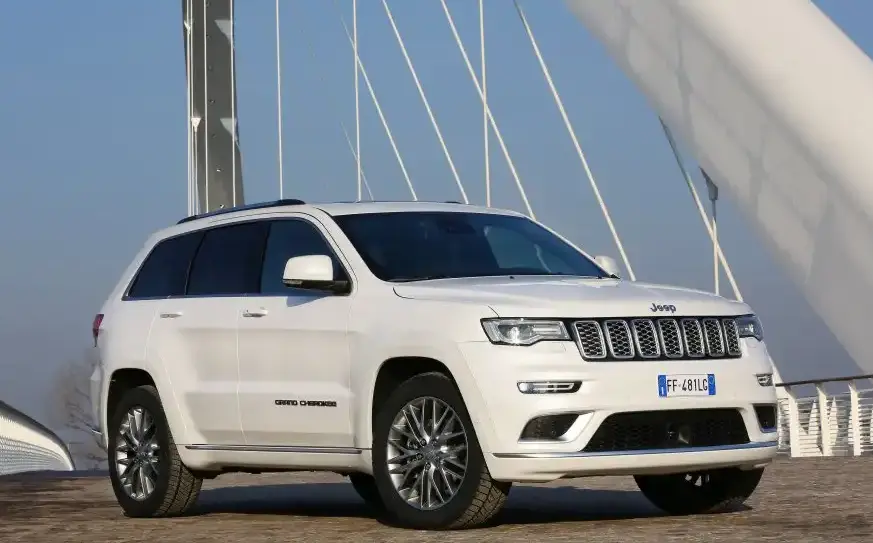
The Jeep Grand Cherokee IV (WK2), specifically the facelifted version produced from 2017 to 2018, represents a significant evolution of Jeep’s flagship SUV. This iteration, equipped with the 3.6-liter Pentastar V6 engine producing 290 horsepower and paired with an eight-speed automatic transmission, and a 4×4 drivetrain, occupied a crucial middle ground in the Grand Cherokee lineup. It aimed to balance performance, capability, and fuel efficiency, appealing to a broad range of buyers seeking a luxurious and versatile SUV. The WK2 generation, launched in 2011, brought a substantial leap forward in refinement and on-road manners compared to its predecessors, and the 2017 facelift further enhanced its appeal with updated styling and technology.
Technical Specifications
| Brand | Jeep |
| Model | Grand Cherokee |
| Generation | Grand Cherokee IV (WK2, facelift 2017) |
| Type (Engine) | 3.6 V6 (290 Hp) 4×4 Automatic |
| Start of production | 2017 |
| End of production | 2018 |
| Powertrain Architecture | Internal Combustion engine |
| Body type | SUV |
| Seats | 5 |
| Doors | 5 |
| Fuel consumption (economy) – urban (NEDC) | 13.5 l/100 km (17.4 US mpg, 20.9 UK mpg, 7.4 km/l) |
| Fuel consumption (economy) – extra urban (NEDC) | 8 l/100 km (29.4 US mpg, 35.3 UK mpg, 12.5 km/l) |
| Fuel consumption (economy) – combined (NEDC) | 10 l/100 km (23.5 US mpg, 28.2 UK mpg, 10 km/l) |
| CO2 emissions (NEDC) | 233 g/km |
| Fuel Type | Petrol (Gasoline) |
| Acceleration 0 – 100 km/h | 8.3 sec |
| Acceleration 0 – 62 mph | 8.3 sec |
| Acceleration 0 – 60 mph | 7.9 sec |
| Maximum speed | 206 km/h (128 mph) |
| Emission standard | Euro 6 |
| Weight-to-power ratio | 7.6 kg/Hp, 132.4 Hp/tonne |
| Weight-to-torque ratio | 6.3 kg/Nm, 158.4 Nm/tonne |
| Power | 290 Hp @ 6400 rpm |
| Power per litre | 80.5 Hp/l |
| Torque | 347 Nm @ 4000 rpm (255.93 lb.-ft. @ 4000 rpm) |
| Engine layout | Front, Longitudinal |
| Engine Model/Code | Pentastar / ERB |
| Engine displacement | 3604 cm3 (219.93 cu. in.) |
| Number of cylinders | 6 |
| Engine configuration | V-engine |
| Cylinder Bore | 96 mm (3.78 in.) |
| Piston Stroke | 83 mm (3.27 in.) |
| Compression ratio | 10.2:1 |
| Number of valves per cylinder | 4 |
| Fuel injection system | Multi-port manifold injection |
| Engine aspiration | Naturally aspirated engine |
| Valvetrain | DOHC |
| Engine oil capacity | 5.7 l (6.02 US qt | 5.02 UK qt) |
| Coolant | 9.9 l (10.46 US qt | 8.71 UK qt) |
| Kerb Weight | 2191-2279 kg (4830.33 – 5024.33 lbs.) |
| Max. weight | 2949 kg (6501.43 lbs.) |
| Max load | 670-758 kg (1477.1 – 1671.1 lbs.) |
| Trunk (boot) space – minimum | 800 l (28.25 cu. ft.) |
| Trunk (boot) space – maximum | 1689 l (59.65 cu. ft.) |
| Fuel tank capacity | 93.5 l (24.7 US gal | 20.57 UK gal) |
| Permitted trailer load with brakes (12%) | 2812 kg (6199.4 lbs.) |
| Permitted trailer load without brakes | 750 kg (1653.47 lbs.) |
| Length | 4828 mm (190.08 in.) |
| Width | 1943 mm (76.5 in.) |
| Width including mirrors | 2156 mm (84.88 in.) |
| Height | 1792-1802 mm (70.55 – 70.94 in.) |
| Wheelbase | 2915 mm (114.76 in.) |
| Ride height (ground clearance) | 206-270 mm (8.11 – 10.63 in.) |
| Drag coefficient (Cd) | 0.371 |
| Minimum turning circle (turning diameter) | 11.6 m (38.06 ft.) |
| Front brakes | Ventilated discs, 350×32 mm |
| Rear brakes | Ventilated discs, 330×22 mm |
| Number of gears and type of gearbox | 8 gears, automatic transmission |
Powertrain & Engine Architecture
The heart of this Grand Cherokee variant is the 3.6-liter Pentastar V6 engine, designated as the ERB code. This engine is a naturally aspirated, 60-degree V6 featuring a lightweight aluminum block and cylinder heads. It utilizes multi-port fuel injection and a double overhead camshaft (DOHC) valvetrain with four valves per cylinder. The Pentastar engine was designed for a balance of power and efficiency, and its relatively simple design contributes to its overall reliability. The eight-speed automatic transmission, sourced from ZF, is a key component of this powertrain. This transmission offers smooth and responsive shifting, contributing to both improved fuel economy and enhanced driving experience. The transmission’s wide gear ratio spread allows the engine to operate in its most efficient range more often.
Driving Characteristics
The 290-horsepower, 3.6-liter V6 paired with the eight-speed automatic delivers adequate performance for most driving situations. Acceleration from 0-60 mph takes approximately 7.9 seconds. While not a sports car, the Grand Cherokee offers sufficient power for highway merging and passing maneuvers. Compared to the available 5.7-liter Hemi V8, this variant provides less outright acceleration, but it offers significantly better fuel economy. The automatic transmission is well-tuned, providing smooth gear changes and responsive downshifts when needed. The 4×4 system provides confident all-weather traction, making it suitable for a variety of road conditions. The gear ratios are optimized for both everyday driving and towing, providing a good balance of performance and usability.
Equipment & Trim Levels
The 3.6L V6 Automatic Grand Cherokee typically came standard with features like dual-zone automatic climate control, a touchscreen infotainment system with Bluetooth connectivity, and a rearview camera. Higher trim levels, such as the Limited and Overland, added features like leather upholstery, heated and ventilated front seats, a premium sound system, and advanced safety technologies like adaptive cruise control and blind-spot monitoring. Optional extras included a panoramic sunroof, rear-seat entertainment system, and various appearance packages.
Chassis & Braking
The Grand Cherokee IV utilizes an independent front suspension with a double wishbone setup and a multi-link independent rear suspension. Many models were equipped with optional air suspension, which provided adjustable ride height and improved off-road capability. Braking duties are handled by ventilated discs on all four wheels. The front brakes measure 350x32mm, while the rear brakes are 330x22mm. Anti-lock brakes (ABS) are standard, providing enhanced stopping power and stability. Stabilizer bars are fitted to both the front and rear axles to reduce body roll during cornering.
Market Reception & Comparison
Critics generally praised the 3.6-liter V6 Grand Cherokee for its comfortable ride, spacious interior, and user-friendly technology. The fuel economy was considered competitive for its class, although not class-leading. Compared to the V8-powered models, the V6 offered a more affordable entry point into the Grand Cherokee lineup, appealing to buyers who prioritized fuel efficiency and value. Some reviewers noted that the V6 engine could feel strained when towing heavy loads or driving uphill, but it was generally considered adequate for most everyday tasks.
Legacy
The 3.6-liter Pentastar V6 engine has proven to be a reliable and durable powertrain. While some minor issues, such as oil leaks and coolant hose failures, have been reported, the engine is generally considered to be well-engineered and long-lasting. In the used car market, the 2017-2018 Grand Cherokee 3.6L V6 Automatic represents a good value proposition, offering a blend of luxury, capability, and affordability. Its relatively simple design and readily available parts contribute to its ease of maintenance and repair, making it a popular choice among used car buyers.