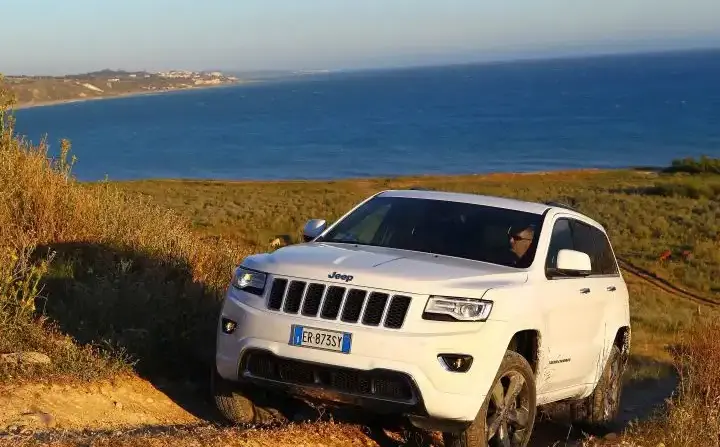
The Jeep Grand Cherokee IV (WK2), specifically the facelifted model produced from 2014 to 2017, represented a significant evolution of Jeep’s flagship SUV. This iteration, positioned as a premium offering in the American market, aimed to blend off-road capability with on-road refinement. The 3.6-liter V6 engine paired with an eight-speed automatic transmission was a core component of the Grand Cherokee lineup, serving as a popular choice for buyers seeking a balance between performance and fuel efficiency. This variant occupied a mid-range position within the broader WK2 portfolio, slotting below the more powerful V8 options and above the diesel variants offered in other markets.
Technical Specifications
| Brand | Jeep |
| Model | Grand Cherokee |
| Generation | Grand Cherokee IV (WK2, facelift 2013) |
| Type (Engine) | 3.6 V6 (294 Hp) 4×4 Automatic |
| Start of production | 2014 |
| End of production | 2017 |
| Powertrain Architecture | Internal Combustion engine |
| Body type | SUV |
| Seats | 5 |
| Doors | 5 |
| Fuel consumption (urban) | 13.8 l/100 km (17 US mpg, 20.5 UK mpg) |
| Fuel consumption (extra urban) | 9.8 l/100 km (24 US mpg, 28.8 UK mpg) |
| Fuel consumption (combined) | 12.4 l/100 km (19 US mpg, 22.8 UK mpg) |
| Fuel Type | Petrol (Gasoline) |
| Weight-to-power ratio | 7.2 kg/Hp, 138.6 Hp/tonne |
| Weight-to-torque ratio | 6 kg/Nm, 166.4 Nm/tonne |
| Power | 294 Hp @ 6400 rpm |
| Power per litre | 81.6 Hp/l |
| Torque | 353 Nm @ 4800 rpm (260.36 lb.-ft. @ 4800 rpm) |
| Engine layout | Front, Longitudinal |
| Engine Model/Code | ERB |
| Engine displacement | 3604 cm3 (219.93 cu. in.) |
| Number of cylinders | 6 |
| Engine configuration | V-engine |
| Cylinder Bore | 96 mm (3.78 in.) |
| Piston Stroke | 83 mm (3.27 in.) |
| Compression ratio | 10.2:1 |
| Number of valves per cylinder | 4 |
| Fuel injection system | Multi-port manifold injection |
| Engine aspiration | Naturally aspirated engine |
| Valvetrain | DOHC |
| Engine oil capacity | 5.7 l (6.02 US qt | 5.02 UK qt) |
| Coolant | 9.9 l (10.46 US qt | 8.71 UK qt) |
| Kerb Weight | 2121 kg (4676 lbs.) |
| Max. weight | 2948 kg (6499.23 lbs.) |
| Max load | 827 kg (1823.22 lbs.) |
| Fuel tank capacity | 93 l (24.57 US gal | 20.46 UK gal) |
| Permitted trailer load with brakes (12%) | 2812 kg (6199.4 lbs.) |
| Length | 4822 mm (189.84 in.) |
| Width | 1943 mm (76.5 in.) |
| Height | 1761 mm (69.33 in.) |
| Wheelbase | 2915 mm (114.76 in.) |
| Front track | 1623 mm (63.9 in.) |
| Rear track | 1627 mm (64.06 in.) |
| Ride height (ground clearance) | 218 mm (8.58 in.) |
| Drag coefficient (Cd) | 0.37 |
| Minimum turning circle | 11.3 m (37.07 ft.) |
| Approach angle | 26.3° |
| Departure angle | 26.5° |
| Ramp-over angle | 18.8° |
| Drive wheel | All wheel drive (4×4) |
| Number of gears | 8 |
| Gearbox type | Automatic transmission |
| Front suspension | Double wishbone |
| Rear suspension | Independent multi-link suspension |
| Front brakes | Ventilated discs |
| Rear brakes | Disc |
| Assisting systems | ABS (Anti-lock braking system) |
| Steering type | Steering rack and pinion |
| Power steering | Electric Steering |
| Tires size | 245/70 R17 |
| Wheel rims size | 17 |
Powertrain & Engine Architecture
The heart of this Grand Cherokee variant is the 3.6-liter Pentastar V6 engine, designated as the ERB code. This engine is a naturally aspirated, 60-degree V6 featuring a dual overhead camshaft (DOHC) valvetrain with four valves per cylinder. The engine utilizes a multi-port fuel injection system, delivering fuel directly into the intake ports. The Pentastar engine is known for its relatively smooth operation and respectable power output. The eight-speed automatic transmission, sourced from ZF, plays a crucial role in optimizing fuel efficiency and providing responsive acceleration. This transmission features a wide gear ratio spread, allowing the engine to operate in its most efficient range more often. The transmission’s shift points are programmed to balance performance and fuel economy, offering a comfortable driving experience.
Driving Characteristics
The 3.6L V6 automatic Grand Cherokee delivers adequate performance for everyday driving. While not as quick as the V8-powered models, it provides sufficient power for highway merging and passing maneuvers. The eight-speed transmission helps to keep the engine in its optimal power band, minimizing turbo lag and providing smooth acceleration. The all-wheel-drive system enhances traction in various weather conditions, making it a capable vehicle for both on and off-road driving. Compared to the manual transmission versions, the automatic offers a more relaxed driving experience, particularly in city traffic. However, the manual transmission provides more driver control and potentially slightly better fuel economy. The 3.6L engine’s torque curve is relatively flat, providing usable power across a wide range of RPMs.
Equipment & Trim Levels
The 3.6L V6 automatic Grand Cherokee typically came standard with features such as air conditioning, power windows and locks, a touchscreen infotainment system, and a rearview camera. Higher trim levels, such as the Limited and Overland, added features like leather upholstery, heated seats, a premium sound system, and advanced safety technologies like blind-spot monitoring and adaptive cruise control. Optional extras included a panoramic sunroof, a rear-seat entertainment system, and various appearance packages. Interior upholstery generally consisted of cloth on base models, with leather becoming standard on higher trims. The dashboard layout was generally consistent across all trims, with a focus on user-friendliness and intuitive controls.
Chassis & Braking
The WK2 Grand Cherokee features a robust chassis designed to handle both on-road and off-road conditions. The front suspension utilizes a double wishbone design, while the rear suspension employs an independent multi-link setup. This configuration provides a comfortable ride and good handling characteristics. The braking system consists of ventilated discs at the front and solid discs at the rear. Anti-lock brakes (ABS) are standard, enhancing safety during emergency braking situations. The vehicle’s weight distribution is relatively balanced, contributing to its stable handling. Stabilizer bars are fitted to both the front and rear axles to reduce body roll during cornering.
Market Reception & Comparison
The 3.6L V6 automatic Grand Cherokee was generally well-received by critics and consumers alike. It was praised for its comfortable ride, spacious interior, and capable all-wheel-drive system. Fuel economy was considered acceptable for a vehicle of its size and weight, although it didn’t match the efficiency of some competitors. Compared to the V8 models, the V6 offered a more affordable price point and better fuel economy, making it a popular choice for buyers who didn’t require the extra power. Reliability was generally good, although some owners reported minor issues with the infotainment system and electrical components.
Legacy
The 3.6L Pentastar V6 engine has proven to be a durable and reliable powertrain. The eight-speed automatic transmission has also demonstrated good long-term reliability. In the used car market, the 2014-2017 Grand Cherokee 3.6L V6 automatic remains a popular choice due to its blend of capability, comfort, and affordability. Regular maintenance, including oil changes and transmission fluid flushes, is crucial for ensuring the longevity of this powertrain. While not as sought after as the V8 models by enthusiasts, the 3.6L variant represents a practical and well-rounded option for buyers seeking a capable and comfortable SUV.